
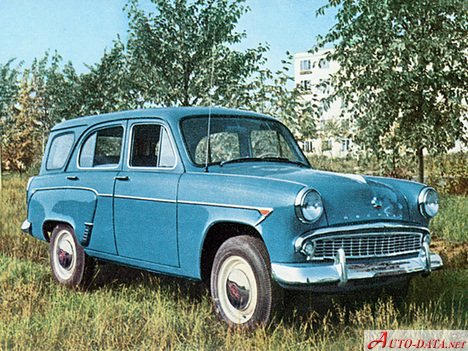
The Moskvich 423 Combi was a Soviet-built station wagon produced from 1958 to 1963. Representing a significant step forward in Soviet automotive design, the 423 Combi aimed to provide a practical and affordable vehicle for families and commercial use within the Eastern Bloc and beyond. While never officially sold in the United States, the Moskvich 423 Combi offers a fascinating glimpse into the automotive engineering and societal needs of the mid-20th century. It was a key model in the Moskvich lineup, a brand that played a crucial role in motorizing the Soviet Union.
Moskvich 423 Combi: A Soviet Family Vehicle
The 423 Combi was part of the broader Moskvich 423 series, which included a sedan and a convertible variant. However, the Combi – the station wagon – proved to be the most popular body style. It addressed the growing demand for vehicles capable of carrying both passengers and cargo, a necessity in a rapidly industrializing nation. The Combi’s design reflected the prevailing aesthetic trends of the time, borrowing influences from Western European and American automobiles, but adapted to Soviet manufacturing capabilities and material availability. It was intended to be a robust and reliable vehicle, capable of withstanding the often-harsh road conditions prevalent in the Soviet Union.
Engine & Performance
The Moskvich 423 Combi was powered by a 1.4-liter (82.99 cubic inches) inline-four cylinder engine. This engine produced 45 horsepower at 4500 rpm and 88 Nm (64.91 lb-ft) of torque at 2600 rpm. While these figures may seem modest by modern standards, they were considered adequate for the vehicle’s intended purpose and weight class. The engine featured a 7:1 compression ratio and utilized a carburetor fuel injection system. Power was delivered to the rear wheels via a four-speed manual transmission. The longitudinal engine placement was a common configuration for vehicles of this era. The car’s top speed was approximately 105 km/h (65.24 mph). The weight-to-power ratio was 21.1 kg/Hp, and the weight-to-torque ratio was 10.8 kg/Nm. Fuel economy figures were 11 l/100 km (21.4 US mpg) in urban settings, 7.5 l/100 km (31.4 US mpg) on the open road, and 9 l/100 km (26.1 US mpg) combined.
Design & Features
The Moskvich 423 Combi was a five-door station wagon with seating for four passengers. Its body style was characterized by relatively simple, functional lines. The design prioritized practicality and ease of manufacturing over elaborate styling. The vehicle’s interior was spartan but functional, reflecting the utilitarian ethos of Soviet design. Features were limited by the standards of the time, but the Combi offered a reasonably spacious cabin and a large cargo area, making it a versatile vehicle for families and businesses. The suspension system consisted of wishbones at the front and leaf springs at the rear, a common setup for vehicles of this era. Braking was handled by drum brakes on all four wheels. The steering system employed a cone worm with recirculation balls. The vehicle rode on 145/80 R15 tires mounted on 4.5K x 15 inch wheel rims.
Technical Specifications
| Brand | Moskvich |
| Model | 423 Kombi |
| Generation | 423 Combi |
| Type (Engine) | 1.4 (45 Hp) |
| Start of production | 1958 |
| End of production | 1963 |
| Powertrain Architecture | Internal Combustion engine |
| Body type | Station wagon (estate) |
| Seats | 4 |
| Doors | 5 |
| Fuel consumption (urban) | 11 l/100 km (21.4 US mpg, 25.7 UK mpg, 9.1 km/l) |
| Fuel consumption (extra urban) | 7.5 l/100 km (31.4 US mpg, 37.7 UK mpg, 13.3 km/l) |
| Fuel consumption (combined) | 9 l/100 km (26.1 US mpg, 31.4 UK mpg, 11.1 km/l) |
| Fuel Type | Petrol (Gasoline) |
| Maximum speed | 105 km/h (65.24 mph) |
| Weight-to-power ratio | 21.1 kg/Hp |
| Weight-to-torque ratio | 10.8 kg/Nm |
| Power | 45 Hp @ 4500 rpm |
| Power per litre | 33.1 Hp/l |
| Torque | 88 Nm @ 2600 rpm (64.91 lb.-ft. @ 2600 rpm) |
| Engine layout | Front, Longitudinal |
| Engine displacement | 1360 cm3 (82.99 cu. in.) |
| Number of cylinders | 4 |
| Engine configuration | Inline |
| Cylinder Bore | 76 mm (2.99 in.) |
| Piston Stroke | 75 mm (2.95 in.) |
| Compression ratio | 7:1 |
| Number of valves per cylinder | 2 |
| Fuel injection system | Carburettor |
| Engine aspiration | Naturally aspirated engine |
| Kerb Weight | 950 kg (2094.39 lbs.) |
| Max. weight | 1430 kg (3152.61 lbs.) |
| Max load | 480 kg (1058.22 lbs.) |
| Fuel tank capacity | 35 l (9.25 US gal | 7.7 UK gal) |
| Length | 4055 mm (159.65 in.) |
| Width | 1540 mm (60.63 in.) |
| Height | 1600 mm (62.99 in.) |
| Wheelbase | 2370 mm (93.31 in.) |
| Front track | 1220 mm (48.03 in.) |
| Rear track | 1220 mm (48.03 in.) |
| Drivetrain Architecture | Rear wheel drive |
| Number of gears | 4 gears, manual transmission |
| Front suspension | Wishbone |
| Rear suspension | Leaf spring |
| Front brakes | Drum |
| Rear brakes | Drum |
| Steering type | Cone worm with recirculation balls |
| Tires size | 145/80 R15 |
| Wheel rims size | 4.5K x 15 |
The Moskvich 423 Combi, while a product of its time and place, represents an important chapter in the history of automotive development. It provided a practical and affordable transportation solution for a large segment of the Soviet population and remains a collectible vehicle for enthusiasts interested in classic cars and Soviet automotive history.
