
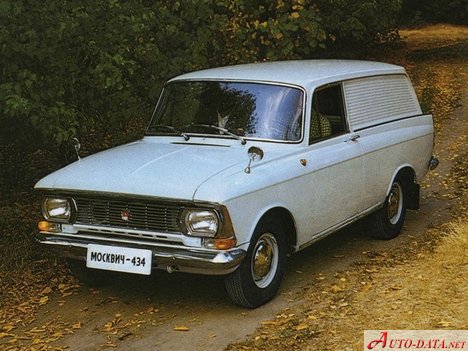
The Moskvich 434 was a Soviet-built station wagon produced from 1969 to 1975. Representing a significant update to the earlier Moskvich 412, the 434 offered increased practicality and a more modern design within the context of the Eastern Bloc automotive industry. While never officially exported to the United States, the Moskvich 434 played a crucial role in providing affordable transportation for families in the Soviet Union and its satellite states. It was a common sight on the roads of Eastern Europe, known for its durability and relatively simple mechanical design. The 434, and the Moskvich brand in general, filled a niche similar to that of the early American station wagons, offering a versatile vehicle for both personal and commercial use.
Moskvich 434 1.5: A Detailed Overview
The Moskvich 434 was part of a lineage of vehicles produced by the AZLK (Avtomobilny Zavod imeni Lenina, or Lenin Automotive Plant) in Moscow. The 434 specifically denotes the station wagon (estate) body style, a popular configuration for families needing ample cargo space. It was a direct response to the growing demand for practical vehicles in the Soviet market. The car’s design reflected the prevailing aesthetic trends of the late 1960s, with a boxy silhouette and relatively restrained styling. The 434 was intended to be a robust and reliable vehicle, capable of withstanding the often-harsh road conditions prevalent in the Soviet Union.
Engine & Performance
The Moskvich 434 was powered by a 1.5-liter (1479 cm3 or 90.25 cu. in.) inline four-cylinder engine, designated the UZA M-412. This engine produced 75 horsepower at 5800 rpm and 108 Nm (79.66 lb.-ft.) of torque at 3800 rpm. While not a performance car by modern standards, the engine provided adequate power for everyday driving. The engine’s power-to-weight ratio was 14.7 kg/Hp, or 68.2 Hp/tonne, and the torque-to-weight ratio was 10.2 kg/Nm, or 98.2 Nm/tonne. The engine featured a compression ratio of 8.8:1 and utilized a carburetor fuel injection system. Power per liter was rated at 50.7 Hp/l. The drivetrain consisted of a rear-wheel drive configuration, with power delivered through a four-speed manual transmission. The Moskvich 434 had a maximum speed of 120 km/h (74.56 mph). Fuel economy was rated at 10 liters per 100 kilometers (23.5 US mpg, 28.2 UK mpg, or 10 km/l combined).
Design & Features
The Moskvich 434 was a five-door, five-seat station wagon. Its body style was characterized by a long roofline extending to the rear of the vehicle, maximizing cargo capacity. The exterior design was functional rather than flamboyant, reflecting the utilitarian ethos of Soviet automotive engineering. The car featured a longitudinal engine layout. Suspension consisted of coil springs in the front and leaf springs in the rear, a common setup for vehicles of this era. Brakes were disc in the front and drum in the rear. Steering was accomplished via a worm-reduction unit. The vehicle rode on 165/80 R13 tires. Interior features were basic but practical, with a focus on durability and ease of maintenance. Safety features were limited by the standards of the time, but the car did offer a degree of protection in the event of a collision. The fuel tank capacity was 46 liters (12.15 US gal, 10.12 UK gal).
Technical Specifications
| Brand | Moskvich |
| Model | 434 |
| Generation | 434 |
| Type (Engine) | 1.5 (75 Hp) |
| Start of production | 1969 |
| End of production | 1975 |
| Powertrain Architecture | Internal Combustion engine |
| Body type | Station wagon (estate) |
| Seats | 5 |
| Doors | 5 |
| Fuel consumption (extra urban) | 8.8 l/100 km (26.7 US mpg, 32.1 UK mpg, 11.4 km/l) |
| Fuel consumption (combined) | 10 l/100 km (23.5 US mpg, 28.2 UK mpg, 10 km/l) |
| Fuel Type | Petrol (Gasoline) |
| Maximum speed | 120 km/h (74.56 mph) |
| Weight-to-power ratio | 14.7 kg/Hp |
| Weight-to-torque ratio | 10.2 kg/Nm |
| Power | 75 Hp @ 5800 rpm |
| Torque | 108 Nm @ 3800 rpm (79.66 lb.-ft. @ 3800 rpm) |
| Engine layout | Front, Longitudinal |
| Engine Model/Code | UZA M-412 |
| Engine displacement | 1479 cm3 (90.25 cu. in.) |
| Number of cylinders | 4 |
| Engine configuration | Inline |
| Cylinder Bore | 82 mm (3.23 in.) |
| Piston Stroke | 70 mm (2.76 in.) |
| Compression ratio | 8.8:1 |
| Number of valves per cylinder | 2 |
| Fuel injection system | Carburettor |
| Engine aspiration | Naturally aspirated engine |
| Kerb Weight | 1100 kg (2425.08 lbs.) |
| Fuel tank capacity | 46 l (12.15 US gal, 10.12 UK gal) |
| Length | 4090 mm (161.02 in.) |
| Width | 1550 mm (61.02 in.) |
| Height | 1500 mm (59.06 in.) |
| Wheelbase | 2400 mm (94.49 in.) |
| Front track | 1247 mm (49.09 in.) |
| Rear track | 1237 mm (48.7 in.) |
| Minimum turning circle | 10.5 m (34.45 ft.) |
| Drivetrain Architecture | Rear wheel drive |
| Number of gears | 4 gears, manual transmission |
| Front suspension | Coil spring |
| Rear suspension | Leaf spring |
| Front brakes | Disc |
| Rear brakes | Drum |
| Steering type | Worm-reduction unit |
| Tires size | 165/80 R13 |
The Moskvich 434, while not a technological marvel, represented a practical and affordable transportation solution for a large segment of the population in the Soviet Union and Eastern Europe. Its simple design, robust construction, and ample cargo space made it a popular choice for families and commercial users alike. Though largely unknown in the West, the 434 holds a significant place in the automotive history of the Eastern Bloc.
