
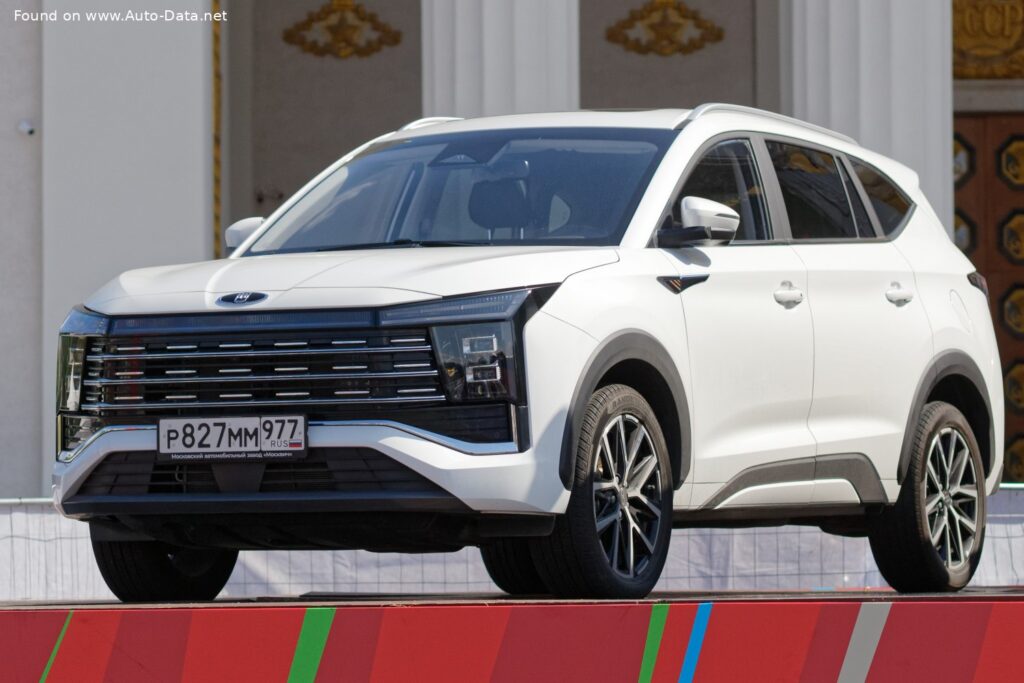
The Moskvich 8 is a compact crossover SUV introduced in 2024 by the revived Russian automaker, Moskvich. Representing a significant step in the company’s attempt to re-establish itself in the automotive market, the 8 is positioned as a family-oriented vehicle offering a blend of practicality, modern features, and affordability. While the Moskvich brand has a long history in Russia dating back to the Soviet era, the 8 is a fundamentally new vehicle built with significant Chinese collaboration and technology, primarily utilizing components and platforms sourced from JAC Motors. It is currently sold exclusively within the Russian market, filling a gap left by the departure of several Western automotive manufacturers.
Moskvich 8: Overview and Market Positioning
The Moskvich 8 competes in the increasingly popular compact crossover segment, a market dominated by global players. Its key selling points are its spacious interior – offering seating for up to seven passengers – and its relatively affordable price point compared to imported alternatives. The vehicle aims to appeal to families and individuals seeking a versatile and practical vehicle for both urban and light off-road use. The 8 represents a departure from Moskvich’s traditionally utilitarian vehicles, embracing a more contemporary design and feature set.
Engine & Performance
The Moskvich 8 1.5T GDI is powered by a 1.5-liter turbocharged four-cylinder gasoline engine, designated HFC4GC1.6E. This engine produces 174 horsepower at 5,500 rpm and 280 Nm (206.52 lb.-ft.) of torque between 1,800 and 3,500 rpm. The engine features direct fuel injection and an intercooler to enhance performance and efficiency. Power is delivered to the front wheels via a seven-speed dual-clutch transmission (DCT), providing smooth and relatively quick gear changes. The vehicle’s weight-to-power ratio is 9.6 kg/Hp, and its weight-to-torque ratio is 5.9 kg/Nm. The Moskvich 8 achieves a maximum speed of 170 km/h (105.63 mph). Fuel economy figures are rated at 10.7 l/100 km (22 US mpg) in urban conditions, 7 l/100 km (33.6 US mpg) on the extra-urban cycle, and 8.3 l/100 km (28.3 US mpg) combined. The engine meets Euro 5 emission standards.
Design & Features
The Moskvich 8 boasts a contemporary crossover design with a focus on practicality and space. Its body style is a five-door crossover, offering a high seating position and good visibility. A key feature is its available seven-seat configuration, making it a relatively rare offering in its class. The exterior design incorporates modern styling cues, including sharp lines, a prominent grille, and LED lighting. Inside, the cabin is designed to be functional and comfortable, with a focus on durability. Standard features include air conditioning, a touchscreen infotainment system, and basic safety equipment such as ABS (Anti-lock Braking System). The trunk offers a minimum capacity of 418 liters (14.76 cu. ft.), expanding to a substantial 2,153 liters (76.03 cu. ft.) with the rear seats folded down. The vehicle’s dimensions are 4,825 mm (189.96 in.) in length, 1,870 mm (73.62 in.) in width, and 1,758 mm (69.21 in.) in height, with a wheelbase of 2,830 mm (111.42 in.). Ground clearance is rated at 190 mm (7.48 in.).
Technical Specifications
| Brand | Moskvich |
| Model | 8 |
| Generation | 8 |
| Type (Engine) | 1.5T GDI (174 Hp) DCT |
| Start of production | 2024 |
| Powertrain Architecture | Internal Combustion engine |
| Body type | Crossover |
| Seats | 7 |
| Doors | 5 |
| Fuel consumption (urban) | 10.7 l/100 km (22 US mpg) |
| Fuel consumption (extra urban) | 7 l/100 km (33.6 US mpg) |
| Fuel consumption (combined) | 8.3 l/100 km (28.3 US mpg) |
| Fuel Type | Petrol (Gasoline) |
| Maximum speed | 170 km/h (105.63 mph) |
| Emission standard | Euro 5 |
| Weight-to-power ratio | 9.6 kg/Hp |
| Weight-to-torque ratio | 5.9 kg/Nm |
| Power | 174 Hp @ 5500 rpm |
| Torque | 280 Nm @ 1800-3500 rpm (206.52 lb.-ft.) |
| Engine layout | Front, Transverse |
| Engine Model/Code | HFC4GC1.6E |
| Engine displacement | 1499 cm3 (91.47 cu. in.) |
| Number of cylinders | 4 |
| Engine configuration | Inline |
| Cylinder Bore | 75 mm (2.95 in.) |
| Piston Stroke | 84.8 mm (3.34 in.) |
| Number of valves per cylinder | 4 |
| Fuel injection system | Direct injection |
| Engine aspiration | Turbocharger, Intercooler |
| Valvetrain | DOHC |
| Kerb Weight | 1665-1750 kg (3670.7 – 3858.09 lbs.) |
| Max. weight | 2215 kg (4883.24 lbs.) |
| Max load | 465-550 kg (1025.15 – 1212.54 lbs.) |
| Trunk (boot) space – minimum | 418 l (14.76 cu. ft.) |
| Trunk (boot) space – maximum | 2153 l (76.03 cu. ft.) |
| Fuel tank capacity | 58 l (15.32 US gal | 12.76 UK gal) |
| Length | 4825 mm (189.96 in.) |
| Width | 1870 mm (73.62 in.) |
| Height | 1758 mm (69.21 in.) |
| Wheelbase | 2830 mm (111.42 in.) |
| Front track | 1575 mm (62.01 in.) |
| Rear track | 1590 mm (62.6 in.) |
| Ride height (ground clearance) | 190 mm (7.48 in.) |
| Minimum turning circle | 11.5 m (37.73 ft.) |
| Drivetrain Architecture | Front wheel drive |
| Number of gears and type of gearbox | 7 gears, automatic transmission DCT |
| Front suspension | Independent type McPherson |
| Rear suspension | Semi-independent, coil spring, Torsion |
| Front brakes | Disc |
| Rear brakes | Disc |
| Assisting systems | ABS (Anti-lock braking system) |
| Steering type | Steering rack and pinion |
| Power steering | Electric Steering |
| Tires size | 235/50 R19 |
| Wheel rims size | 19 |
The Moskvich 8 represents a significant undertaking for the revitalized Moskvich brand. Its success will depend on its ability to deliver a compelling combination of value, practicality, and reliability in a competitive market. The vehicle’s reliance on Chinese technology and components is a key aspect of its development and will likely influence its long-term performance and perception among consumers.
