
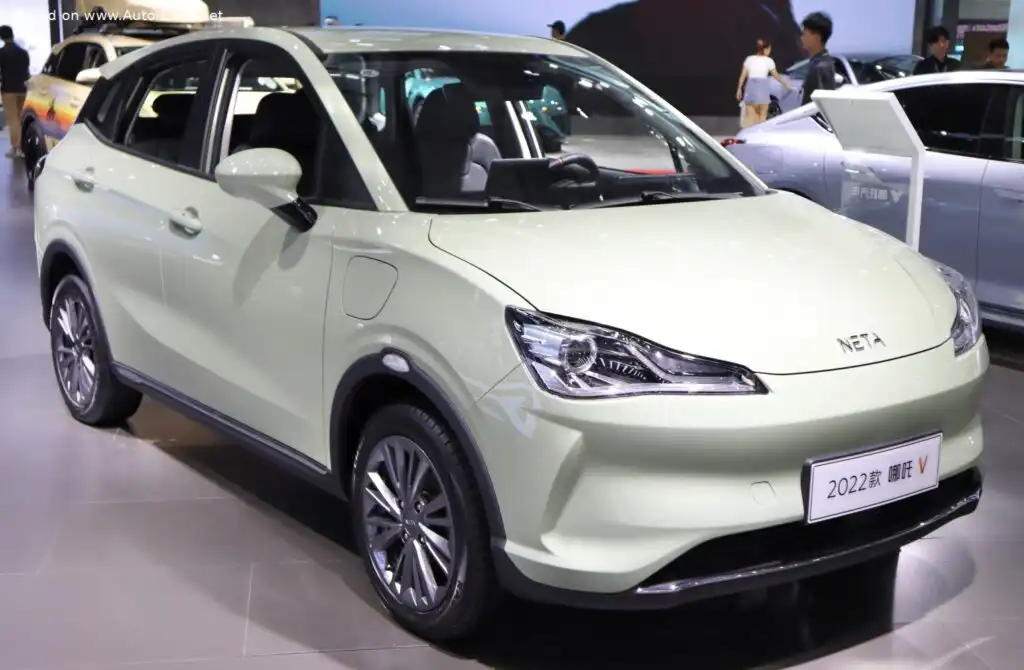
The Neta V 40.7 kWh (95 hp) is a battery electric vehicle (BEV) introduced by the Chinese manufacturer Neta Auto in 2023. Positioned as an entry-level subcompact crossover SUV, the V represents Neta’s initial foray into the rapidly expanding electric vehicle market. It’s primarily targeted towards urban commuters and first-time EV buyers seeking an affordable and practical electric vehicle. The 40.7 kWh variant is the base model in the Neta V lineup, offering a balance between range and cost. It utilizes a lithium iron phosphate (LiFePO4) battery pack and a single electric motor driving the front wheels.
Technical Specifications
| Brand | Neta |
| Model | V |
| Generation | V |
| Type (Engine) | 40.7 kWh (95 Hp) |
| Start of production | 2023 |
| Powertrain Architecture | BEV (Electric Vehicle) |
| Body type | SUV, Crossover |
| Seats | 5 |
| Doors | 5 |
| Fuel Type | Electricity |
| Maximum speed | 120 km/h (74.56 mph) |
| Gross battery capacity | 40.7 kWh |
| Battery voltage | 353.9 V |
| Battery technology | Lithium iron phosphate (LiFePO4) |
| Battery weight | 301 kg (663.59 lbs.) |
| Battery location | Below the floor |
| All-electric range (NEDC) | 384 km (238.61 mi) |
| Average Energy consumption (NEDC) | 14.3 kWh/100 km (23.01 kWh/100 mi) |
| Electric motor power | 95 Hp |
| Electric motor Torque | 150 Nm (110.63 lb.-ft.) |
| Maximum revolutions of the electric motor | 13000 rpm |
| Electric motor location | Front axle, Transverse |
| Electric motor type | Synchronous |
| System power | 95 Hp |
| System torque | 150 Nm (110.63 lb.-ft.) |
| Kerb Weight | 1269 kg (2797.67 lbs.) |
| Max. weight | 1569 kg (3459.05 lbs.) |
| Max load | 300 kg (661.39 lbs.) |
| Length | 4070 mm (160.24 in.) |
| Width | 1690 mm (66.54 in.) |
| Height | 1540 mm (60.63 in.) |
| Wheelbase | 2420 mm (95.28 in.) |
| Front track | 1440 mm (56.69 in.) |
| Rear (Back) track | 1415 mm (55.71 in.) |
| Ride height (ground clearance) | 130 mm (5.12 in.) |
| Minimum turning circle (turning diameter) | 9.7 m (31.82 ft.) |
| Drivetrain Architecture | One electric motor drives the front wheels. |
| Drive wheel | Front wheel drive |
| Number of gears and type of gearbox | 1 gears, automatic transmission |
| Front brakes | Disc, 236×12.3 mm |
| Rear brakes | Disc, 236×10.4 mm |
| Tires size | 185/55 R16 |
Powertrain & Engine Architecture
The Neta V 40.7 kWh utilizes a single synchronous electric motor mounted transversely on the front axle. This motor produces 95 horsepower and 150 Nm (110.63 lb-ft) of torque. The motor is powered by a 40.7 kWh lithium iron phosphate (LiFePO4) battery pack located under the vehicle floor, contributing to a low center of gravity. LiFePO4 batteries are known for their thermal stability and longer lifespan compared to other lithium-ion chemistries, though they generally offer slightly lower energy density. The vehicle employs a single-speed automatic transmission, typical of most electric vehicles, delivering seamless acceleration. The battery pack operates at 353.9V. The charging port specifications are not widely publicized, but it is expected to support both AC and DC fast charging.
Driving Characteristics
The 95 hp output and front-wheel-drive configuration of the Neta V 40.7 kWh result in modest, but adequate, performance for urban driving. Acceleration is linear and predictable, with the instant torque characteristic of electric motors providing brisk response at lower speeds. Top speed is limited to 120 km/h (74.56 mph). Compared to potential higher-powered variants of the Neta V, this base model prioritizes efficiency over outright speed. The single-speed transmission simplifies the driving experience, eliminating the need for gear changes. The relatively low weight (1269 kg / 2797.67 lbs) helps to mitigate the effects of the limited horsepower. The steering is electrically assisted, providing a light and easy feel, suitable for maneuvering in city traffic.
Equipment & Trim Levels
The Neta V 40.7 kWh typically comes standard with a range of features designed to appeal to budget-conscious buyers. These include air conditioning, power windows, a central touchscreen infotainment system (size varies by market), Bluetooth connectivity, and basic safety features like ABS (Anti-lock Braking System). Interior upholstery is generally cloth, and the dashboard design is functional and modern. Optional extras may include a larger touchscreen, a rearview camera, parking sensors, and advanced driver-assistance systems (ADAS) such as lane departure warning and automatic emergency braking, depending on the specific market and trim package.
Chassis & Braking
The Neta V utilizes a McPherson strut independent suspension setup at the front, providing a comfortable ride and responsive handling. The rear suspension employs a trailing arm configuration, a cost-effective solution for compact crossovers. The braking system consists of disc brakes on all four wheels, with the front discs measuring 236×12.3 mm and the rear discs measuring 236×10.4 mm. The vehicle is equipped with ABS to enhance braking performance and stability. The relatively low ride height (130 mm / 5.12 in.) contributes to stability, but may limit off-road capability.
Market Reception & Comparison
The Neta V 40.7 kWh has been generally well-received in the Chinese market as an affordable entry point into the EV segment. Critics have praised its practicality, comfortable ride, and decent range for urban commuting. However, some have noted the relatively modest power output and basic interior trim. Compared to other EVs in its class, such as the BYD Dolphin or Wuling Hongguang Mini EV, the Neta V offers a more conventional crossover SUV design and a slightly more refined driving experience. Its NEDC-rated range of 384 km (238.61 mi) is competitive, but real-world range may vary depending on driving conditions and usage. The energy consumption of 14.3 kWh/100 km (146 MPGe) is also reasonable for a vehicle of its size and type.
Legacy
As a relatively new model, the long-term reliability of the Neta V 40.7 kWh is still being established. However, the use of a LiFePO4 battery pack suggests good durability and longevity. The simplicity of the electric powertrain, with fewer moving parts than a traditional internal combustion engine, also contributes to potentially lower maintenance costs. In the used car market, the Neta V is expected to hold its value reasonably well, particularly as demand for affordable EVs continues to grow. The 40.7 kWh variant serves as a crucial stepping stone for Neta Auto, establishing the brand in the competitive EV landscape and paving the way for future models with increased range and performance.
