
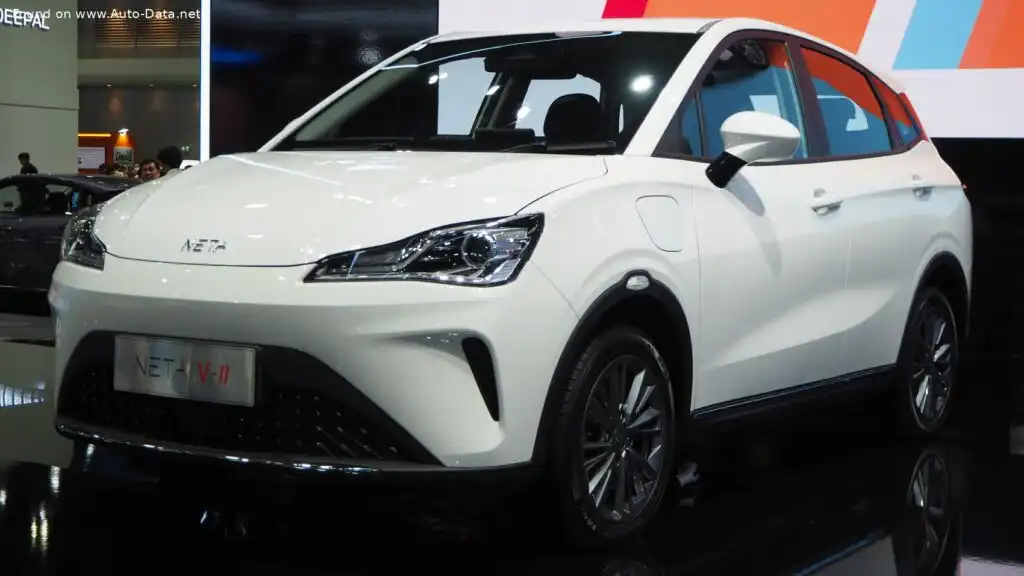
The Neta V-II (facelift 2024) 36.1 kWh (95 hp) represents an entry-level offering within the Neta V series of compact electric crossover SUVs. Introduced in 2024, this variant is positioned as an affordable and efficient option for urban commuters and first-time EV buyers. The V-II facelift builds upon the original Neta V, incorporating styling updates and refinements to the interior and technology. It primarily targets the Chinese domestic market, where Neta, a subsidiary of Hozon Auto, has established a growing presence. This specific configuration, with its smaller battery pack and single electric motor, aims to balance range with cost-effectiveness.
Technical Specifications
| Brand | Neta |
| Model | V |
| Generation | V-II (facelift 2024) |
| Type (Engine) | 36.1 kWh (95 Hp) |
| Start of production | 2024 |
| Powertrain Architecture | BEV (Electric Vehicle) |
| Body type | SUV, Crossover |
| Seats | 5 |
| Doors | 5 |
| Fuel Type | Electricity |
| Weight-to-power ratio | 12.1 kg/Hp |
| Hp/tonne | 82.5 |
| Weight-to-torque ratio | 7.7 kg/Nm |
| Nm/tonne | 130.3 |
| Gross battery capacity | 36.1 kWh |
| Battery voltage | 347.2 V |
| Battery technology | Lithium iron phosphate (LiFePO4) |
| Battery weight | 283 kg (623.91 lbs.) |
| Battery location | Below the floor |
| All-electric range | 382-401 km (237.36 – 249.17 mi) |
| Average Energy consumption | 9.7 kWh/100 km (15.61 kWh/100 mi) |
| MPGe | 216 |
| km/kWh | 10.3 |
| mi/kWh | 6.4 |
| Electric motor power | 95 Hp |
| Electric motor Torque | 150 Nm (110.63 lb.-ft.) |
| Electric motor model/code | TZ180XSP12 |
| Maximum revolutions of the electric motor | 13000 rpm |
| Electric motor location | Front axle, Transverse |
| Electric motor type | Synchronous |
| System power | 95 Hp |
| System torque | 150 Nm (110.63 lb.-ft.) |
| Kerb Weight | 1151-1180 kg (2537.52 – 2601.45 lbs.) |
| Max. weight | 1555 kg (3428.19 lbs.) |
| Max load | 375-404 kg (826.73 – 890.67 lbs.) |
| Trunk (boot) space – minimum | 335 l (11.83 cu. ft.) |
| Trunk (boot) space – maximum | 588 l (20.77 cu. ft.) |
| Length | 4070 mm (160.24 in.) |
| Width | 1690 mm (66.54 in.) |
| Height | 1540 mm (60.63 in.) |
| Wheelbase | 2420 mm (95.28 in.) |
| Front track | 1440 mm (56.69 in.) |
| Rear (Back) track | 1415 mm (55.71 in.) |
| Ride height (ground clearance) | 130 mm (5.12 in.) |
| Minimum turning circle (turning diameter) | 9.7 m (31.82 ft.) |
| Approach angle | 18° |
| Departure angle | 24° |
| Drivetrain Architecture | One electric motor drives the front wheels. |
| Drive wheel | Front wheel drive |
| Number of gears and type of gearbox | 1 gears, automatic transmission |
| Front suspension | Independent, type McPherson with coil spring and anti-roll bar |
| Rear suspension | Trailing arm |
| Front brakes | Disc |
| Rear brakes | Disc |
| Assisting systems | ABS (Anti-lock braking system) |
| Steering type | Steering rack and pinion |
| Power steering | Electric Steering |
| Tires size | 185/55 R16 |
| Wheel rims size | 6J x 16 |
Powertrain & Engine Architecture
The Neta V-II 36.1 kWh utilizes a single electric motor, designated TZ180XSP12, driving the front wheels. This synchronous motor produces 95 horsepower and 150 Nm (110.63 lb-ft) of torque. The powertrain is built around a 36.1 kWh Lithium Iron Phosphate (LiFePO4) battery pack, chosen for its cost-effectiveness, thermal stability, and longer cycle life compared to Nickel Manganese Cobalt (NMC) batteries. The battery is mounted under the floor, contributing to a lower center of gravity. The vehicle employs a single-speed automatic transmission, typical for electric vehicles, delivering seamless acceleration. The battery voltage is 347.2V. The electric motor is transversely mounted at the front axle.
Driving Characteristics
The 95 hp output and 150 Nm of torque provide adequate performance for city driving and short commutes. Acceleration is brisk from a standstill, typical of electric motors, but the V-II isn’t designed for rapid highway overtaking. The single-speed transmission offers a linear power delivery, without the gear changes found in internal combustion engine vehicles. The weight-to-power ratio of 12.1 kg/hp results in a noticeable difference in acceleration compared to higher-powered variants of the Neta V. The relatively small battery pack limits the range to 382-401 km (237-249 miles) under optimal conditions, making it best suited for daily commutes rather than long road trips.
Equipment & Trim Levels
The Neta V-II 36.1 kWh typically comes standard with features such as air conditioning, power windows, a touchscreen infotainment system, Bluetooth connectivity, and basic safety features like ABS. Higher trim levels, available as options, may include features like a larger touchscreen, a panoramic sunroof, keyless entry, and advanced driver-assistance systems (ADAS) such as adaptive cruise control and lane-keeping assist. Interior upholstery is generally cloth, with the option of leatherette in higher trims. The dashboard layout is modern and minimalist, focusing on the central touchscreen display.
Chassis & Braking
The Neta V-II utilizes a McPherson strut independent suspension at the front and a trailing arm suspension at the rear. This setup provides a comfortable ride quality for urban driving conditions. The vehicle is equipped with disc brakes on all four wheels, providing adequate stopping power. ABS (Anti-lock Braking System) is standard. The relatively low curb weight (1151-1180 kg / 2537.52 – 2601.45 lbs.) contributes to nimble handling. The ride height is 130mm (5.12 inches).
Market Reception & Comparison
The Neta V-II 36.1 kWh has been well-received in the Chinese market as an affordable entry point into the EV segment. Critics have praised its value for money, comfortable ride, and practical interior space. Compared to higher-range Neta V variants, the 36.1 kWh model offers a lower purchase price but sacrifices range. Its fuel economy, expressed as 9.7 kWh/100 km (15.61 kWh/100 mi), is competitive with other EVs in its class. Reliability reports are still emerging, but the LiFePO4 battery technology is generally considered to be durable and long-lasting.
Legacy
The Neta V-II 36.1 kWh plays a significant role in making electric vehicles more accessible to a wider range of consumers. Its affordability and practicality position it as a strong contender in the rapidly growing Chinese EV market. The use of LiFePO4 battery technology demonstrates a commitment to safety and longevity. As the EV market matures, the V-II is likely to be remembered as a key model in the early stages of electric vehicle adoption, offering a compelling combination of price, efficiency, and practicality.
