
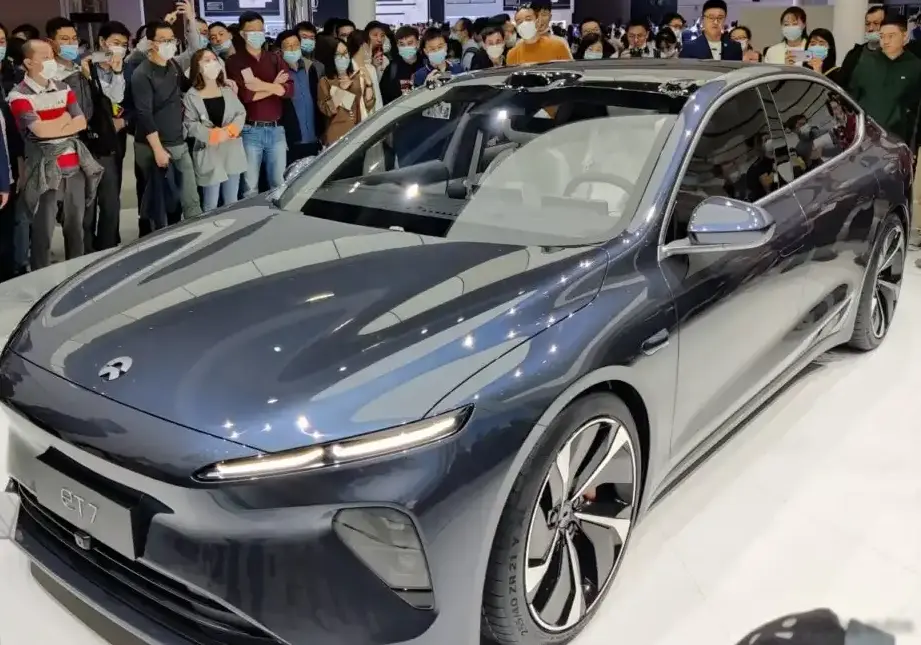
The NIO ET7 70 kWh (653 Hp) 4WD Electric is a fully electric, five-seater sedan produced by the Chinese automotive manufacturer NIO, beginning in March 2022. Representing NIO’s initial foray into the premium electric vehicle segment, the ET7 is positioned as a direct competitor to established luxury EVs like the Tesla Model S and the Porsche Taycan. The 70 kWh variant, while offering a substantial performance level, serves as the entry point into the ET7 lineup, balancing range, performance, and cost. It’s a key model in NIO’s strategy to establish itself as a leading global EV brand, particularly focusing on advanced technology and a premium user experience.
Technical Specifications
| Brand | NIO |
| Model | ET7 |
| Generation | ET7 |
| Type (Engine) | 70 kWh (653 Hp) 4WD Electric |
| Start of production | March, 2022 |
| Powertrain Architecture | BEV (Electric Vehicle) |
| Body type | Sedan |
| Seats | 5 |
| Doors | 4 |
| Fuel Type | Electricity |
| Acceleration 0 – 100 km/h | 3.9 sec |
| Acceleration 0 – 62 mph | 3.9 sec |
| Acceleration 0 – 60 mph | 3.7 sec |
| 100 km/h – 0 | 33.5 m |
| Gross battery capacity | 70 kWh |
| All-electric range | 500 km (310.69 mi) |
| Electric motor 1 power | 245 Hp |
| Electric motor 1 location | Front axle, Transverse |
| Electric motor 2 power | 408 Hp |
| Electric motor 2 location | Rear axle, Transverse |
| System power | 653 Hp |
| System torque | 850 Nm (626.93 lb.-ft.) |
| Length | 5098 mm (200.71 in.) |
| Width | 1987 mm (78.23 in.) |
| Height | 1505 mm (59.25 in.) |
| Wheelbase | 3060 mm (120.47 in.) |
| Front track | 1668 mm (65.67 in.) |
| Rear track | 1672 mm (65.83 in.) |
| Drag coefficient (Cd) | 0.23 |
| Drivetrain Architecture | One electric motor drives the front wheels, one electric motor drives the rear wheels. |
| Drive wheel | All wheel drive (4×4) |
| Number of gears | 1 |
| Gearbox type | Automatic transmission |
| Front suspension | Independent multi-link suspension |
| Rear suspension | Independent multi-link suspension |
| Front brakes | Ventilated discs |
| Rear brakes | Ventilated discs |
| Assisting systems | ABS (Anti-lock braking system) |
| Tires size | 245/50 R19; 245/45 R20 |
| Wheel rims size | 19; 20 |
Powertrain & Engine Architecture
The NIO ET7 70 kWh utilizes a dual-motor, all-wheel drive (AWD) powertrain. Unlike traditional internal combustion engine vehicles, it doesn’t have an “engine” in the conventional sense. Instead, it employs two independent electric motors – one powering the front axle and the other powering the rear. The front motor produces 245 horsepower, while the rear motor generates a more substantial 408 horsepower, resulting in a combined system output of 653 horsepower and 850 Nm (626.93 lb.-ft.) of torque. Both motors are permanent magnet synchronous motors, known for their high efficiency and power density. The 70 kWh battery pack utilizes lithium-ion cells and is positioned within the floor of the vehicle to optimize weight distribution and lower the center of gravity. The single-speed automatic transmission is inherent to electric vehicle design, providing seamless acceleration without the need for multiple gears. The vehicle’s energy management system is sophisticated, incorporating regenerative braking to recapture energy during deceleration and extend the vehicle’s range.
Driving Characteristics
The ET7 70 kWh delivers impressive acceleration, achieving 0-60 mph in approximately 3.7 seconds. The dual-motor AWD system provides excellent traction and stability, particularly in adverse weather conditions. While the 70 kWh variant offers substantial performance, it’s slightly less potent than the higher-capacity battery versions (100 kWh and 150 kWh). The single-speed transmission provides instant torque delivery, resulting in a responsive and engaging driving experience. The suspension, featuring independent multi-link setups at both the front and rear, is tuned for a balance between comfort and handling. Steering is precise and well-weighted, contributing to a confident feel behind the wheel. Compared to the longer-range models, the 70 kWh version may exhibit a slightly more noticeable reduction in power during sustained high-speed driving as the battery capacity is utilized.
Equipment & Trim Levels
The ET7 70 kWh comes standard with a comprehensive suite of technology and luxury features. The interior is characterized by premium materials, including leather upholstery (available in various colors), wood trim, and a minimalist design aesthetic. A large, high-resolution touchscreen display serves as the central control interface for the vehicle’s infotainment system, which includes navigation, audio, and vehicle settings. Standard features also include a panoramic sunroof, advanced driver-assistance systems (ADAS) such as adaptive cruise control and lane-keeping assist, and over-the-air (OTA) software update capability. Optional extras include a premium sound system, upgraded interior trim materials, and additional ADAS features. The ET7 prioritizes a connected car experience, with seamless integration of smartphone apps and cloud-based services.
Chassis & Braking
The ET7’s chassis is constructed from a combination of aluminum and high-strength steel, optimizing both weight and rigidity. The independent multi-link suspension at all four corners provides a comfortable ride and precise handling. Ventilated disc brakes are employed on all wheels, providing ample stopping power. The anti-lock braking system (ABS) and electronic stability control (ESC) enhance safety and control. The vehicle’s low center of gravity, thanks to the battery pack’s placement, contributes to its stability and cornering ability. The ET7’s steering system is electrically assisted, providing a responsive and precise feel.
Market Reception & Comparison
The NIO ET7 has been generally well-received by automotive critics, praised for its luxurious interior, advanced technology, and impressive performance. The 70 kWh variant, while being the entry-level model, offers a compelling value proposition for buyers seeking a premium electric sedan. Compared to the 100 kWh and 150 kWh versions, the 70 kWh model offers a shorter range but at a lower price point. Fuel economy, measured in terms of energy consumption, is competitive with other premium EVs. Reliability data is still emerging, as the ET7 is a relatively new model, but NIO has demonstrated a commitment to quality and continuous improvement through OTA software updates.
Legacy
The NIO ET7 represents a significant step forward for the Chinese automotive industry, demonstrating its ability to compete with established global brands in the premium EV segment. The 70 kWh variant, as the entry point to the ET7 lineup, has played a crucial role in attracting a wider range of customers to the NIO brand. The long-term reliability of the ET7’s powertrain remains to be seen, but the inherent simplicity of electric powertrains suggests a potentially high level of durability. As the EV market continues to evolve, the ET7 is poised to become a benchmark for luxury electric sedans, and the 70 kWh version will likely remain a popular choice for buyers seeking a balance of performance, range, and affordability.
