
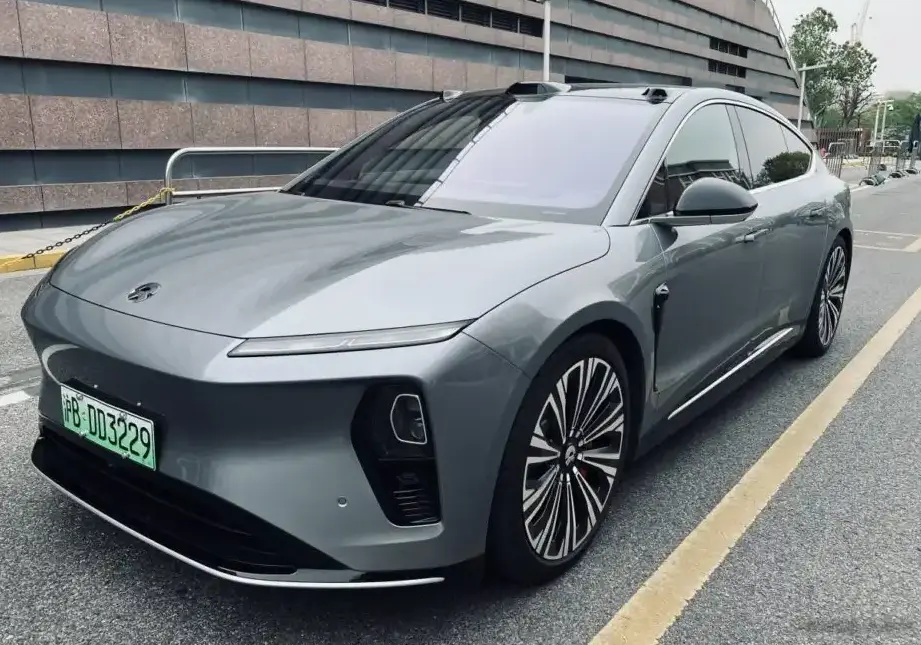
The NIO ET9, launched in December 2024, represents NIO’s flagship electric sedan, positioned as a premium, technology-laden competitor in the burgeoning EV market. Built upon a dedicated electric vehicle architecture, the ET9 aims to deliver a blend of high performance, long range, and advanced autonomous driving capabilities. It is the latest iteration in NIO’s expanding lineup, intended to showcase the brand’s technological prowess and appeal to a discerning clientele. The ET9 is a four-door, four-seat sedan designed to compete with established luxury brands and other high-end electric vehicles.
Technical Specifications
| Brand | NIO |
| Model | ET9 |
| Generation | ET9 |
| Type (Engine) | 100 kWh (707 Hp) Electric 4WD |
| Start of production | December, 2024 |
| Powertrain Architecture | BEV (Electric Vehicle) |
| Body type | Sedan |
| Seats | 4 |
| Doors | 4 |
| Fuel Type | Electricity |
| Acceleration 0 – 100 km/h | 4.3 sec |
| Acceleration 0 – 62 mph | 4.3 sec |
| Acceleration 0 – 60 mph | 4.1 sec |
| Maximum speed | 220 km/h (136.7 mph) |
| 100 km/h – 0 | 35.2 m |
| Weight-to-power ratio | 3.8 kg/Hp, 261.9 Hp/tonne |
| Weight-to-torque ratio | 3.9 kg/Nm, 259.3 Nm/tonne |
| Gross battery capacity | 100 kWh |
| Battery voltage | 900 V |
| Battery technology | Lithium nickel manganese cobalt oxides (Li-NMC) |
| Battery location | Below the floor |
| All-electric range (CLTC) | 650 km (403.89 mi) |
| Average Energy consumption (CLTC) | 16.2 kWh/100 km (26.07 kWh/100 mi) |
| Average Energy consumption (MPGe) | 129 MPGe |
| Average Energy consumption (km/kWh) | 6.2 km/kWh |
| Average Energy consumption (mi/kWh) | 3.8 mi/kWh |
| Electric motor 1 power | 245 Hp |
| Electric motor 1 Torque | 300 Nm (221.27 lb.-ft.) |
| Electric motor 1 location | Front axle, Transverse |
| Electric motor 1 type | Asynchronous |
| Electric motor 2 power | 462 Hp |
| Electric motor 2 Torque | 400 Nm (295.02 lb.-ft.) |
| Electric motor 2 location | Rear axle, Transverse |
| Electric motor 2 type | Synchronous |
| System power | 707 Hp |
| System torque | 700 Nm (516.29 lb.-ft.) |
| Kerb Weight | 2700 kg (5952.48 lbs.) |
| Max. weight | 3100 kg (6834.33 lbs.) |
| Max load | 400 kg (881.85 lbs.) |
| Trunk (boot) space – minimum | 544 l (19.21 cu. ft.) |
| Length | 5325 mm (209.65 in.) |
| Width | 2017 mm (79.41 in.) |
| Height | 1621 mm (63.82 in.) |
| Wheelbase | 3250 mm (127.95 in.) |
| Front track | 1731 mm (68.15 in.) |
| Rear (Back) track | 1758 mm (69.21 in.) |
| Drag coefficient (Cd) | 0.243 |
| Drivetrain Architecture | One electric motor drives the front wheels, one electric motor drives the rear wheels. |
| Drive wheel | All wheel drive (4×4) |
| Number of gears | 1 |
| Type of gearbox | automatic transmission |
| Front suspension | Independent multi-link suspension |
| Rear suspension | Independent multi-link suspension |
| Front brakes | Ventilated discs |
| Rear brakes | Ventilated discs |
| Assisting systems | ABS (Anti-lock braking system) |
| Steering type | Steering rack and pinion |
| Power steering | Electric Steering |
| Tires size | 255/45 R22 |
| Wheel rims size | 22 |
Powertrain & Engine Architecture
The NIO ET9 utilizes a dual-motor all-wheel-drive (AWD) powertrain, a common configuration for high-performance electric vehicles. The front motor is an asynchronous motor producing 245 horsepower, while the rear motor employs a synchronous design generating 462 horsepower. Combined, these motors deliver a system output of 707 horsepower and 700 Nm (516.29 lb.-ft.) of torque. The powertrain operates on a high-voltage 900V architecture, enabling faster charging times and improved energy efficiency. The 100 kWh battery pack, utilizing Lithium Nickel Manganese Cobalt Oxide (Li-NMC) chemistry, is positioned under the floor to optimize weight distribution and passenger space. The single-speed automatic transmission is typical for electric vehicles, providing seamless acceleration without the need for multiple gears.
Driving Characteristics
The ET9’s dual-motor setup provides rapid acceleration, achieving 0-60 mph in approximately 4.1 seconds. The AWD system ensures excellent traction and stability, particularly in adverse weather conditions. The instant torque delivery characteristic of electric motors provides a responsive and engaging driving experience. While specific gear ratios aren’t publicly detailed, the single-speed transmission is optimized for both acceleration and cruising efficiency. Compared to potential future performance variants, the 707 hp model strikes a balance between exhilarating performance and everyday usability. The low center of gravity, thanks to the underfloor battery pack, contributes to confident handling and reduced body roll.
Equipment & Trim Levels
As a flagship model, the NIO ET9 is expected to come standard with a comprehensive suite of features. These likely include a large touchscreen infotainment system, advanced driver-assistance systems (ADAS), premium leather upholstery, a panoramic sunroof, and a high-end audio system. NIO is known for its focus on user experience, and the ET9 will likely feature over-the-air (OTA) software updates to continuously improve functionality. Optional extras may include advanced autonomous driving capabilities, upgraded interior trim materials, and personalized customization options. Specific trim levels and their associated feature sets are expected to be announced closer to the vehicle’s official market launch.
Chassis & Braking
The ET9 features an independent multi-link suspension system at both the front and rear axles, designed to provide a comfortable ride and precise handling. Ventilated disc brakes are employed on all four wheels, ensuring strong stopping power. An Anti-lock Braking System (ABS) is standard, enhancing safety and control during emergency braking situations. The vehicle’s steering utilizes an electric power steering system, offering precise and responsive steering feel. The 22-inch wheels are fitted with 255/45 R22 tires, providing a balance of grip and ride comfort.
Market Reception & Comparison
The NIO ET9 enters a competitive segment of the luxury electric sedan market, facing rivals such as the Tesla Model S, Porsche Taycan, and Mercedes-Benz EQS. Initial reception has been positive, with industry observers praising the vehicle’s design, technology, and performance potential. The ET9’s 650 km (403.89 mi) CLTC range is competitive with other high-end EVs, and its 900V architecture promises faster charging times. Compared to other NIO models, the ET9 represents a significant step up in terms of luxury, technology, and performance. Long-term reliability data is not yet available, but NIO has been steadily improving its quality control processes.
Legacy
The NIO ET9 is poised to be a significant vehicle for the brand, showcasing its commitment to innovation and its ambition to become a leading player in the global EV market. The 900V architecture and advanced battery technology are likely to influence future NIO models and potentially inspire other manufacturers. The ET9’s success will depend on its ability to deliver on its promises of performance, range, and reliability. In the used car market, the ET9 is expected to hold its value well, particularly among enthusiasts and early adopters of electric vehicle technology. The long-term durability of the dual-motor powertrain and battery pack will be key factors in determining its overall legacy.
