
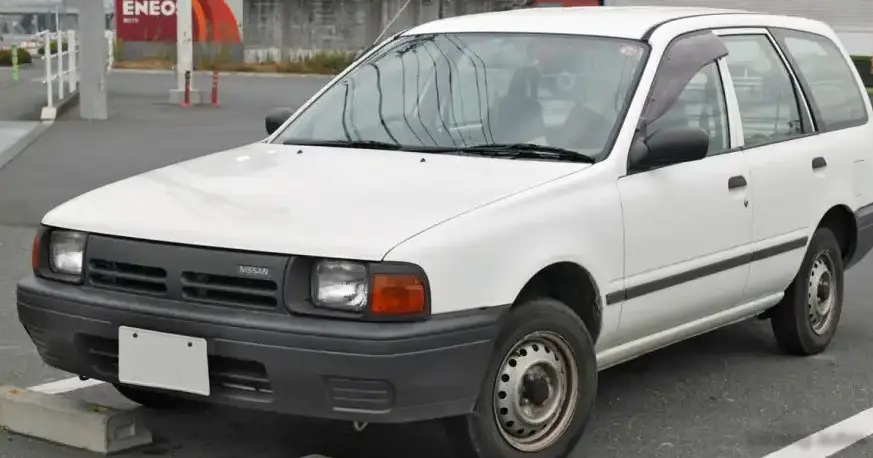
The Nissan AD Y10, specifically the 1.3 i variant producing 79 horsepower, was a compact station wagon produced between 1990 and 1996. Positioned as an entry-level offering within the Y10 AD series, it served as a practical and affordable family vehicle, primarily targeted at the Japanese domestic market (JDM). The AD Y10 represented Nissan’s attempt to cater to the growing demand for small, versatile vehicles suitable for urban environments and family use. It was built on Nissan’s B11 platform, sharing components with other models like the Nissan Sunny and Sentra of the era. This variant, with its smaller engine and manual transmission, was designed for fuel efficiency and ease of driving, making it a popular choice for first-time car buyers and those seeking a no-frills workhorse.
Technical Specifications
| Brand | Nissan |
| Model | AD |
| Generation | AD Y10 |
| Type (Engine) | 1.3 i (79 Hp) |
| Start of production | 1990 |
| End of production | 1996 |
| Powertrain Architecture | Internal Combustion engine |
| Body type | Station wagon (estate) |
| Seats | 5 |
| Doors | 5 |
| Fuel Type | Petrol (Gasoline) |
| Weight-to-power ratio | 12.2 kg/Hp, 82.3 Hp/tonne |
| Weight-to-torque ratio | 9.3 kg/Nm, 107.3 Nm/tonne |
| Power | 79 Hp @ 6000 rpm |
| Power per litre | 62 Hp/l |
| Torque | 103 Nm @ 4000 rpm (75.97 lb.-ft. @ 4000 rpm) |
| Engine layout | Front, Transverse |
| Engine displacement | 1275 cm3 (77.81 cu. in.) |
| Number of cylinders | 4 |
| Engine configuration | Inline |
| Cylinder Bore | 71 mm (2.8 in.) |
| Piston Stroke | 80.5 mm (3.17 in.) |
| Compression ratio | 9.5:1 |
| Number of valves per cylinder | 4 |
| Fuel injection system | Multi-port manifold injection |
| Engine aspiration | Naturally aspirated engine |
| Valvetrain | DOHC |
| Kerb Weight | 960 kg (2116.44 lbs.) |
| Fuel tank capacity | 50 l (13.21 US gal | 11 UK gal) |
| Length | 4175 mm (164.37 in.) |
| Width | 1665 mm (65.55 in.) |
| Height | 1480 mm (58.27 in.) |
| Wheelbase | 2400 mm (94.49 in.) |
| Front track | 1445 mm (56.89 in.) |
| Rear (Back) track | 1445 mm (56.89 in.) |
| Ride height (ground clearance) | 140 mm (5.51 in.) |
| Drivetrain Architecture | The Internal combustion engine (ICE) drives the front wheels of the vehicle. |
| Drive wheel | Front wheel drive |
| Number of gears and type of gearbox | 5 gears, manual transmission |
| Front brakes | Ventilated discs |
| Rear brakes | Drum |
Powertrain & Engine Architecture
The heart of the AD Y10 1.3 i was the GA13DS engine, a 1.3-liter inline-four cylinder gasoline engine. This engine featured a double overhead camshaft (DOHC) valvetrain and multi-port fuel injection, contributing to its relatively efficient operation for its time. The GA13DS produced 79 horsepower at 6000 rpm and 103 Nm (75.97 lb-ft) of torque at 4000 rpm. The engine’s design prioritized fuel economy and reliability over outright performance. The 5-speed manual transmission was the standard offering for this trim level, providing a direct connection between the engine and the front wheels. The transmission’s gear ratios were tuned for everyday driving, emphasizing acceleration in lower gears and comfortable cruising at highway speeds. The engine code, GA13DS, is crucial for identifying specific parts and service information.
Driving Characteristics
The 1.3L engine and manual transmission combination in the AD Y10 offered a reasonably engaging driving experience, especially considering its entry-level positioning. While not particularly quick, the car felt nimble and responsive in urban settings. The 5-speed manual allowed drivers to keep the engine in its optimal power band, making overtaking maneuvers manageable. Compared to the later, more powerful 1.5-liter variants, the 1.3 i felt noticeably less potent, particularly when fully loaded with passengers and cargo. However, this trade-off was accepted in exchange for improved fuel economy. The manual transmission provided a more connected feel compared to the optional automatic transmission available on other AD Y10 models. The relatively light weight of the vehicle (960 kg) helped to mitigate the engine’s modest power output.
Equipment & Trim Levels
The AD Y10 1.3 i was typically equipped with basic, yet functional features. Standard equipment included cloth upholstery, a simple dashboard layout with analog gauges, and manual windows and door locks. Power steering was often included, but air conditioning and electric windows were typically optional extras. The interior was designed with practicality in mind, offering ample space for passengers and cargo. The trim level was generally considered the base model, with limited cosmetic enhancements. Optional extras included a radio/cassette player, upgraded seat fabrics, and a rear window wiper. The focus was on providing a reliable and affordable vehicle rather than luxurious amenities.
Chassis & Braking
The AD Y10 featured a front-wheel-drive layout with an independent MacPherson strut suspension in the front and a semi-independent torsion beam suspension in the rear. The front brakes were ventilated discs, providing adequate stopping power, while the rear brakes were drums. This configuration was typical for vehicles in this class during the early 1990s. The suspension was tuned for comfort, providing a relatively smooth ride over uneven surfaces. The steering was light and easy to use, making it well-suited for city driving. Stabilizer bars were often omitted on the base 1.3 i model to keep costs down, resulting in slightly more body roll during cornering compared to higher-spec variants.
Market Reception & Comparison
The Nissan AD Y10 1.3 i was generally well-received in the Japanese market as a practical and affordable family vehicle. Critics praised its fuel efficiency, reliability, and spacious interior. However, some reviewers noted its lack of power and basic equipment levels. Compared to other station wagons in its class, such as the Toyota Corolla Wagon and the Honda Civic Wagon, the AD Y10 offered a competitive price point and a decent level of practicality. The 1.3 i variant was often seen as a sensible choice for budget-conscious buyers who prioritized fuel economy and reliability over performance. The automatic transmission versions, while offering convenience, were often criticized for their sluggish performance and reduced fuel efficiency.
Legacy
The Nissan AD Y10 1.3 i, while not a particularly groundbreaking vehicle, holds a significant place in Nissan’s history as a popular and affordable family car. The GA13DS engine proved to be a reliable and durable powerplant, and many examples are still on the road today. In the used car market, the AD Y10 1.3 i is often sought after by those looking for a simple, inexpensive, and reliable vehicle. Maintenance costs are generally low, and parts availability is still reasonable. The car’s simple design and robust construction contribute to its longevity. While it may not offer the performance or features of more modern vehicles, the AD Y10 1.3 i remains a testament to Nissan’s commitment to building practical and affordable transportation.
