
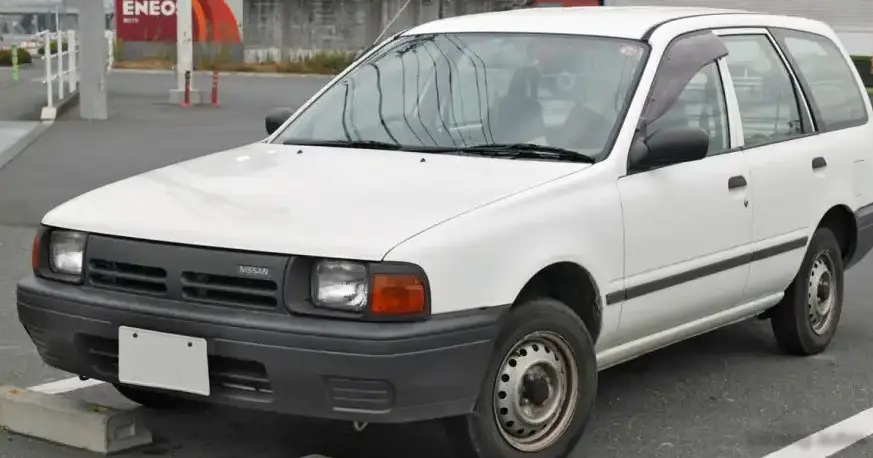
The Nissan AD Y10 1.5i, producing 94 horsepower, was a variant of the Y10 series, a compact station wagon produced by Nissan from 1990 to 1996. Positioned as an entry-level offering within the AD lineup, it served as a practical and affordable vehicle primarily targeted at families and commercial users in the Japanese domestic market (JDM). The AD series, standing for “Active & Dynamic,” was designed to offer a blend of utility, fuel efficiency, and ease of driving, catering to the needs of a broad customer base. This particular 1.5-liter engine and five-speed manual transmission combination represented a balance between cost and usability, making it a popular choice for those seeking a no-frills, reliable workhorse.
Technical Specifications
| Brand | Nissan |
| Model | AD |
| Generation | AD Y10 |
| Type (Engine) | 1.5 i (94 Hp) |
| Start of production | 1990 |
| End of production | 1996 |
| Powertrain Architecture | Internal Combustion engine |
| Body type | Station wagon (estate) |
| Seats | 5 |
| Doors | 5 |
| Fuel Type | Petrol (Gasoline) |
| Power | 94 Hp @ 6000 rpm |
| Power per litre | 62.8 Hp/l |
| Torque | 126 Nm @ 3600 rpm / 92.93 lb.-ft. @ 3600 rpm |
| Engine layout | Front, Transverse |
| Engine displacement | 1497 cm3 / 91.35 cu. in. |
| Number of cylinders | 4 |
| Engine configuration | Inline |
| Cylinder Bore | 73.6 mm / 2.9 in. |
| Piston Stroke | 88 mm / 3.46 in. |
| Compression ratio | 9.5:1 |
| Number of valves per cylinder | 4 |
| Fuel injection system | Carburettor |
| Engine aspiration | Naturally aspirated engine |
| Valvetrain | DOHC |
| Max. weight | 970 kg / 2138.48 lbs |
| Length | 4175 mm / 164.37 in. |
| Width | 1665 mm / 65.55 in. |
| Height | 1480 mm / 58.27 in. |
| Wheelbase | 2400 mm / 94.49 in. |
| Front track | 1445 mm / 56.89 in. |
| Rear (Back) track | 1445 mm / 56.89 in. |
| Ride height (ground clearance) | 140 mm / 5.51 in. |
| Drivetrain Architecture | The Internal combustion engine (ICE) drives the front wheels of the vehicle. |
| Drive wheel | Front wheel drive |
| Number of gears and type of gearbox | 5 gears, manual transmission |
| Front brakes | Ventilated discs |
| Rear brakes | Drum |
Powertrain & Engine Architecture
The heart of the AD Y10 1.5i was the GA15DE engine, a 1.5-liter inline-four cylinder gasoline engine. While later iterations of the GA15 engine would feature multi-point fuel injection, the 1990-1996 AD Y10 utilized a carburetor system, a cost-saving measure for the entry-level trim. This carburetor setup, while simpler, resulted in slightly lower fuel efficiency and emissions compared to fuel-injected counterparts. The engine employed a double overhead camshaft (DOHC) valvetrain with four valves per cylinder, contributing to reasonable power output for its displacement. The GA15DE produced 94 horsepower at 6000 rpm and 126 Nm (93 lb-ft) of torque at 3600 rpm. The engine was transversely mounted in the front of the vehicle, driving the front wheels. The standard transmission was a five-speed manual, offering a direct and engaging driving experience. A three-speed automatic transmission was also available as an option, though it came with a slight performance penalty.
Driving Characteristics
The AD Y10 1.5i with the five-speed manual transmission provided adequate, though not exhilarating, performance. Acceleration was modest, with a focus on fuel economy rather than outright speed. The gear ratios were tuned for everyday usability, prioritizing smooth cruising and ease of driving in urban environments. The carburetor system meant a slightly less responsive throttle compared to fuel-injected engines, but the engine was generally tractable and predictable. The automatic transmission version, while offering convenience, further reduced acceleration and responsiveness. The relatively light weight of the vehicle (around 970 kg or 2138 lbs) helped to mitigate the effects of the modest power output. Handling was typical of a compact station wagon – safe and predictable, but not particularly sporty. The front-wheel-drive configuration provided decent grip in most conditions.
Equipment & Trim Levels
The AD Y10 1.5i was typically equipped with basic amenities, reflecting its position as the entry-level model. Standard features generally included cloth upholstery, a simple dashboard layout with analog gauges, and manual windows and door locks. Air conditioning was often an optional extra. The interior was designed for practicality and durability, with hard-wearing materials used throughout. Higher trim levels, such as the 1.5iX, offered additional features like power windows, central locking, and upgraded interior trim. The AD Y10 was not known for its luxurious appointments, but it provided a comfortable and functional space for passengers and cargo.
Chassis & Braking
The AD Y10 utilized a relatively simple chassis design. The front suspension consisted of MacPherson struts, while the rear suspension employed a twist-beam axle. This setup provided a comfortable ride, but wasn’t particularly sophisticated in terms of handling. The braking system featured ventilated discs on the front wheels and drum brakes on the rear. This configuration was common for vehicles in this price range during the early 1990s. The brakes were adequate for normal driving conditions, but lacked the stopping power of more advanced braking systems. Stabilizer bars were typically fitted to improve handling and reduce body roll.
Market Reception & Comparison
The Nissan AD Y10 1.5i was well-received in the Japanese market as a practical and affordable station wagon. Critics praised its fuel efficiency, reliability, and spacious interior. However, the carburetor-equipped engine was often criticized for its slightly lower performance and emissions compared to fuel-injected alternatives. Compared to other trims in the AD lineup, such as the 1.5iX or the 1.8-liter variants, the 1.5i offered a more budget-friendly option, sacrificing some performance and features for a lower price point. It competed with other compact station wagons from Japanese manufacturers like Toyota and Honda.
Legacy
The Nissan AD Y10 1.5i, while not a particularly groundbreaking vehicle, remains a popular choice among enthusiasts and collectors of JDM cars. The GA15DE engine, despite its carburetor setup, is known for its durability and reliability. Parts availability is generally good, making it relatively easy to maintain and repair. In the used car market, the AD Y10 1.5i is often sought after for its affordability and practicality. It represents a snapshot of Japanese automotive engineering from the early 1990s, offering a simple, honest, and reliable driving experience. The Y10 series as a whole helped solidify Nissan’s reputation for building dependable and versatile vehicles.
