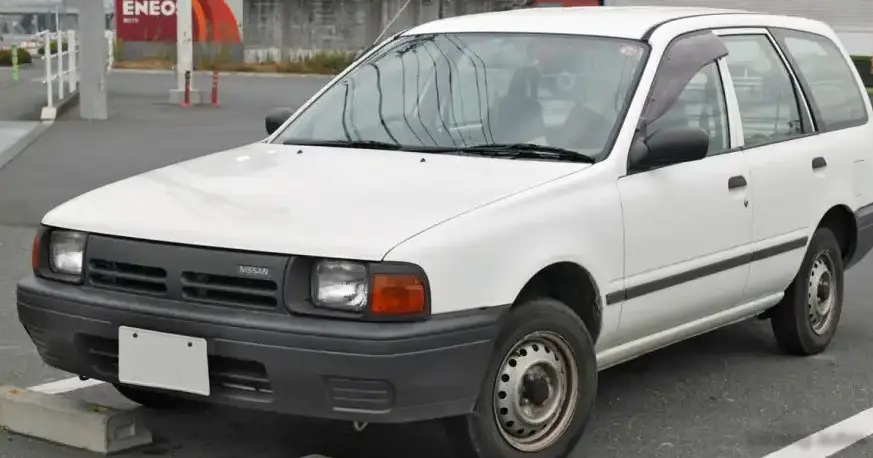
The Nissan AD Y11 1.8i 4×4 Automatic, produced between 1999 and 2006, represents a practical and versatile offering within the broader Y11 series of compact station wagons. The AD, standing for “Active Duty,” was primarily marketed in Japan as a commercial vehicle, often favored by small businesses and families needing a robust and adaptable vehicle. This 1.8-liter, four-wheel-drive, automatic variant occupied a mid-range position in the Y11 lineup, offering a balance between affordability, practicality, and all-weather capability. It was designed to compete with other Japanese-market station wagons like the Toyota Caldina and Mitsubishi Libero, focusing on utility and dependability rather than outright performance or luxury.
Technical Specifications
| Brand | Nissan |
| Model | AD |
| Generation | AD Y11 |
| Type | 1.8i (122 Hp) 4×4 Automatic |
| Start of production | 1999 |
| End of production | 2006 |
| Powertrain Architecture | Internal Combustion engine |
| Body type | Station wagon (estate) |
| Seats | 5 |
| Doors | 5 |
| Fuel Type | Petrol (Gasoline) |
| Power | 122 Hp @ 5600 rpm |
| Power per litre | 69 Hp/l |
| Torque | 165 Nm @ 4400 rpm / 121.7 lb.-ft. @ 4400 rpm |
| Engine layout | Front, Transverse |
| Engine displacement | 1769 cm3 / 107.95 cu. in. |
| Number of cylinders | 4 |
| Engine configuration | Inline |
| Number of valves per cylinder | 4 |
| Fuel injection system | Multi-port manifold injection |
| Engine aspiration | Naturally aspirated engine |
| Max. weight | 1655 kg / 3648.65 lbs |
| Fuel tank capacity | 50 l / 13.21 US gal | 11 UK gal |
| Length | 4370 mm / 172.05 in |
| Width | 1695 mm / 66.73 in |
| Height | 1475 mm / 58.07 in |
| Wheelbase | 2535 mm / 99.8 in |
| Front track | 1480 mm / 58.27 in |
| Rear track | 1440 mm / 56.69 in |
| Ride height (ground clearance) | 145 mm / 5.71 in |
| Drive wheel | All wheel drive (4×4) |
| Number of gears and type of gearbox | 4 gears, automatic transmission |
| Front brakes | Ventilated discs |
| Rear brakes | Drum |
Powertrain & Engine Architecture
The heart of the AD Y11 1.8i 4×4 Automatic is the Nissan QR18DE engine. This 1.8-liter inline-four cylinder engine utilizes a naturally aspirated configuration and multi-point fuel injection. The QR series engines, introduced in the late 1990s, were designed to be compact, lightweight, and efficient. The QR18DE features a dual overhead camshaft (DOHC) design with four valves per cylinder, contributing to its relatively smooth power delivery. While not a high-performance engine, the QR18DE is known for its reliability and ease of maintenance. The engine is paired with a four-speed automatic transmission, a common choice for this class of vehicle in Japan, prioritizing ease of use over sporty driving dynamics. The transmission is electronically controlled, offering smooth shifts but lacking the responsiveness of more modern gearboxes. The 4×4 system is typically a part-time system, engaging the rear wheels when traction is needed, enhancing stability in slippery conditions.
Driving Characteristics
The 122 horsepower and 165 Nm (121.7 lb-ft) of torque produced by the QR18DE engine, coupled with the four-speed automatic transmission, result in a driving experience geared towards practicality rather than excitement. Acceleration is adequate for everyday driving, but overtaking maneuvers require planning. The automatic transmission’s gear ratios are tuned for fuel efficiency and smooth cruising, rather than aggressive acceleration. Compared to the manual transmission versions of the AD Y11, the automatic suffers a slight performance penalty. The all-wheel-drive system provides enhanced traction, particularly on loose surfaces, making it a capable vehicle in inclement weather. The suspension is tuned for comfort, absorbing bumps and providing a relatively smooth ride, although it can feel somewhat soft during spirited cornering. The steering is light and easy to use, making it well-suited for urban driving.
Equipment & Trim Levels
The AD Y11 1.8i 4×4 Automatic typically came equipped with a reasonable level of standard features for its market segment. These included power windows, power door locks, air conditioning, and an AM/FM radio. Higher trim levels, often denoted by suffixes like “RX” or “S,” added features such as alloy wheels, upgraded interior upholstery, a CD player, and optional extras like a sunroof. Interior materials were generally durable and practical, reflecting the vehicle’s commercial orientation. The dashboard layout is functional and straightforward, prioritizing ease of use over aesthetic appeal. Safety features were relatively basic for the period, typically including dual airbags and ABS brakes.
Chassis & Braking
The AD Y11 utilizes a MacPherson strut front suspension and a torsion beam rear suspension. This configuration provides a good balance between ride comfort and handling. The front brakes are ventilated discs, offering adequate stopping power, while the rear brakes are drums, a cost-saving measure common in this class of vehicle. The chassis is relatively lightweight, contributing to the vehicle’s fuel efficiency. Stabilizer bars are present on both the front and rear axles, helping to reduce body roll during cornering. The all-wheel-drive system adds to the vehicle’s weight, but also enhances its stability and traction.
Market Reception & Comparison
The Nissan AD Y11 1.8i 4×4 Automatic was well-received in the Japanese market as a practical and reliable workhorse. Critics praised its fuel efficiency, spacious interior, and all-weather capability. However, it was often criticized for its lack of performance and somewhat basic interior. Compared to other trims in the AD Y11 lineup, the 1.8i 4×4 Automatic offered a good compromise between price and features. The smaller 1.5-liter engine was more affordable but lacked the power of the 1.8-liter, while the larger 2.0-liter engine offered more performance but came at a higher cost. Fuel economy was generally comparable to other vehicles in its class, averaging around 7-9 liters per 100 kilometers (34-39 mpg) in mixed driving conditions.
Legacy
The Nissan AD Y11 series, including the 1.8i 4×4 Automatic variant, has developed a reputation for long-term reliability. The QR18DE engine is known to be durable and relatively trouble-free, provided it receives regular maintenance. In the used car market, these vehicles are often sought after for their affordability and practicality. While they may not offer the latest technology or luxurious features, they remain a viable option for those seeking a dependable and versatile station wagon. Parts availability is generally good, and maintenance costs are relatively low, making them an attractive option for budget-conscious buyers. The Y11 AD continues to be seen on Japanese roads today, a testament to its enduring quality and practicality.