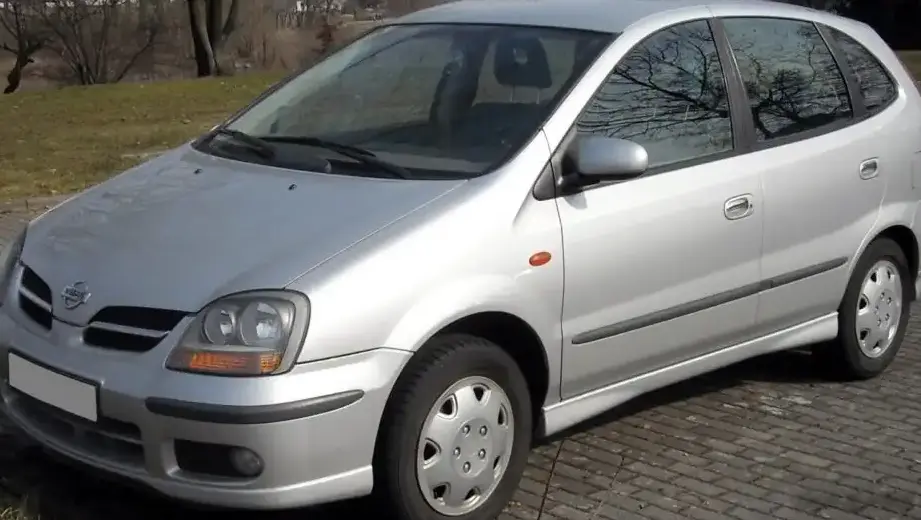
The Nissan Almera Tino 1.8, produced between 2000 and 2003, was a compact minivan marketed primarily in Europe and Japan. Representing Nissan’s entry into the leisure activity vehicle (LAV) segment, the Tino aimed to provide a practical and versatile family vehicle with a focus on interior space and comfort. This particular 1.8-liter variant, generating 114 horsepower, occupied a mid-range position within the Tino lineup, offering a balance between performance and fuel efficiency. It was positioned above the base 1.6-liter models and below the more powerful 1.8L with continuously variable transmission (CVT).
Technical Specifications
| Brand | Nissan |
| Model | Almera |
| Generation | Almera Tino |
| Type (Engine) | 1.8 (114 Hp) |
| Start of production | 2000 |
| End of production | 2003 |
| Powertrain Architecture | Internal Combustion engine |
| Body type | Minivan |
| Seats | 5 |
| Doors | 5 |
| Fuel consumption (urban) | 10.3 l/100 km (22.8 US mpg) |
| Fuel consumption (extra urban) | 6.3 l/100 km (37.3 US mpg) |
| Fuel consumption (combined) | 7.8 l/100 km (30.2 US mpg) |
| Fuel Type | Petrol (Gasoline) |
| Acceleration 0 – 100 km/h | 12.7 sec |
| Acceleration 0 – 62 mph | 12.7 sec |
| Acceleration 0 – 60 mph | 12.1 sec |
| Maximum speed | 173 km/h (107.5 mph) |
| Weight-to-power ratio | 12 kg/Hp |
| Weight-to-torque ratio | 8.7 kg/Nm |
| Power | 114 Hp @ 5600 rpm |
| Torque | 158 Nm @ 2800 rpm (116.53 lb.-ft. @ 2800 rpm) |
| Engine layout | Front, Transverse |
| Engine Model/Code | QG18DE |
| Engine displacement | 1769 cm3 (107.95 cu. in.) |
| Number of cylinders | 4 |
| Engine configuration | Inline |
| Cylinder Bore | 80 mm (3.15 in.) |
| Piston Stroke | 88 mm (3.46 in.) |
| Compression ratio | 9.5:1 |
| Number of valves per cylinder | 4 |
| Fuel injection system | Multi-port manifold injection |
| Engine aspiration | Naturally aspirated |
| Valvetrain | DOHC |
| Engine oil capacity | 2.9 l (3.06 US qt | 2.55 UK qt) |
| Coolant capacity | 6.6 l (6.97 US qt | 5.81 UK qt) |
| Kerb Weight | 1370 kg (3020.33 lbs.) |
| Max. weight | 1830 kg (4034.46 lbs.) |
| Max load | 460 kg (1014.13 lbs.) |
| Trunk (boot) space – minimum | 440 l (15.54 cu. ft.) |
| Trunk (boot) space – maximum | 1950 l (68.86 cu. ft.) |
| Fuel tank capacity | 60 l (15.85 US gal | 13.2 UK gal) |
| Length | 4264 mm (167.87 in.) |
| Width | 1758 mm (69.21 in.) |
| Height | 1608 mm (63.31 in.) |
| Wheelbase | 2535 mm (99.8 in.) |
| Front track | 1535 mm (60.43 in.) |
| Rear track | 1510 mm (59.45 in.) |
| Ride height (ground clearance) | 150 mm (5.91 in.) |
| Drivetrain | Front wheel drive |
| Number of gears | 5 |
| Gearbox type | Manual transmission |
| Front brakes | Ventilated discs |
| Rear brakes | Disc |
| Tires size | 195/65 R15 |
| Wheel rims size | 15 |
INTRODUCTION
The Nissan Almera Tino 1.8, launched in 2000, was a five-door compact minivan built on the Nissan S platform (shared with the Almera hatchback and Sentra). It was designed to appeal to families seeking a more spacious and versatile alternative to traditional hatchbacks. The Tino distinguished itself with its flexible seating arrangements, including individually folding rear seats and a generous cargo capacity. The 1.8-liter engine variant was a key offering, providing a reasonable level of performance for everyday driving while maintaining acceptable fuel economy. Production continued until 2003, with the Tino being discontinued as Nissan shifted its focus towards other models in the compact vehicle segment.
Powertrain & Engine Architecture
The heart of the Almera Tino 1.8 is the QG18DE engine, a 1.8-liter inline-four cylinder gasoline engine. This engine is a naturally aspirated design, meaning it doesn’t utilize a turbocharger or supercharger. It features a double overhead camshaft (DOHC) valvetrain with four valves per cylinder, contributing to its relatively efficient operation. Fuel delivery is managed by a multi-port fuel injection system, ensuring precise fuel metering for optimal combustion. The QG18DE engine produces 114 horsepower at 5600 rpm and 158 Nm (116.53 lb-ft) of torque at 2800 rpm. This engine is known for its reliability and relatively straightforward maintenance requirements. The Tino 1.8 was paired with a five-speed manual transmission, providing drivers with direct control over gear selection. This transmission was chosen for its durability and cost-effectiveness.
Driving Characteristics
The Almera Tino 1.8 with a manual transmission offers a reasonably engaging driving experience for its class. While not particularly sporty, the 114 horsepower engine provides adequate power for everyday driving situations, including highway merging and overtaking. The five-speed manual gearbox allows drivers to keep the engine in its optimal power band, maximizing acceleration. The gear ratios are tuned for fuel efficiency, meaning the engine doesn’t feel overly stressed at cruising speeds. Compared to the base 1.6-liter models, the 1.8-liter variant offers noticeably improved acceleration and overall responsiveness. However, it doesn’t match the performance of the later Tino models equipped with the continuously variable transmission (CVT), which offered smoother acceleration and potentially better fuel economy. The Tino’s suspension is tuned for comfort, providing a relatively smooth ride over uneven road surfaces.
Equipment & Trim Levels
The Almera Tino 1.8 typically came equipped with a reasonable level of standard features. These included power steering, central locking, electric front windows, and an adjustable steering column. Interior upholstery was typically cloth, with a functional and durable design. Higher trim levels offered options such as air conditioning, alloy wheels, a CD player, and upgraded interior trim. The dashboard layout was straightforward and user-friendly, with clearly labeled controls. Safety features included dual front airbags and anti-lock brakes (ABS) on some models. The Tino’s interior was designed with practicality in mind, offering ample storage compartments and a flexible seating arrangement.
Chassis & Braking
The Almera Tino 1.8 utilizes a front-wheel-drive layout with an independent MacPherson strut suspension in the front and a torsion beam suspension in the rear. This suspension setup provides a good balance between ride comfort and handling. The front brakes are ventilated discs, offering good stopping power, while the rear brakes are solid discs. The Tino’s steering is hydraulic power-assisted, providing light and responsive steering feel. The vehicle rides on 15-inch wheels with 195/65 R15 tires, offering a good compromise between comfort and grip. The relatively lightweight construction of the Tino contributes to its nimble handling characteristics.
Market Reception & Comparison
The Nissan Almera Tino 1.8 received generally positive reviews from automotive critics. It was praised for its spacious interior, versatile seating arrangements, and comfortable ride. However, some critics noted that the 1.8-liter engine could feel underpowered when fully loaded or driving uphill. Compared to other compact minivans of the time, such as the Renault Scenic and Citroën Xsara Picasso, the Tino offered a competitive level of practicality and value. In terms of fuel economy, the 1.8-liter variant offered similar figures to its competitors, averaging around 30.2 US mpg in combined driving conditions. Reliability was generally good, with the QG18DE engine proving to be a durable and dependable unit.
Legacy
The Nissan Almera Tino 1.8 has established a reputation as a reliable and practical family vehicle in the used car market. The QG18DE engine is known for its longevity, and with proper maintenance, it can provide many years of trouble-free service. While not a particularly sought-after model among enthusiasts, the Tino 1.8 remains a viable option for buyers seeking an affordable and spacious compact minivan. Parts availability is generally good, and maintenance costs are relatively low. Today, the Almera Tino 1.8 represents a practical and affordable entry point into the world of compact minivans, offering a blend of space, comfort, and reliability.