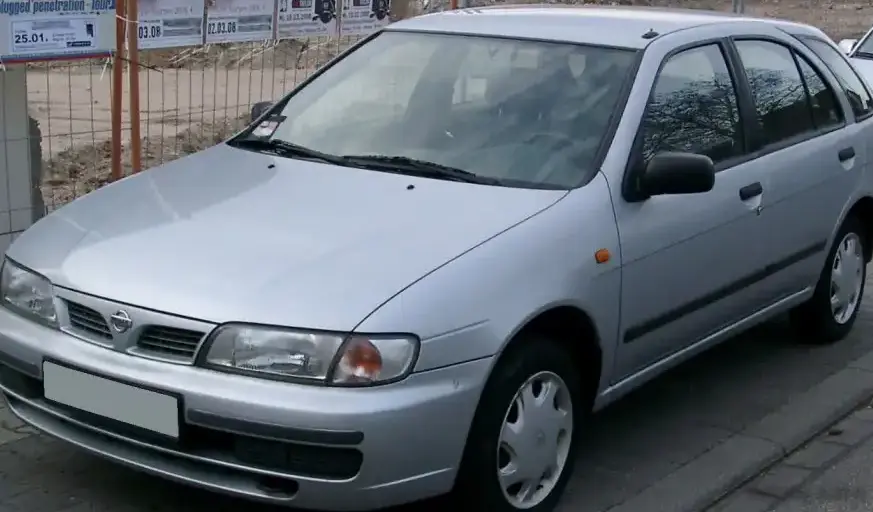
The Nissan Almera Tino (facelift, introduced in 2003) 1.8 represents a mid-cycle refresh of Nissan’s compact minivan, marketed primarily in Europe and Asia. Produced from 2003 to 2006, this variant occupied a middle ground within the Tino lineup, offering a balance between affordability and performance. The Almera Tino, based on the Nissan Sunny/Sentra platform (N16 chassis), aimed to provide a practical and spacious family vehicle in a segment increasingly focused on versatility. This specific 1.8-liter engine and five-speed manual transmission combination was designed to appeal to buyers seeking a more responsive driving experience than the base models, while remaining economical for daily use.
Technical Specifications
| Brand | Nissan |
| Model | Almera |
| Generation | Almera Tino (facelift 2003) |
| Type (Engine) | 1.8 (114 Hp) |
| Start of production | 2003 |
| End of production | 2006 |
| Powertrain Architecture | Internal Combustion engine |
| Body type | Minivan |
| Seats | 5 |
| Doors | 5 |
| Fuel consumption (urban) | 10.3 l/100 km (22.8 US mpg) |
| Fuel consumption (extra urban) | 6.3 l/100 km (37.3 US mpg) |
| Fuel consumption (combined) | 7.8 l/100 km (30.2 US mpg) |
| Fuel Type | Petrol (Gasoline) |
| Acceleration 0 – 100 km/h | 12.7 sec |
| Acceleration 0 – 62 mph | 12.7 sec |
| Acceleration 0 – 60 mph | 12.1 sec |
| Maximum speed | 173 km/h (107.5 mph) |
| Weight-to-power ratio | 12 kg/Hp |
| Weight-to-torque ratio | 8.7 kg/Nm |
| Power | 114 Hp @ 5600 rpm |
| Torque | 158 Nm @ 2800 rpm (116.53 lb.-ft. @ 2800 rpm) |
| Engine layout | Front, Transverse |
| Engine Model/Code | QG18DE |
| Engine displacement | 1769 cm3 (107.95 cu. in.) |
| Number of cylinders | 4 |
| Engine configuration | Inline |
| Cylinder Bore | 80 mm (3.15 in.) |
| Piston Stroke | 88 mm (3.46 in.) |
| Compression ratio | 9.5:1 |
| Number of valves per cylinder | 4 |
| Fuel injection system | Multi-port manifold injection |
| Engine aspiration | Naturally aspirated |
| Valvetrain | DOHC |
| Engine oil capacity | 2.9 l (3.06 US qt | 2.55 UK qt) |
| Coolant capacity | 6.6 l (6.97 US qt | 5.81 UK qt) |
| Kerb Weight | 1370 kg (3020.33 lbs.) |
| Max. weight | 1830 kg (4034.46 lbs.) |
| Max load | 460 kg (1014.13 lbs.) |
| Trunk (boot) space – minimum | 440 l (15.54 cu. ft.) |
| Trunk (boot) space – maximum | 1950 l (68.86 cu. ft.) |
| Fuel tank capacity | 60 l (15.85 US gal | 13.2 UK gal) |
| Length | 4264 mm (167.87 in.) |
| Width | 1758 mm (69.21 in.) |
| Height | 1611 mm (63.43 in.) |
| Wheelbase | 2535 mm (99.8 in.) |
| Front track | 1535 mm (60.43 in.) |
| Rear track | 1510 mm (59.45 in.) |
| Ride height (ground clearance) | 150 mm (5.91 in.) |
| Drivetrain | Front wheel drive |
| Number of gears | 5 |
| Gearbox type | Manual transmission |
| Front brakes | Ventilated discs |
| Rear brakes | Disc |
| Tires size | 195/65 R15 |
| Wheel rims size | 15 |
Powertrain & Engine Architecture
The heart of the Almera Tino 1.8 is the QG18DE engine, a 1.8-liter inline-four cylinder gasoline engine. This engine is part of Nissan’s QG series, known for its relatively simple design and durability. The QG18DE features a dual overhead camshaft (DOHC) valvetrain with four valves per cylinder, contributing to improved breathing and power output. Fuel delivery is managed by a multi-port fuel injection system, providing precise fuel metering for optimal combustion. The engine produces 114 horsepower at 5600 rpm and 158 Nm (116.53 lb-ft) of torque at 2800 rpm. This power is then sent to the front wheels through a five-speed manual transmission. The transmission’s gear ratios are tuned for a balance of acceleration and fuel efficiency, offering a reasonably engaging driving experience.
Driving Characteristics
The 1.8-liter engine provides a noticeable step up in performance compared to the lower-displacement engines offered in the Almera Tino range. While not a sports car, the 1.8 delivers adequate acceleration for everyday driving and highway merging. The five-speed manual transmission allows drivers to maintain optimal engine speed for various driving conditions. The gear ratios are spaced to provide good responsiveness, although the engine can feel slightly strained at very high RPMs. Compared to the automatic transmission options, the manual version offers more control and a more direct connection to the engine. The Almera Tino 1.8’s handling is generally considered safe and predictable, but not particularly sporty. The suspension is tuned for comfort, absorbing bumps and imperfections in the road reasonably well.
Equipment & Trim Levels
The Almera Tino 1.8 typically came equipped with a reasonable level of standard features. These included power windows, central locking, air conditioning, and an audio system. Higher trim levels added features such as alloy wheels, a sunroof, and upgraded interior upholstery. The interior design is functional and practical, with a focus on maximizing space. The dashboard layout is straightforward and easy to use. Optional extras included features like a CD changer, navigation system, and upgraded sound system.
Chassis & Braking
The Almera Tino utilizes a front-wheel-drive chassis with independent suspension in the front and a torsion beam setup in the rear. The front suspension consists of MacPherson struts, while the rear utilizes a semi-independent torsion beam. This configuration provides a good balance of ride comfort and handling. Braking duties are handled by ventilated discs on the front wheels and solid discs on the rear. The braking system is adequate for everyday use, but lacks the stopping power of more performance-oriented vehicles. The vehicle’s weight of approximately 1370 kg (3020 lbs) contributes to its moderate braking performance.
Market Reception & Comparison
The Almera Tino 1.8 was generally well-received by automotive critics as a practical and affordable family vehicle. It was praised for its spacious interior, comfortable ride, and relatively fuel-efficient engine. However, some critics noted that the engine lacked outright power and that the handling was not particularly engaging. Compared to other compact minivans in the European market, such as the Renault Scenic and Citroën Xsara Picasso, the Almera Tino offered a competitive level of features and value. The 1.8-liter engine provided a good balance between performance and fuel economy, making it a popular choice for buyers who wanted a more responsive driving experience than the base models.
Legacy
The Nissan Almera Tino 1.8, while not a groundbreaking vehicle, has proven to be a reliable and durable option in the used car market. The QG18DE engine is known for its longevity, and with proper maintenance, can provide many years of trouble-free service. The Almera Tino’s spacious interior and practical design continue to appeal to buyers looking for an affordable and versatile family vehicle. While it may not offer the latest technology or the most exciting driving experience, the Almera Tino 1.8 remains a solid and dependable choice for those seeking a no-frills, practical minivan.