
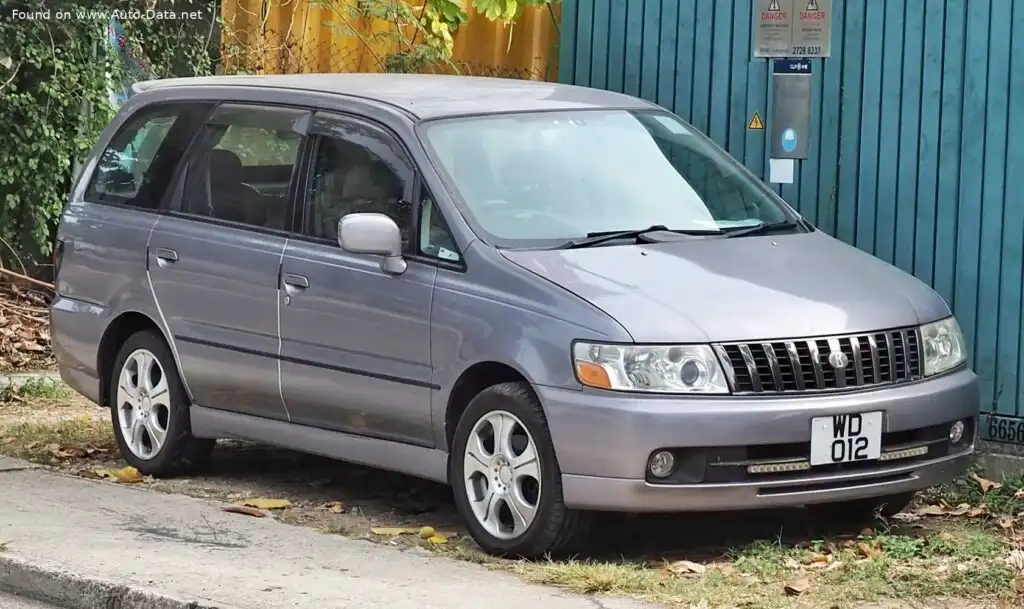
The Nissan Bassara 3.0i V6 24V Automatic, produced between 1999 and 2002, represents a significant offering in Nissan’s lineup of family vehicles. Primarily marketed in Japan, the Bassara was a large-class minivan designed to provide spacious and comfortable transportation for families. This particular variant, equipped with the VQ30DE 3.0-liter V6 engine and a four-speed automatic transmission, occupied a premium position within the Bassara range, offering a balance of performance and convenience. It was positioned above the smaller-engined models and aimed at buyers seeking a more refined driving experience.
Technical Specifications
| Brand | Nissan |
| Model | Bassara |
| Generation | Bassara |
| Type (Engine) | 3.0i V6 24V (220 Hp) Automatic |
| Start of production | 1999 year |
| End of production | 2002 year |
| Powertrain Architecture | Internal Combustion engine |
| Body type | Minivan |
| Seats | 7 |
| Doors | 5 |
| Fuel consumption (economy) – combined | 10.8 l/100 km |
| Fuel consumption (economy) – combined | 21.8 US mpg |
| Fuel consumption (economy) – combined | 26.2 UK mpg |
| Fuel consumption (economy) – combined | 9.3 km/l |
| Fuel Type | Petrol (Gasoline) |
| Weight-to-power ratio | 7.4 kg/Hp |
| Weight-to-power ratio | 135.8 Hp/tonne |
| Weight-to-torque ratio | 5.8 kg/Nm |
| Weight-to-torque ratio | 172.2 Nm/tonne |
| Power | 220 Hp @ 6400 rpm |
| Power per litre | 73.7 Hp/l |
| Torque | 279 Nm @ 4400 rpm |
| Torque | 205.78 lb.-ft. @ 4400 rpm |
| Engine layout | Front, Transverse |
| Engine displacement | 2987 cm3 |
| Engine displacement | 182.28 cu. in. |
| Number of cylinders | 6 |
| Engine configuration | V-engine |
| Cylinder Bore | 93 mm |
| Cylinder Bore | 3.66 in. |
| Piston Stroke | 73.3 mm |
| Piston Stroke | 2.89 in. |
| Compression ratio | 10:1 |
| Number of valves per cylinder | 4 |
| Fuel injection system | Multi-port manifold injection |
| Engine aspiration | Naturally aspirated engine |
| Valvetrain | DOHC |
| Kerb Weight | 1620 kg |
| Kerb Weight | 3571.49 lbs |
| Max. weight | 2005 kg |
| Max. weight | 4420.27 lbs |
| Max load | 385 kg |
| Max load | 848.78 lbs |
| Fuel tank capacity | 65 l |
| Fuel tank capacity | 17.17 US gal |
| Fuel tank capacity | 14.3 UK gal |
| Length | 4795 mm |
| Length | 188.78 in. |
| Width | 1770 mm |
| Width | 69.69 in. |
| Height | 1725 mm |
| Height | 67.91 in. |
| Wheelbase | 2800 mm |
| Wheelbase | 110.24 in. |
| Front track | 1535 mm |
| Front track | 60.43 in. |
| Rear (Back) track | 1520 mm |
| Rear (Back) track | 59.84 in. |
| Ride height (ground clearance) | 150 mm |
| Ride height (ground clearance) | 5.91 in. |
| Drivetrain Architecture | The Internal combustion engine (ICE) drives the front wheels of the vehicle. |
| Drive wheel | Front wheel drive |
| Number of gears and type of gearbox | 4 gears, automatic transmission |
| Front suspension | Coil spring |
| Rear suspension | Coil spring |
| Front brakes | Ventilated discs |
| Rear brakes | Disc |
| Assisting systems | ABS (Anti-lock braking system) |
| Steering type | Steering rack and pinion |
| Power steering | Hydraulic Steering |
| Tires size | 215/60 R16 |
| Wheel rims size | 16 |
Powertrain & Engine Architecture
The heart of the Bassara 3.0i is Nissan’s VQ30DE engine, a 3.0-liter (2987 cc) naturally aspirated V6. This engine is a member of the highly regarded VQ engine family, known for its smooth operation, reliability, and relatively high output. The VQ30DE features a double overhead camshaft (DOHC) valvetrain with four valves per cylinder, and utilizes multi-port fuel injection. The engine produces 220 horsepower at 6400 rpm and 279 Nm (205.78 lb-ft) of torque at 4400 rpm. The engine’s design prioritizes a broad torque curve, making it well-suited for the demands of a family minivan. Paired with the engine is a four-speed automatic transmission, chosen for its ease of use and suitability for comfortable cruising. While not offering the quickest acceleration, this transmission provided smooth shifts and adequate performance for everyday driving.
Driving Characteristics
The Bassara 3.0i Automatic delivers a comfortable and relaxed driving experience. The four-speed automatic transmission, while not as sophisticated as modern multi-gear units, provides smooth and predictable shifts. Acceleration is adequate for merging onto highways and overtaking, but it’s not a particularly sporty vehicle. The focus is on providing a comfortable ride and ample space for passengers and cargo. Compared to the lower-powered 2.0-liter and 2.4-liter versions of the Bassara, the 3.0i offers a noticeable improvement in performance, particularly when fully loaded with passengers and luggage. The automatic transmission does diminish some of the engine’s potential, as a manual transmission would offer more direct control and potentially slightly better fuel economy.
Equipment & Trim Levels
The 3.0i trim level of the Bassara typically included a generous array of standard features. These often included power windows, power locks, air conditioning, and an upgraded audio system. Higher-spec versions could be equipped with features like leather upholstery, woodgrain interior trim, and a sunroof. The Bassara was designed with family comfort in mind, so features like rear climate control vents and multiple cupholders were common. Optional extras often included a navigation system (a relatively new technology at the time) and upgraded sound systems.
Chassis & Braking
The Bassara utilizes a front-engine, front-wheel-drive layout. Suspension consists of coil springs on all four wheels, providing a comfortable ride. The front suspension features a MacPherson strut design, while the rear utilizes a multi-link setup. Braking duties are handled by ventilated discs at the front and solid discs at the rear. An Anti-lock Braking System (ABS) was standard equipment, enhancing safety. The steering system is a rack-and-pinion setup with hydraulic power assistance, providing light and easy steering feel.
Market Reception & Comparison
The Nissan Bassara 3.0i was generally well-received in the Japanese market as a spacious and comfortable family minivan. Critics praised its smooth engine, comfortable ride, and generous interior space. However, some noted that the four-speed automatic transmission felt somewhat dated compared to newer transmissions with more gears. Fuel economy, at 10.8 l/100 km (21.8 US mpg), was typical for a vehicle of this size and engine displacement. Compared to other minivans in its class, such as the Toyota Estima and Honda Odyssey, the Bassara offered a competitive level of features and performance, often at a slightly lower price point.
Legacy
The Nissan Bassara, while not a globally recognized model, remains a popular choice among used car buyers in Japan. The VQ30DE engine is known for its durability and reliability, and with proper maintenance, can provide many years of service. The four-speed automatic transmission is also generally reliable, although it may require servicing as it ages. Today, the Bassara 3.0i represents a comfortable and affordable option for families seeking a spacious and well-equipped minivan. Its relatively simple mechanical design makes it easier and less expensive to maintain compared to more modern vehicles with complex electronic systems.
