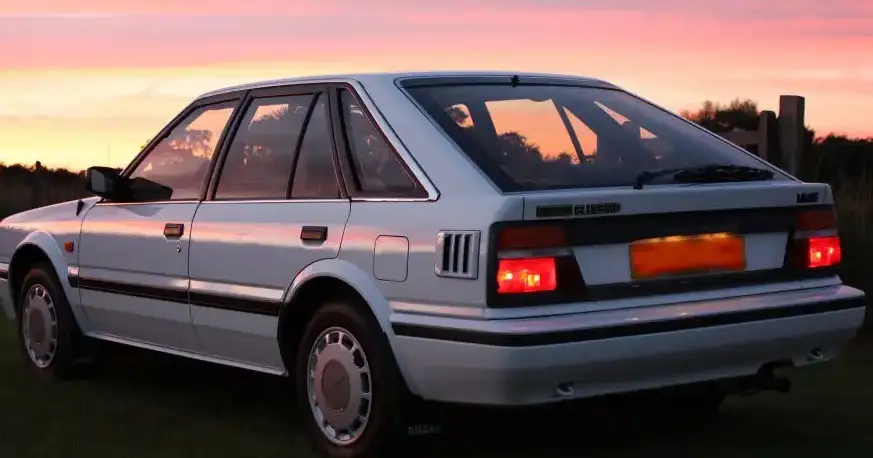
The Nissan Bluebird U12, produced between 1987 and 1991, represented a significant evolution of Nissan’s long-running Bluebird lineage. This generation, sold primarily in Japan, Australia, and select Asian markets, aimed to offer a comfortable and reliable family sedan. Within the U12 range, the 2.0 D variant, equipped with a 67 horsepower diesel engine and a four-speed automatic transmission, occupied a specific niche – offering fuel economy and ease of use, albeit with modest performance. It was positioned as a practical, no-frills option within the Bluebird lineup, appealing to buyers prioritizing efficiency over outright speed.
Technical Specifications
| Brand | Nissan |
| Model | Bluebird |
| Generation | Bluebird (U12) |
| Type (Engine) | 2.0 D (67 Hp) Automatic |
| Start of production | 1987 |
| End of production | 1991 |
| Powertrain Architecture | Internal Combustion engine |
| Body type | Sedan |
| Seats | 5 |
| Doors | 4 |
| Fuel consumption (urban) | 7.4 l/100 km (31.8 US mpg, 38.2 UK mpg, 13.5 km/l) |
| Fuel Type | Diesel |
| Power | 67 Hp |
| Power per litre | 33.9 Hp/l |
| Engine displacement | 1974 cm3 (120.46 cu. in.) |
| Number of cylinders | 4 |
| Engine configuration | Inline |
| Number of valves per cylinder | 2 |
| Fuel injection system | Precombustion chamber injection |
| Engine aspiration | Naturally aspirated engine |
| Valvetrain | OHC |
| Fuel tank capacity | 60 l (15.85 US gal, 13.2 UK gal) |
| Length | 4520 mm (177.95 in.) |
| Width | 1690 mm (66.54 in.) |
| Height | 1375 mm (54.13 in.) |
| Wheelbase | 2550 mm (100.39 in.) |
| Front track | 1460 mm (57.48 in.) |
| Rear track | 1440 mm (56.69 in.) |
| Minimum turning circle | 10 m (32.81 ft.) |
| Drivetrain Architecture | Front wheel drive, Internal Combustion Engine |
| Number of gears | 4 |
| Gearbox type | Automatic transmission |
| Front brakes | Ventilated discs |
| Rear brakes | Drum |
Powertrain & Engine Architecture
The heart of the Bluebird 2.0 D Automatic was the Nissan LD20 diesel engine. This 1,974 cc inline-four cylinder engine utilized a precombustion chamber injection system, a common design for diesel engines of the era. This system involved injecting fuel into a precombustion chamber connected to the main cylinder, promoting more complete combustion and reducing noise. The LD20 featured a single overhead camshaft (OHC) operating two valves per cylinder. While not a high-performance engine, the LD20 was known for its durability and relatively smooth operation for a diesel. The four-speed automatic transmission was a conventional hydraulic unit, chosen for its simplicity and ease of use. It wasn’t designed for rapid shifts, prioritizing smooth engagement and fuel efficiency over sporty responsiveness.
Driving Characteristics
The 67 horsepower output of the LD20 diesel, coupled with the four-speed automatic, resulted in modest acceleration. The Bluebird 2.0 D Automatic was not a vehicle designed for spirited driving. Acceleration from a standstill was leisurely, and overtaking required careful planning. The automatic transmission’s gear ratios were optimized for fuel economy, meaning the engine often operated at lower RPMs. This contributed to a quiet cabin experience but also limited the vehicle’s ability to climb hills or accelerate quickly when loaded. Compared to the gasoline-powered Bluebird variants, the diesel offered significantly less power, but it compensated with superior fuel economy and a broader torque curve, making it more tractable in everyday driving situations. A manual transmission option was available on other Bluebird models, offering a more engaging driving experience, but the automatic was favored by those seeking convenience.
Equipment & Trim Levels
The 2.0 D Automatic trim level of the U12 Bluebird typically represented a mid-range offering. Standard equipment generally included cloth upholstery, a basic AM/FM radio, and manual windows and door locks. Air conditioning was often an optional extra, as were power windows and central locking. The dashboard layout was functional and straightforward, prioritizing usability over aesthetic flair. Interior trim materials were durable but not luxurious. The Bluebird aimed to provide a comfortable and practical interior without excessive frills. Higher trim levels within the U12 range offered features like upgraded audio systems, velour upholstery, and more comprehensive instrumentation.
Chassis & Braking
The U12 Bluebird featured a conventional front-engine, front-wheel-drive layout. The suspension consisted of MacPherson struts at the front and a twist-beam rear axle. This setup provided a comfortable ride, although it wasn’t particularly sporty. The front brakes were ventilated discs, offering adequate stopping power, while the rear brakes were drums, a cost-saving measure common in this class of vehicle. The steering was power-assisted, making it relatively easy to maneuver in urban environments. Stabilizer bars were typically fitted to both the front and rear axles to reduce body roll during cornering, but the overall handling characteristics were geared towards comfort and stability rather than dynamic performance.
Market Reception & Comparison
The Nissan Bluebird U12 2.0 D Automatic was generally well-received in markets where fuel economy was a primary concern. Critics praised its reliability and low running costs, but acknowledged its lack of performance. Compared to other diesel-powered sedans of the time, such as the Toyota Corolla Diesel, the Bluebird offered a similar level of practicality and fuel efficiency. However, the Corolla often had a reputation for even greater reliability. Within the Bluebird lineup, the 2.0 D Automatic appealed to a different demographic than the gasoline-powered models. It was favored by drivers who prioritized economy and ease of use over performance and driving enjoyment. The gasoline engines offered more power and a more refined driving experience, but at the cost of increased fuel consumption.
Legacy
The LD20 diesel engine, found in the Bluebird 2.0 D Automatic, proved to be a remarkably durable and long-lasting powerplant. Many examples of this engine are still in service today, testament to its robust construction and relatively simple design. While not particularly sophisticated by modern standards, the LD20 was a reliable workhorse. In the used car market, U12 Bluebirds with the 2.0 D Automatic transmission are often sought after by those looking for an affordable and dependable classic car. Maintenance is generally straightforward, and parts availability, while diminishing, remains reasonable. The Bluebird U12 2.0 D Automatic represents a practical and economical choice from a bygone era of automotive engineering, offering a glimpse into the priorities of car buyers in the late 1980s and early 1990s.