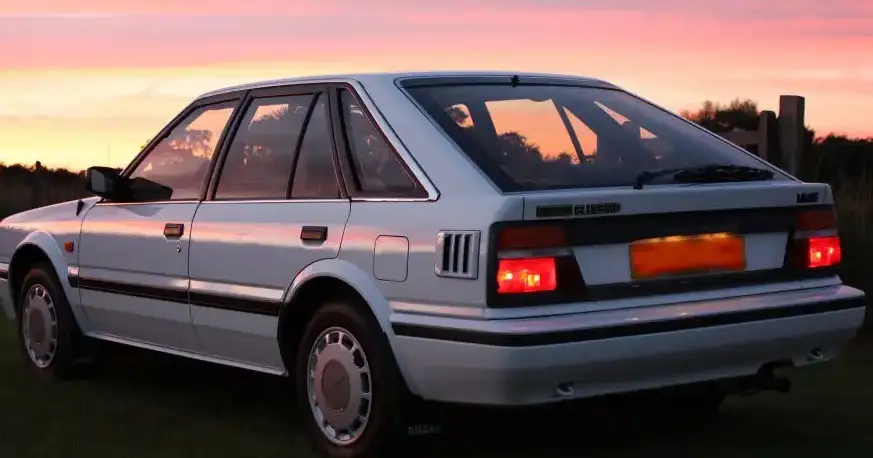
The Nissan Bluebird U13, produced between 1991 and 1996, represented a significant evolution for Nissan’s long-running Bluebird line. This generation, sold primarily in Japan and select export markets, aimed to blend comfort, practicality, and a degree of sporting performance. The 2.0T variant, equipped with a turbocharged four-cylinder engine and a four-speed automatic transmission, occupied a premium position within the U13 range, offering a step up in power and refinement compared to the naturally aspirated models. It was positioned as a comfortable and relatively quick family sedan, appealing to buyers who desired a more engaging driving experience without sacrificing everyday usability.
Technical Specifications
| Brand | Nissan |
| Model | Bluebird |
| Generation | Bluebird (U13) |
| Type (Engine) | 2.0T (211 Hp) Automatic |
| Start of production | 1991 |
| End of production | 1996 |
| Powertrain Architecture | Internal Combustion engine |
| Body type | Sedan |
| Seats | 5 |
| Doors | 4 |
| Fuel Type | Petrol (Gasoline) |
| Power | 211 Hp @ 6000 rpm |
| Power per litre | 105.6 Hp/l |
| Torque | 275 Nm @ 4000 rpm |
| Torque (lb.-ft.) | 202.83 lb.-ft. @ 4000 rpm |
| Engine layout | Front, Transverse |
| Engine displacement | 1998 cm3 |
| Engine displacement (cu. in.) | 121.93 cu. in. |
| Number of cylinders | 4 |
| Engine configuration | Inline |
| Cylinder Bore | 86 mm |
| Cylinder Bore (in.) | 3.39 in. |
| Piston Stroke | 86 mm |
| Piston Stroke (in.) | 3.39 in. |
| Compression ratio | 10:1 |
| Number of valves per cylinder | 4 |
| Fuel injection system | Multi-port manifold injection |
| Engine aspiration | Turbocharger |
| Fuel tank capacity | 60 l |
| Fuel tank capacity (US gal) | 15.85 US gal |
| Fuel tank capacity (UK gal) | 13.2 UK gal |
| Length | 4585 mm |
| Length (in.) | 180.51 in. |
| Width | 1695 mm |
| Width (in.) | 66.73 in. |
| Height | 1405 mm |
| Height (in.) | 55.31 in. |
| Wheelbase | 2620 mm |
| Wheelbase (in.) | 103.15 in. |
| Front track | 1465 mm |
| Front track (in.) | 57.68 in. |
| Rear track | 1455 mm |
| Rear track (in.) | 57.28 in. |
| Ride height (ground clearance) | 160 mm |
| Ride height (ground clearance) (in.) | 6.3 in. |
| Drivetrain Architecture | The Internal combustion engine (ICE) drives the front wheels of the vehicle. |
| Drive wheel | Front wheel drive |
| Number of gears | 4 |
| Gearbox type | automatic transmission |
| Front brakes | Ventilated discs |
| Rear brakes | Disc |
| Steering type | Steering rack and pinion |
Powertrain & Engine Architecture
The heart of the Bluebird 2.0T was Nissan’s SR20DET engine, a 1998cc, inline-four cylinder powerplant. This engine was a derivative of the SR20DE, but distinguished by the addition of a Garrett turbocharger and an intercooler. The SR20DET featured multi-port fuel injection and a 10:1 compression ratio. The turbocharger significantly boosted power output, delivering 211 horsepower at 6000 rpm and 275 Nm (202.83 lb-ft) of torque at 4000 rpm. The engine’s robust bottom end and well-engineered cylinder head contributed to its durability and tunability. The four-speed automatic transmission, while providing convenience, was a conventional torque converter type, and wasn’t known for particularly quick shifts compared to manual transmissions available in other Bluebird variants. It was designed for smooth operation and reliability rather than outright performance.
Driving Characteristics
The 2.0T automatic Bluebird offered a noticeably more spirited driving experience than its naturally aspirated counterparts. While the automatic transmission did detract somewhat from the engine’s potential, the readily available torque from the turbocharger provided strong acceleration in everyday driving situations. The gear ratios were tuned for comfortable cruising, but kickdown response could be a little sluggish. Compared to the five-speed manual transmission available on some Bluebird models, the automatic version felt less engaging and slightly slower in terms of acceleration. However, the automatic provided a more relaxed driving experience, particularly in urban traffic. The front-wheel-drive configuration offered predictable handling, although it wasn’t as balanced as a rear-wheel-drive setup.
Equipment & Trim Levels
The 2.0T automatic trim typically included features such as power windows, power locks, air conditioning, and a decent audio system. Interior upholstery was usually cloth, although leather options were sometimes available. The dashboard layout was functional and straightforward, with easy-to-read gauges. Optional extras could include a sunroof, upgraded audio systems, and alloy wheels. The 2.0T often featured a slightly more refined interior trim compared to the base models, with higher-quality materials and additional sound insulation. The overall focus was on providing a comfortable and well-equipped cabin for both driver and passengers.
Chassis & Braking
The U13 Bluebird utilized a MacPherson strut front suspension and a multi-link rear suspension. The 2.0T variant typically featured slightly stiffer springs and dampers compared to the lower-spec models to better manage the increased power. Front brakes were ventilated discs, providing adequate stopping power, while rear brakes were solid discs. The steering was rack and pinion, offering precise and responsive control. Stabilizer bars were fitted to both the front and rear axles to reduce body roll during cornering. The chassis was designed to provide a comfortable ride while maintaining reasonable handling characteristics.
Market Reception & Comparison
The Bluebird 2.0T automatic was generally well-received by critics as a capable and comfortable family sedan. It was praised for its strong engine performance and refined interior. However, some reviewers noted that the automatic transmission held the engine back from reaching its full potential. Compared to other turbocharged sedans of the era, such as the Toyota Camry 2.2, the Bluebird 2.0T offered a more engaging driving experience. Fuel economy was reasonable for a turbocharged engine, but not class-leading. Reliability was generally good, although the turbocharger did require regular maintenance.
Legacy
The Nissan Bluebird U13 2.0T remains a popular choice among enthusiasts and collectors. The SR20DET engine is highly regarded for its tunability and durability, and many examples have been modified for increased performance. The automatic transmission, while not as desirable as the manual, is still considered reliable. Finding well-maintained examples can be challenging, as many have been driven hard or neglected over the years. However, the Bluebird 2.0T continues to offer a unique blend of comfort, performance, and affordability in the used car market. Its status as a capable and well-engineered sedan has ensured its continued appeal to those seeking a classic Japanese car with a bit of extra punch.