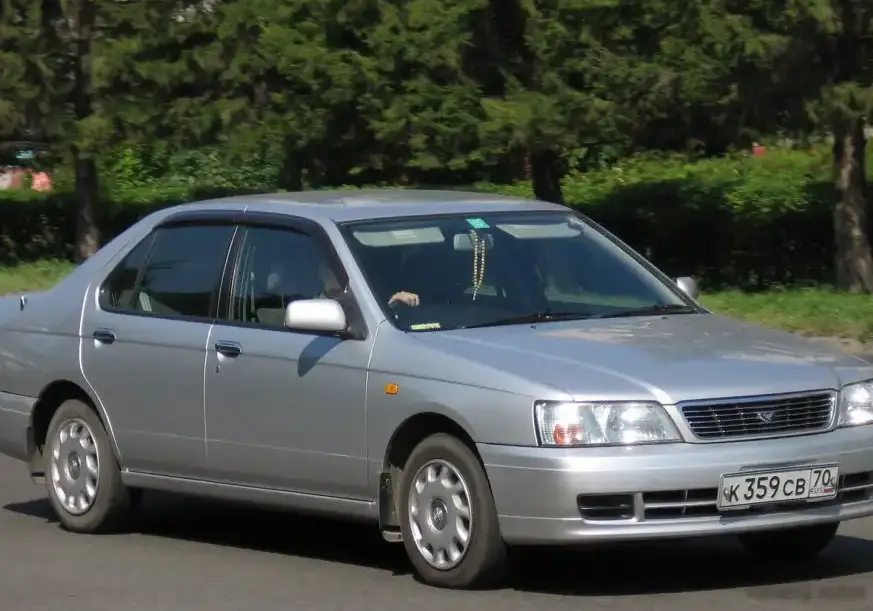
The Nissan Bluebird U14 2.0d Automatic, produced between 1996 and 1998, represented a practical and economical offering within the broader Bluebird (U14) range. Positioned as a diesel-powered variant, it catered to buyers prioritizing fuel efficiency and durability over outright performance. The U14 generation Bluebird, sold primarily in Japan, Australia, and select Asian markets, aimed to provide comfortable and reliable transportation for families. This 2.0d Automatic trim served as a mid-range option, offering a balance between affordability and convenience, though it was often overshadowed by the more popular gasoline-powered models.
Technical Specifications
| Brand | Nissan |
| Model | Bluebird |
| Generation | Bluebird (U14) |
| Type (Engine) | 2.0d (76 Hp) Automatic |
| Start of production | 1996 |
| End of production | 1998 |
| Powertrain Architecture | Internal Combustion engine |
| Body type | Sedan |
| Seats | 5 |
| Doors | 4 |
| Fuel consumption (urban) | 7.5-9.9 l/100 km (31.4 – 23.8 US mpg, 37.7 – 28.5 UK mpg, 13.3 – 10.1 km/l) |
| Fuel consumption (extra urban) | 5.7-7.5 l/100 km (41.3 – 31.4 US mpg, 49.6 – 37.7 UK mpg, 17.5 – 13.3 km/l) |
| Fuel consumption (combined) | 7.4 l/100 km (31.8 US mpg, 38.2 UK mpg, 13.5 km/l) |
| Fuel Type | Diesel |
| Acceleration 0 – 100 km/h | 18.7 sec |
| Acceleration 0 – 62 mph | 18.7 sec |
| Acceleration 0 – 60 mph | 17.8 sec |
| Maximum speed | 162 km/h (100.66 mph) |
| Weight-to-power ratio | 16.2 kg/Hp, 61.8 Hp/tonne |
| Weight-to-torque ratio | 9.3 kg/Nm, 107.3 Nm/tonne |
| Power | 76 Hp @ 4800 rpm |
| Power per litre | 38.5 Hp/l |
| Torque | 132 Nm @ 2800 rpm (97.36 lb.-ft. @ 2800 rpm) |
| Engine layout | Front, Transverse |
| Engine Model/Code | CD20 |
| Engine displacement | 1974 cm3 (120.46 cu. in.) |
| Number of cylinders | 4 |
| Engine configuration | Inline |
| Cylinder Bore | 84.5 mm (3.33 in.) |
| Piston Stroke | 88 mm (3.46 in.) |
| Compression ratio | 22.2:1 |
| Number of valves per cylinder | 2 |
| Fuel injection system | Precombustion chamber injection |
| Engine aspiration | Naturally aspirated engine |
| Valvetrain | SOHC |
| Kerb Weight | 1230 kg (2711.69 lbs.) |
| Fuel tank capacity | 60 l (15.85 US gal | 13.2 UK gal) |
| Length | 4565 mm (179.72 in.) |
| Width | 1695 mm (66.73 in.) |
| Height | 1395 mm (54.92 in.) |
| Wheelbase | 2600 mm (102.36 in.) |
| Front track | 1465 mm (57.68 in.) |
| Rear track | 1455 mm (57.28 in.) |
| Ride height (ground clearance) | 140 mm (5.51 in.) |
| Drag coefficient (Cd) | 0.32 |
| Minimum turning circle | 10.4 m (34.12 ft.) |
| Drivetrain Architecture | The Internal combustion engine (ICE) drives the front wheels of the vehicle. |
| Drive wheel | Front wheel drive |
| Number of gears | 4 |
| Gearbox type | automatic transmission |
| Front brakes | Ventilated discs |
| Rear brakes | Drum |
| Steering type | Steering rack and pinion |
| Tires size | 175/70 R14 |
| Wheel rims size | 14 |
Powertrain & Engine Architecture
The heart of the Bluebird U14 2.0d Automatic was the CD20 diesel engine, a 1974cc inline-four cylinder unit. This engine utilized a precombustion chamber injection system, a common technology for diesel engines of the era, designed to improve combustion efficiency and reduce noise. The CD20 featured a single overhead camshaft (SOHC) valvetrain, operating two valves per cylinder. While not a high-performance engine, the CD20 was known for its robustness and relatively simple mechanical design. The four-speed automatic transmission was a conventional hydraulic unit, prioritizing smooth shifts and ease of use over sporty responsiveness. The transmission’s gear ratios were geared towards maximizing fuel economy rather than acceleration.
Driving Characteristics
The 2.0d Automatic variant of the Bluebird U14 offered a decidedly unhurried driving experience. With only 76 horsepower and 132 Nm of torque, acceleration was slow, taking nearly 19 seconds to reach 62 mph. The automatic transmission, while convenient, further muted any sense of urgency. However, the engine’s torque characteristics made it reasonably tractable for everyday driving, particularly in urban environments. Compared to the gasoline-powered Bluebird models, the diesel offered significantly better fuel economy, but at the expense of performance. Manual transmission versions of the 2.0d, while rare, provided slightly improved responsiveness due to the elimination of transmission losses.
Equipment & Trim Levels
The 2.0d Automatic trim typically included basic amenities such as power steering, central locking, and air conditioning. Interior upholstery was generally cloth, with a functional, if somewhat spartan, dashboard layout. Optional extras could include power windows, upgraded audio systems, and alloy wheels. The overall interior design prioritized practicality and durability over luxury. The trim level sat in the middle of the Bluebird range, offering more features than the base models but lacking the premium appointments found in higher-spec versions.
Chassis & Braking
The Bluebird U14 featured a conventional front-wheel-drive chassis with MacPherson strut front suspension and a torsion beam rear axle. The front brakes were ventilated discs, providing adequate stopping power, while the rear brakes were drums, a cost-saving measure common in this class of vehicle. Stabilizer bars were fitted to both the front and rear axles to reduce body roll during cornering. The suspension tuning was geared towards comfort, resulting in a relatively soft ride quality. The 175/70 R14 tires provided a reasonable balance between grip and ride comfort.
Market Reception & Comparison
The Nissan Bluebird U14 2.0d Automatic was generally well-received as a practical and economical family car. Critics praised its fuel efficiency and reliability, but noted its lack of performance. Compared to other diesel-powered sedans of the time, such as the Toyota Corolla Diesel, the Bluebird offered a similar level of refinement and fuel economy. However, the gasoline-powered Bluebird models were often preferred by buyers seeking more spirited driving dynamics. The diesel variant appealed to those who prioritized long-term cost of ownership and durability.
Legacy
The CD20 diesel engine, while not renowned for its sophistication, proved to be a durable and reliable powerplant. Bluebird U14 2.0d Automatics, if properly maintained, can still be found on the road today, testament to their inherent robustness. In the used car market, these vehicles are valued for their affordability and fuel efficiency, making them a practical choice for budget-conscious buyers. However, finding parts can sometimes be challenging, as the U14 Bluebird was not widely sold in all markets. The 2.0d Automatic represents a practical and dependable, if somewhat unremarkable, chapter in Nissan’s history.