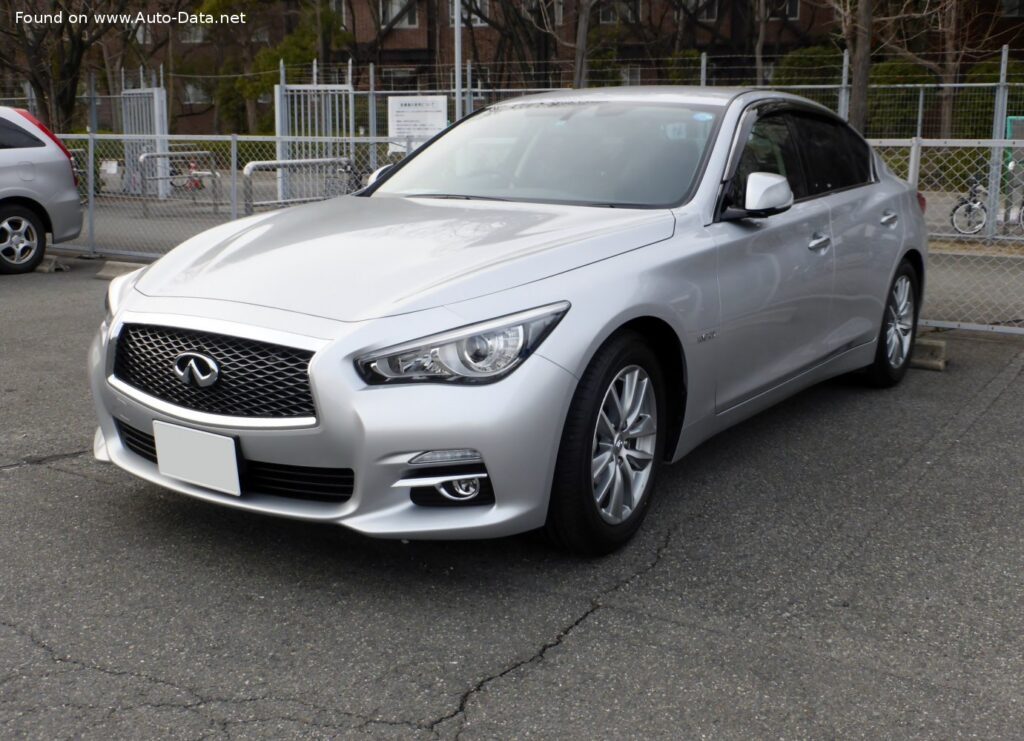
Introduction to the Nissan Skyline XIII (HV37)
The Nissan Skyline XIII (HV37) represents a pivotal chapter in the storied history of Nissan’s iconic Skyline lineage, marking a significant embrace of advanced hybrid technology within a premium sports sedan package. Produced from February 2014 to 2017, this thirteenth generation Skyline, known internally by its HV37 chassis code, was a testament to Nissan’s engineering prowess, blending potent performance with impressive fuel efficiency. While internationally recognized as the Infiniti Q50 Hybrid in markets like North America and Europe, in its home market of Japan, it proudly carried the revered Skyline badge, continuing a legacy that stretches back decades. This iteration was specifically designed to appeal to a sophisticated clientele seeking a dynamic driving experience coupled with the environmental benefits and economic advantages of a full hybrid electric vehicle (FHEV) powertrain. It positioned itself as a modern, technologically advanced contender in the competitive luxury sedan segment, showcasing Nissan’s commitment to innovation and sustainable mobility without compromising on the performance expected from a Skyline.
Engine and Performance: The Heart of the Nissan Skyline XIII (HV37)
At the core of the Nissan Skyline XIII (HV37)‘s impressive capabilities lies a sophisticated FHEV powertrain architecture, meticulously engineered to deliver a harmonious blend of power and efficiency. The internal combustion engine is the renowned VQ35HR, a 3.5-liter V6 unit, longitudinally mounted at the front. This naturally aspirated engine, celebrated for its smooth power delivery and robust character, develops a formidable 306 horsepower at 6800 rpm and 258.15 lb-ft of torque at 5000 rpm. Featuring a DOHC (Dual Overhead Camshaft) valvetrain and multi-port manifold injection, the VQ35HR boasts a compression ratio of 10.6:1, contributing to its responsive nature.
Complementing the V6 engine is an advanced electric motor, designated HM34. This motor, strategically positioned between the combustion engine and the 7-speed automatic transmission, adds an additional 68 horsepower at 1770-2000 rpm and a substantial 213.89 lb-ft of torque at a low 1770 rpm. The synergy between the gasoline engine and the electric motor results in a remarkable combined system output of 364 horsepower at 6500 rpm and an impressive 420.41 lb-ft of torque at just 2000 rpm. This substantial torque figure, available from low rpm, ensures brisk acceleration and effortless passing maneuvers.
Power is channeled to the rear wheels, upholding the Skyline’s traditional rear-wheel-drive dynamics, which is a hallmark for enthusiast drivers. The FHEV system allows for operation in full electric mode at lower speeds or under light loads, seamlessly transitioning to a combined engine and electric motor drive for higher performance demands. The energy for the electric motor is stored in a 1.4 kWh Lithium-ion battery, cleverly located behind the back wall of the passenger cabin to optimize weight distribution.
Despite its powerful output, the Nissan Skyline XIII (HV37) achieves an outstanding combined fuel economy of 5.4 liters per 100 km, which translates to an impressive 43.6 US miles per gallon. This efficiency is a direct benefit of its advanced hybrid system and contributes significantly to its appeal as a daily driver. With a curb weight of 3880.14 pounds, the vehicle boasts a favorable weight-to-power ratio of 4.8 kg per horsepower, or 206.8 horsepower per tonne, underscoring its performance credentials. The 75-liter (19.81 US gallon) fuel tank ensures a substantial cruising range, further enhancing its practicality.
Design and Features
The Nissan Skyline XIII (HV37) sports a contemporary and sophisticated design, characteristic of a premium sports sedan. Its body type is a classic 4-door, 5-seat sedan, offering a blend of elegance and practicality. Measuring 188.58 inches in length, 71.65 inches in width, and 56.69 inches in height, with a wheelbase of 112.2 inches, the Skyline HV37 presents a confident and athletic stance. The design is further enhanced by a low drag coefficient of 0.26, contributing to both its aerodynamic efficiency and its sleek visual appeal.
Underneath its refined exterior, the HV37 generation Skyline benefits from a highly capable chassis designed for both comfort and dynamic handling. The front suspension employs a double wishbone setup, known for its precise control and ability to maintain optimal tire contact with the road. At the rear, an independent multi-link suspension system ensures excellent ride quality and stability. Braking performance is handled by ventilated discs on both the front and rear axles, providing strong, consistent stopping power. An Anti-lock Braking System (ABS) is standard, enhancing safety and control during emergency braking situations.
Steering is managed by a responsive rack and pinion system, offering direct feedback to the driver. The vehicle rides on 17-inch wheel rims, fitted with 225/55 R17 tires, striking a balance between ride comfort and grip. With a minimum turning circle of 36.75 feet, the Skyline HV37 demonstrates surprising maneuverability for its size, making it adept in urban environments. The ground clearance of 5.12 inches is typical for a sports sedan, providing a low center of gravity for improved handling while still being practical for everyday driving. The cabin, though not detailed in the raw data, would have featured a premium interior with high-quality materials, advanced infotainment, and a suite of driver-assistance technologies, aligning with its luxury market positioning.
Technical Specifications: Nissan Skyline XIII (HV37) 3.5 V6 (364 Hp) Hybrid Automatic
General Information |
|
| Brand | Nissan |
| Model | Skyline |
| Generation | Skyline XIII (HV37) |
| Type (Engine) | 3.5 V6 (364 Hp) Hybrid Automatic |
| Start of production | February, 2014 |
| End of production | 2017 |
| Powertrain Architecture | FHEV (Full Hybrid Electric Vehicle) |
| Body type | Sedan |
| Seats | 5 |
| Doors | 4 |
Performance Specs |
|
| Fuel consumption (economy) – combined | 5.4 l/100 km (43.6 US mpg) |
| Fuel Type | Petrol (Gasoline) |
| Weight-to-power ratio | 4.8 kg/Hp (206.8 Hp/tonne) |
| Weight-to-torque ratio | 3.1 kg/Nm (323.9 Nm/tonne) |
Electric Cars and Hybrids Specs |
|
| Gross battery capacity | 1.4 kWh |
| Battery technology | Lithium-ion (Li-Ion) |
| Battery location | Behind the back wall of the passenger cabin |
| Electric motor power | 68 Hp @ 1770-2000 rpm |
| Electric motor Torque | 290 Nm (213.89 lb-ft) @ 1770 rpm |
| Electric motor model/code | HM34 |
| Electric motor location | Between the combustion engine and the transmission |
| System power | 364 Hp @ 6500 rpm |
| System torque | 570 Nm (420.41 lb-ft) @ 2000 rpm |
Internal Combustion Engine Specs |
|
| Power | 306 Hp @ 6800 rpm |
| Power per liter | 87.5 Hp/l |
| Torque | 350 Nm (258.15 lb-ft) @ 5000 rpm |
| Engine layout | Front, Longitudinal |
| Engine Model/Code | VQ35HR |
| Engine displacement | 3498 cm3 (3.5 liters, 213.46 cu. in.) |
| Number of cylinders | 6 |
| Engine configuration | V-engine |
| Cylinder Bore | 95.5 mm (3.76 in.) |
| Piston Stroke | 81.4 mm (3.2 in.) |
| Compression ratio | 10.6:1 |
| Number of valves per cylinder | 4 |
| Fuel injection system | Multi-port manifold injection |
| Engine aspiration | Naturally aspirated engine |
| Valvetrain | DOHC |
| Engine oil capacity | 4.9 l (5.18 US qt) |
| Coolant | 9.8 l (10.36 US qt) |
Space, Volume and Weights |
|
| Kerb Weight | 1760 kg (3880.14 lbs) |
| Max. weight | 2035 kg (4486.41 lbs) |
| Max load | 275 kg (606.27 lbs) |
| Fuel tank capacity | 75 l (19.81 US gal) |
Dimensions |
|
| Length | 4790 mm (188.58 in.) |
| Width | 1820 mm (71.65 in.) |
| Height | 1440 mm (56.69 in.) |
| Wheelbase | 2850 mm (112.2 in.) |
| Front track | 1545 mm (60.83 in.) |
| Rear (Back) track | 1570 mm (61.81 in.) |
| Ride height (ground clearance) | 130 mm (5.12 in.) |
| Drag coefficient (Cd) | 0.26 |
| Minimum turning circle (turning diameter) | 11.2 m (36.75 ft.) |
Drivetrain, Brakes and Suspension Specs |
|
| Drivetrain Architecture | FHEV (Full Hybrid Electric Vehicle). The Internal combustion engine (ICE) and electric motor drive the rear wheels of the car with the ability to work in full electric or mixed mode. |
| Drive wheel | Rear wheel drive |
| Number of gears and type of gearbox | 7 gears, automatic transmission |
| Front suspension | Double wishbone |
| Rear suspension | Independent multi-link suspension |
| Front brakes | Ventilated discs |
| Rear brakes | Ventilated discs |
| Assisting systems | ABS (Anti-lock braking system) |
| Steering type | Steering rack and pinion |
| Tires size | 225/55 R17 |
| Wheel rims size | 17 inches |
Nissan Skyline XIII (HV37) Legacy and Market Impact
The Nissan Skyline XIII (HV37) holds a unique and significant place in automotive history, particularly within its primary market of Japan. For Japanese consumers, the Skyline nameplate carries immense heritage, conjuring images of performance, innovation, and a distinct automotive identity. The HV37 generation, by embracing a full hybrid powertrain, skillfully navigated the evolving demands for efficiency and environmental responsibility without abandoning the performance expectations associated with the Skyline badge.
In Japan, the HV37 Skyline competed in the premium sports sedan segment, facing off against domestic rivals such as the Lexus IS and Toyota Crown, as well as formidable imports from Germany like the BMW 3 Series, Mercedes-Benz C-Class, and Audi A4. What set the Skyline HV37 apart was its distinctive blend of Japanese engineering refinement, a powerful hybrid system, and its rear-wheel-drive dynamics. While its global counterpart, the Infiniti Q50 Hybrid, aimed for a broader luxury market, the Skyline HV37 maintained a more focused identity for its home audience, emphasizing its technological leadership and commitment to a greener yet thrilling driving experience.
Its market impact was significant in demonstrating that hybrid technology could be seamlessly integrated into a performance-oriented luxury sedan. The HV37 showcased Nissan’s ability to develop a sophisticated hybrid system that not only delivered exceptional fuel economy but also augmented performance, providing instant torque and a substantial power boost. This helped solidify Nissan’s reputation as an innovator in hybrid powertrains, bridging the gap between traditional gasoline-powered performance cars and the future of electrified vehicles.
The legacy of the Nissan Skyline XIII (HV37) is one of evolution and adaptation. It successfully modernized a legendary nameplate for a new era, proving that the spirit of the Skyline could thrive amidst changing automotive landscapes. It contributed to the ongoing narrative of the Skyline as a vehicle that consistently pushes boundaries, whether through its early racing prowess, its groundbreaking GT-R iterations, or its later embrace of advanced sustainable technologies. For enthusiasts and the general public alike, the HV37 represents a sophisticated, efficient, and thoroughly modern interpretation of a true automotive icon, ensuring the Skyline’s relevance and appeal well into the future. Its production run from 2014 to 2017 might have been relatively short, but its influence on showcasing a high-performance, efficient hybrid in a revered nameplate remains a key part of its historical significance.