The Nissan Sunny (B15): A Global Compact Sedan Workhorse
The Nissan Sunny, a nameplate synonymous with reliable and economical compact transportation for decades, saw its B15 generation introduced in 1998. This iteration continued the Sunny’s legacy as a foundational model for Nissan in numerous international markets, particularly across Asia, the Middle East, and parts of Europe, where it was often positioned as a practical and affordable family sedan. While never officially sold under the “Sunny” name in the United States during this period, the B15 platform shared significant commonality with the Nissan Sentra offered in North America, highlighting Nissan’s global engineering strategies. The Nissan Sunny (B15) represented a modern step forward for the venerable nameplate, incorporating contemporary design cues and updated mechanicals to compete in the fiercely contested compact segment.
Produced from 1998 to 2003, the B15 generation brought a more refined driving experience and improved comfort over its predecessors, while maintaining the core values of durability and low running costs that customers expected from a Sunny. The specific variant under review, the 1.8 i 16V (130 Hp) model, was a significant offering, providing a balance of performance and efficiency that appealed to a broad demographic looking for a capable daily driver.
Engine and Performance of the Nissan Sunny (B15) 1.8 i 16V
At the heart of this particular Nissan Sunny (B15) variant was a 1.8-liter, 16-valve, naturally aspirated internal combustion engine. This powertrain delivered a respectable 130 horsepower, which for a compact sedan of its era, provided ample motivation for both urban commuting and highway travel. Nissan’s engineering philosophy for engines during this period emphasized reliability, smooth power delivery, and fuel efficiency, and this 1.8-liter unit was a prime example.
The 16-valve configuration allowed for more efficient air intake and exhaust scavenging, contributing to the engine’s responsive character and its ability to produce power across a wide RPM range. As a naturally aspirated engine, it offered predictable and linear power delivery, which was appreciated by drivers in its target markets who valued simplicity and ease of maintenance over forced-induction complexity. This engine was paired with a front-wheel-drive architecture, a standard setup for compact sedans that optimized interior space and offered good traction in various conditions.
For its class, the 130 horsepower output was competitive, placing it favorably against rivals like the Toyota Corolla and Honda Civic in terms of straight-line performance. While not a performance car, the 1.8-liter Sunny offered a confident driving experience, capable of comfortably cruising at highway speeds and navigating city traffic with ease. Its focus remained on providing a dependable and economical powertrain that could withstand the demands of diverse driving environments globally.
Design and Features of the Nissan Sunny (B15)
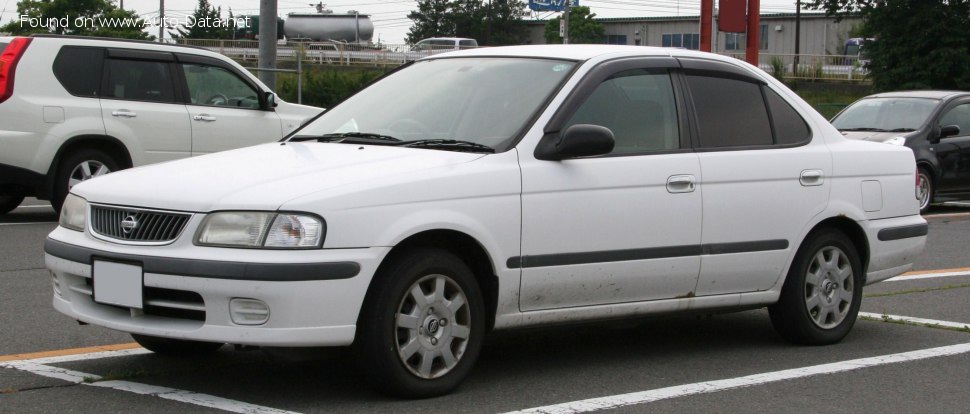
The Nissan Sunny (B15) adopted a more rounded and aerodynamic design compared to its boxier predecessors, reflecting the prevailing automotive trends of the late 1990s. As a sedan, it featured a traditional three-box profile, prioritizing interior space and trunk capacity. The design was conservative yet appealing, aiming for broad appeal rather than polarizing aesthetics. Its clean lines and understated elegance ensured it aged gracefully.
Inside, the B15 generation focused on practicality and user-friendliness. The cabin was designed to be spacious and comfortable for up to five occupants, with an emphasis on durable materials built to withstand years of use. While specific feature lists varied by market and trim level, common amenities for this era and segment typically included air conditioning, power windows, central locking, and an integrated audio system. Safety features, increasingly becoming standard, would have included front airbags and anti-lock brakes (ABS) on higher trims or as options, providing enhanced protection for occupants.
The sedan body type was particularly popular in the Sunny’s primary markets, offering a distinct trunk separate from the passenger compartment, which was often preferred for security and cargo versatility. The B15’s design was a testament to Nissan’s understanding of its core customer base: individuals and families seeking a reliable, low-maintenance, and comfortable vehicle for their daily needs.
Technical Specifications: Nissan Sunny (B15) 1.8 i 16V (130 Hp)
| Attribute | Specification |
|---|---|
| Brand | Nissan |
| Model | Sunny |
| Generation | Sunny (B15) |
| Type (Engine) | 1.8 i 16V (130 Hp) |
| Start of Production | 1998 year |
| End of Production | 2003 year |
| Powertrain Architecture | Internal Combustion engine |
| Body type | Sedan |
| Fuel Type | Petrol (Gasoline) |
| Power | 130 Hp |
| Engine Aspiration | Naturally aspirated engine |
Legacy and Market Impact
The Nissan Sunny (B15) 1.8 i 16V (130 Hp) continued the long-standing tradition of the Sunny nameplate as a global automotive staple. Its reputation was built on unwavering reliability, economical operation, and a practical approach to motoring. In its primary markets, the B15 Sunny was often seen as a smart purchase, providing excellent value for money and a dependable ownership experience.
Competitors in its segment were numerous and formidable, including the likes of the Toyota Corolla, Honda Civic, Mitsubishi Lancer, and Mazda Familia (323). The Sunny managed to hold its own by offering a compelling package of Nissan’s renowned engineering, comfortable interiors, and competitive pricing. Its appeal resonated with consumers who prioritized longevity and low running costs over overt styling or high-performance aspirations.
Historically, the B15 generation played a crucial role in maintaining Nissan’s strong presence in key international markets during a period of significant corporate restructuring for the company. It demonstrated Nissan’s ability to produce globally relevant vehicles that could be adapted to diverse consumer needs and environmental conditions. The platform beneath the B15 Sunny was also highly significant, underpinning not just the Sunny but also the North American market Sentra, the Almera in Europe, and various other models globally. This strategic platform sharing allowed Nissan to achieve economies of scale and offer a consistent level of quality and engineering across its compact vehicle lineup worldwide.
Even after its production ended in 2003, the Nissan Sunny (B15) continued to be a common sight on roads in many countries, a testament to its robust construction and enduring appeal. It cemented the Sunny’s legacy as one of Nissan’s most successful and enduring nameplates, a true workhorse that reliably served millions of drivers around the globe.