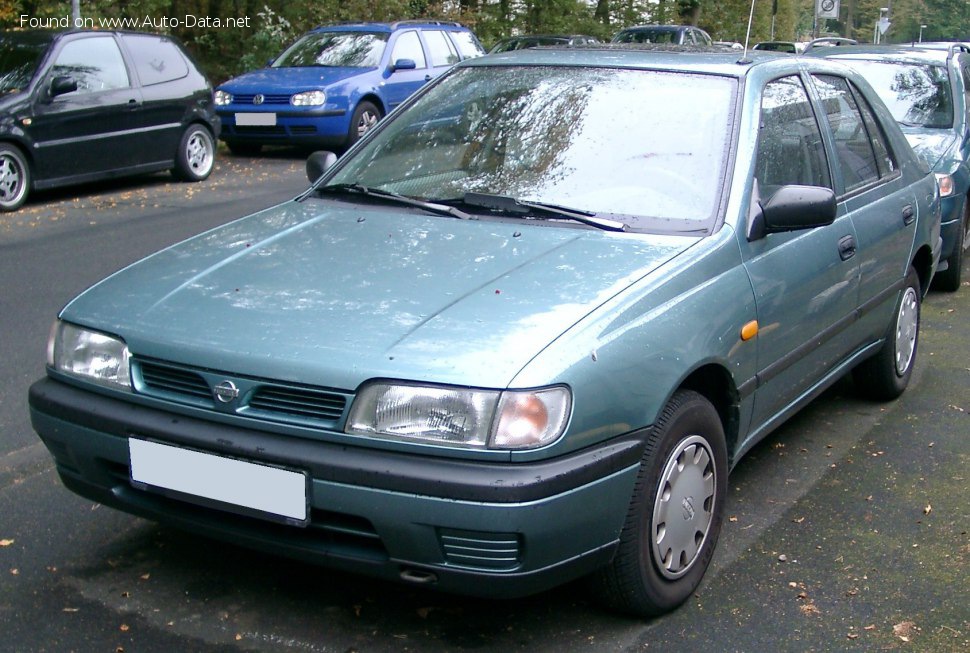
The Nissan Sunny III Hatch (N14): A Global Compact Workhorse (1992-1995)
The Nissan Sunny, a nameplate with a rich and extensive history dating back to 1966, represented Nissan’s formidable presence in the compact car segment across numerous international markets. The third generation of the Sunny Hatchback, internally designated N14, was a crucial model for the Japanese automaker, particularly in Europe and Asia, where it competed fiercely against established rivals. Produced from 1992 to 1995, the Nissan Sunny III Hatch (N14) offered a practical, reliable, and economical solution for drivers seeking a dependable compact vehicle. While the Sunny name was largely supplanted by Sentra in the North American market, the N14 generation, in its various body styles, served as a global ambassador for Nissan’s engineering prowess and commitment to utility.
The specific variant under examination, the 5-door 1.4 i 16V with 75 horsepower, epitomized the N14’s core appeal: a no-frills, efficient, and adequately powered compact hatchback designed for everyday commuting and family duties. Its powertrain architecture centered around a conventional internal combustion engine driving the front wheels, a layout that had become the industry standard for efficiency and packaging in this class. The N14 series built upon the legacy of its predecessors by offering improved refinement, enhanced safety features for its time, and a contemporary design that resonated with the early 1990s aesthetic.
Engine and Performance: The GA14DE Powerplant in the Nissan Sunny III Hatch (N14)
Under the hood of the Nissan Sunny III Hatch (N14) 1.4 i 16V lay the GA14DE engine, a testament to Nissan’s reliable and efficient small-displacement engineering of the era. This naturally aspirated, inline four-cylinder engine featured a DOHC (Double Overhead Camshaft) valvetrain with four valves per cylinder, a configuration that was becoming increasingly common for optimizing both power output and fuel efficiency. With an engine displacement of 1392 cubic centimeters (84.95 cu. in.), it was designed to deliver a balance of usable power and economical operation.
The GA14DE produced a respectable 75 horsepower at 6000 rpm, providing adequate motivation for a vehicle of its size and weight. Torque stood at 116 Nm (85.56 lb.-ft.) delivered at a lower 4000 rpm, ensuring reasonable responsiveness in city driving conditions and when accelerating from a standstill. This engine’s multi-port manifold injection system contributed to its efficiency and smooth power delivery, a significant improvement over older carbureted designs. The compression ratio of 9.5:1 was typical for a naturally aspirated gasoline engine of its time, balancing performance with the ability to run on standard petrol (gasoline).
Mated to a 5-speed manual transmission, the 1.4 i 16V variant achieved a 0-60 mph acceleration time of 11.9 seconds, a competitive figure for a compact hatchback in the early 1990s. Its maximum speed of 106.25 mph (171 km/h) further underscored its capability for highway travel, though its primary domain was urban and suburban commuting. Fuel economy was a strong suit, with a combined rating of 6.5 liters per 100 kilometers, translating to an impressive 36.2 US mpg. This efficiency made the Sunny an attractive option for budget-conscious buyers and those facing rising fuel costs.
Design and Features
The Nissan Sunny III Hatch (N14) adopted a contemporary and functional design for its time, characterized by its practical 5-door hatchback body type. The N14 generation moved away from the more angular styling of its predecessors, embracing smoother lines and a more aerodynamic profile that was in vogue during the early 1990s. The 5-door configuration offered excellent versatility, providing easy access for passengers and cargo alike.
With a length of 163.19 inches, a width of 66.54 inches, and a height of 54.92 inches, the Sunny N14 was a true compact car, designed to navigate congested city streets and tight parking spaces with ease. Despite its compact exterior dimensions, Nissan engineers optimized interior space, accommodating five occupants comfortably. The hatchback design truly shone in terms of cargo flexibility. It offered a minimum trunk (boot) space of 431 liters (15.22 cu. ft.), which could be dramatically expanded to a generous 1290 liters (45.56 cu. ft.) by folding down the rear seats. This made the Sunny an exceptionally practical vehicle for hauling groceries, luggage, or even larger items, a key selling point for families and individuals needing versatile transport.
In terms of driver aids and safety, the N14 Sunny was equipped with features that were becoming standard or optional in the compact segment during its production run. The inclusion of ABS (Anti-lock Braking System) was a significant safety enhancement, aiding in maintaining steering control during emergency braking. The front suspension utilized a wishbone design, while the rear featured spring struts, a common and effective setup for providing a comfortable ride and predictable handling. Braking power came from ventilated discs at the front, offering superior heat dissipation, and drum brakes at the rear. Steering was managed by a rack and pinion system with hydraulic power steering, providing ease of maneuverability at low speeds and a connected feel on the open road. The car rode on 175/70 R13 tires, a common size for compact cars of the era, balancing grip, ride comfort, and affordability.
Technical Specifications
| Category | Specification | Metric Value | US/Imperial Value |
|---|---|---|---|
| General Information | |||
| Brand | Nissan | ||
| Model | Sunny | ||
| Generation | Sunny III Hatch (N14) 5 doors | ||
| Type (Engine) | 1.4 i 16V (75 Hp) | ||
| Start of Production | 1992 year | ||
| End of Production | 1995 year | ||
| Powertrain Architecture | Internal Combustion engine | ||
| Body Type | Hatchback | ||
| Seats | 5 | ||
| Doors | 5 | ||
| Performance Specs | |||
| Fuel Consumption (Combined) | 6.5 l/100 km | 15.4 km/l | 36.2 US mpg / 43.5 UK mpg |
| Fuel Type | Petrol (Gasoline) | ||
| Acceleration 0-100 km/h | 12.5 sec | ||
| Acceleration 0-62 mph | 12.5 sec | ||
| Acceleration 0-60 mph (Calculated) | 11.9 sec | ||
| Maximum Speed | 171 km/h | 106.25 mph | |
| Weight-to-Power Ratio | 14 kg/Hp | 71.4 Hp/tonne | |
| Weight-to-Torque Ratio | 9.1 kg/Nm | 110.5 Nm/tonne | |
| Engine Specs | |||
| Power | 75 Hp @ 6000 rpm | ||
| Power per Liter | 53.9 Hp/l | ||
| Torque | 116 Nm @ 4000 rpm | 85.56 lb.-ft. @ 4000 rpm | |
| Engine Layout | Front, Transverse | ||
| Engine Model/Code | GA14DE | ||
| Engine Displacement | 1392 cm³ | 84.95 cu. in. | |
| Number of Cylinders | 4 | ||
| Engine Configuration | Inline | ||
| Cylinder Bore | 73.6 mm | 2.9 in. | |
| Piston Stroke | 81.8 mm | 3.22 in. | |
| Compression Ratio | 9.5:1 | ||
| Number of Valves per Cylinder | 4 | ||
| Fuel Injection System | Multi-port manifold injection | ||
| Engine Aspiration | Naturally aspirated engine | ||
| Valvetrain | DOHC | ||
| Engine Oil Capacity | 3.2 l | 3.38 US qt / 2.82 UK qt | |
| Coolant Capacity | 5.7 l | 6.02 US qt / 5.02 UK qt | |
| Space, Volume and Weights | |||
| Kerb Weight | 1050 kg | 2314.85 lbs. | |
| Max. Weight | 1545 kg | 3406.14 lbs. | |
| Max Load | 495 kg | 1091.29 lbs. | |
| Trunk (boot) Space – Minimum | 431 l | 15.22 cu. ft. | |
| Trunk (boot) Space – Maximum | 1290 l | 45.56 cu. ft. | |
| Fuel Tank Capacity | 50 l | 13.21 US gal / 11 UK gal | |
| Dimensions | |||
| Length | 4145 mm | 163.19 in. | |
| Width | 1690 mm | 66.54 in. | |
| Height | 1395 mm | 54.92 in. | |
| Wheelbase | 2430 mm | 95.67 in. | |
| Front Track | 1445 mm | 56.89 in. | |
| Rear (Back) Track | 1430 mm | 56.3 in. | |
| Drivetrain, Brakes and Suspension Specs | |||
| Drivetrain Architecture | The Internal combustion engine (ICE) drives the front wheels of the vehicle. | ||
| Drive Wheel | Front wheel drive | ||
| Number of Gears and Type of Gearbox | 5 gears, manual transmission | ||
| Front Suspension | Wishbone | ||
| Rear Suspension | Spring Strut | ||
| Front Brakes | Ventilated discs | ||
| Rear Brakes | Drum | ||
| Assisting Systems | ABS (Anti-lock braking system) | ||
| Steering Type | Steering rack and pinion | ||
| Power Steering | Hydraulic Steering | ||
| Tires Size | 175/70 R13 | ||
Legacy and Market Impact
The Nissan Sunny III Hatch (N14) played a significant role in Nissan’s global strategy during the early to mid-1990s, particularly in markets outside of North America. In Europe, where compact hatchbacks were the backbone of the automotive market, the N14 Sunny was a direct competitor to popular models like the Volkswagen Golf, Opel Astra (Vauxhall Astra in the UK), Ford Escort, and Honda Civic. While it may not have always matched the dynamic driving characteristics of some European rivals or the technological edge of some Japanese competitors, the Sunny carved out a strong reputation for its unwavering reliability, practical design, and competitive pricing.
Its robust build quality and the longevity of its GA14DE engine made it a popular choice for families and fleet operators alike. The car’s low running costs, primarily due to its excellent fuel economy and straightforward maintenance, further solidified its appeal. In many markets, the Sunny was seen as a sensible, dependable, and unpretentious choice, a car that simply got the job done without fuss. This reputation for reliability has allowed many N14 models to remain on the road for decades, a testament to Nissan’s engineering from that era.
The N14 generation, including the hatchback, sedan, and wagon variants, represented a period of refinement for Nissan’s compact offerings. It bridged the gap between the more utilitarian designs of the 1980s and the increasingly sophisticated and safety-conscious vehicles of the late 1990s. While the Sunny nameplate eventually faded from many markets, often being replaced by the Almera (which was essentially a rebadged N15 Sunny in Europe) or other global models, the N14 series remains a significant chapter in Nissan’s history. It underscored the company’s ability to produce globally relevant, durable, and efficient compact cars that met the diverse needs of drivers around the world, embodying the spirit of accessible, dependable transportation.