Nissan Sunny III Wagon (Y10): A Global Workhorse of the Early 90s
The Nissan Sunny III Wagon (Y10) represents a pivotal era for compact, practical transportation, particularly outside of the North American market. Introduced in 1991, this generation of the Sunny, known internally as the Y10, continued Nissan’s legacy of producing reliable and economical vehicles. While the Sunny nameplate had a presence globally, including in the U.S. (often as the Sentra), the Y10 station wagon variant carved out a distinct niche in Europe, Asia, and other international markets where compact wagons were highly valued for their blend of maneuverability, fuel efficiency, and cargo capacity. The 1.6 16V (90 Hp) model, produced between 1991 and 1992, was a common and well-regarded powertrain option, embodying the robust engineering and sensible design that characterized Nissan during this period. It was designed as a no-nonsense family hauler and small business vehicle, excelling in everyday utility rather than outright performance or luxury.
Engine and Performance of the Nissan Sunny III Wagon (Y10) 1.6 16V
At the heart of the Nissan Sunny III Wagon (Y10) 1.6 16V model was the GA16DE engine, a well-proven and widely utilized powertrain in Nissan’s compact lineup. This inline four-cylinder engine featured a dual overhead camshaft (DOHC) valvetrain with 16 valves, allowing for efficient breathing and a responsive power delivery for its displacement. With an engine displacement of 1,597 cubic centimeters (approximately 1.6 liters or 97.45 cubic inches), it was a workhorse designed for longevity and economy.
The GA16DE engine produced a respectable 90 horsepower at 6,000 revolutions per minute, which was competitive for its class in the early 1990s. More importantly for a utility-focused vehicle like a station wagon, it delivered 136 Newton-meters (100.31 lb.-ft.) of torque at a relatively low 4,000 rpm. This torque profile ensured adequate pulling power for carrying passengers and cargo, making it suitable for both city driving and longer highway journeys without feeling strained. The engine’s naturally aspirated design, coupled with a multi-port manifold injection system, contributed to its reliability and relatively straightforward maintenance.
Power was transmitted to the front wheels via a standard five-speed manual transmission, a common and efficient choice for vehicles of this segment. This drivetrain architecture, with the engine mounted transversely at the front, optimized interior space and provided predictable handling characteristics. The vehicle’s lightweight curb weight of just 2,050.3 pounds (930 kg) meant that the 90 horsepower was sufficient for a sprightly feel, yielding a weight-to-power ratio of 10.3 kg/Hp (or 96.8 Hp/tonne). Fueling the engine was gasoline, with a compression ratio of 9.8:1, balancing performance with fuel efficiency. The GA16DE’s reputation for robustness and ease of service further cemented the Sunny Y10 Wagon’s appeal as a dependable daily driver.
Design and Features of the Sunny Y10 Wagon
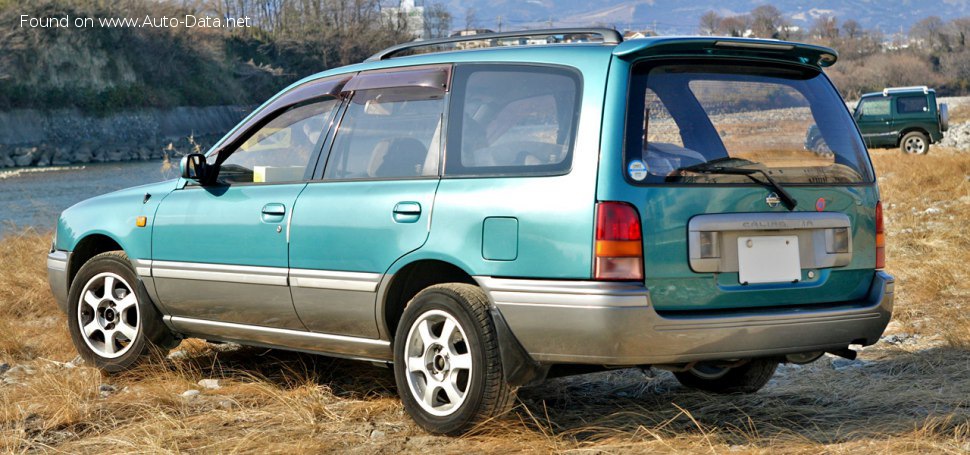
The Nissan Sunny III Wagon (Y10) adopted a functional and unpretentious design philosophy, typical of compact station wagons of its era. Its body style, a 5-door station wagon (often referred to as an “estate” in European markets), prioritized practicality and utility above all else. With a length of 164.37 inches, a width of 65.55 inches, and a height of 59.84 inches, it was compact enough to navigate urban environments with ease, yet offered a surprisingly spacious interior. The 94.49-inch wheelbase provided a stable ride and contributed to the vehicle’s interior volume.
Inside, the Y10 Wagon was configured to comfortably seat five occupants. However, its true strength lay in its cargo-carrying capabilities. The rear hatch opened to reveal a generous minimum trunk space of 16.24 cubic feet (460 liters), which could expand dramatically to an impressive 56.5 cubic feet (1600 liters) with the rear seats folded down. This flexibility made it an ideal choice for families, small businesses, or anyone needing to transport substantial loads.
From a mechanical and safety standpoint, the Sunny Y10 featured a robust setup. The front suspension utilized a wishbone design, while the rear employed spring struts, providing a comfortable yet competent ride. Braking duties were handled by ventilated discs at the front for effective stopping power, complemented by drum brakes at the rear. An important safety feature for its time, an Anti-lock Braking System (ABS), was available, enhancing control during emergency braking. Steering was managed by a rack and pinion system with hydraulic power assistance, ensuring light and precise steering feel, particularly at lower speeds. The vehicle rode on 175/70 R13 tires, a common size that balanced grip, comfort, and affordability. The overall design language was conservative, focusing on clean lines and durable materials, reflecting its role as a reliable and economical vehicle built to withstand the rigors of daily use.
Technical Specifications
| Category | Specification |
|---|---|
| General Information | |
| Brand | Nissan |
| Model | Sunny |
| Generation | Sunny III Wagon (Y10) |
| Type (Engine) | 1.6 16V (90 Hp) |
| Production Start | 1991 year |
| Production End | 1992 year |
| Powertrain Architecture | Internal Combustion Engine |
| Body Type | Station wagon (estate) |
| Seats | 5 |
| Doors | 5 |
| Performance Specs | |
| Fuel Type | Petrol (Gasoline) |
| Weight-to-Power Ratio | 10.3 kg/Hp, 96.8 Hp/tonne |
| Weight-to-Torque Ratio | 6.8 kg/Nm, 146.2 Nm/tonne |
| Engine Specs | |
| Power | 90 Hp @ 6000 rpm |
| Power per liter | 56.4 Hp/l |
| Torque | 136 Nm @ 4000 rpm (100.31 lb.-ft. @ 4000 rpm) |
| Engine Layout | Front, Transverse |
| Engine Model/Code | GA16DE |
| Engine Displacement | 1597 cm³ (1.6 liters / 97.45 cu. in.) |
| Number of Cylinders | 4 |
| Engine Configuration | Inline |
| Cylinder Bore | 76 mm (2.99 in.) |
| Piston Stroke | 88 mm (3.46 in.) |
| Compression Ratio | 9.8:1 |
| Valves per Cylinder | 4 |
| Fuel Injection System | Multi-port manifold injection |
| Engine Aspiration | Naturally aspirated engine |
| Valvetrain | DOHC |
| Engine Oil Capacity | 3.2 l (3.38 US qt) |
| Coolant Capacity | 5.5 l (5.81 US qt) |
| Space, Volume and Weights | |
| Kerb Weight | 930 kg (2050.3 lbs.) |
| Trunk (boot) Space – Minimum | 460 l (16.24 cu. ft.) |
| Trunk (boot) Space – Maximum | 1600 l (56.5 cu. ft.) |
| Fuel Tank Capacity | 50 l (13.21 US gal) |
| Dimensions | |
| Length | 4175 mm (164.37 in.) |
| Width | 1665 mm (65.55 in.) |
| Height | 1520 mm (59.84 in.) |
| Wheelbase | 2400 mm (94.49 in.) |
| Front Track | 1435 mm (56.5 in.) |
| Rear (Back) Track | 1435 mm (56.5 in.) |
| Drivetrain, Brakes and Suspension Specs | |
| Drivetrain Architecture | Front-engine, Front-wheel drive |
| Drive Wheel | Front wheel drive |
| Gearbox | 5 gears, manual transmission |
| Front Suspension | Wishbone |
| Rear Suspension | Spring Strut |
| Front Brakes | Ventilated discs |
| Rear Brakes | Drum |
| Assisting Systems | ABS (Anti-lock braking system) |
| Steering Type | Steering rack and pinion |
| Power Steering | Hydraulic Steering |
| Tires Size | 175/70 R13 |
Legacy and Market Impact
The Nissan Sunny III Wagon (Y10) 1.6 16V left a significant mark, particularly in markets outside the United States where compact station wagons were a staple of family and commercial transport. While the Sunny nameplate often morphed into the Sentra for the North American market, the Y10 wagon variant was a common sight across Europe, Asia, and other global regions, valued for its unpretentious reliability and exceptional practicality.
Its reputation was built on several key pillars: durability, fuel economy, and low running costs. The GA16DE engine, in particular, was lauded for its robustness and ability to accumulate high mileage with minimal fuss, a testament to Nissan’s engineering prowess during this era. This made the Sunny Y10 an attractive proposition for budget-conscious families and businesses alike, who prioritized function over flash.
In its primary markets, the Sunny Y10 Wagon faced stiff competition from other global players. Key rivals included the Ford Escort Wagon (or Orion in some markets), the Opel Astra Wagon (Vauxhall Astra in the UK), the Volkswagen Golf Variant (known as the Jetta Wagon in North America), the Toyota Corolla Wagon, and the Honda Civic Wagon. Each of these offered a similar blend of compact dimensions and cargo versatility. However, the Sunny often distinguished itself with its slightly more robust build quality and a perception of unwavering dependability, often outlasting its contemporaries.
Historically, the Nissan Sunny III Wagon (Y10) played a crucial role in cementing Nissan’s image as a manufacturer of sensible, well-built cars. It was a vehicle that simply got the job done, day in and day out, without complaint. Its mechanical simplicity and ease of maintenance ensured that it remained a popular choice in the used car market for many years after its production ceased. While it may not feature in lists of groundbreaking automotive designs, its legacy is one of quiet competence and steadfast service, a true workhorse that reliably transported countless families and their belongings, embodying the pragmatic spirit of early 1990s compact automotive engineering. It was, in essence, an honest car for honest needs, and its impact on everyday mobility in its target markets was profound.