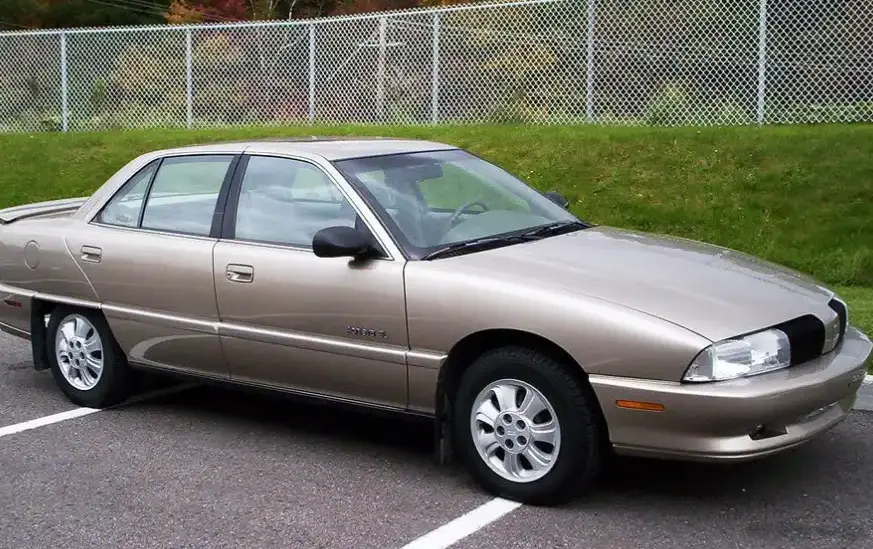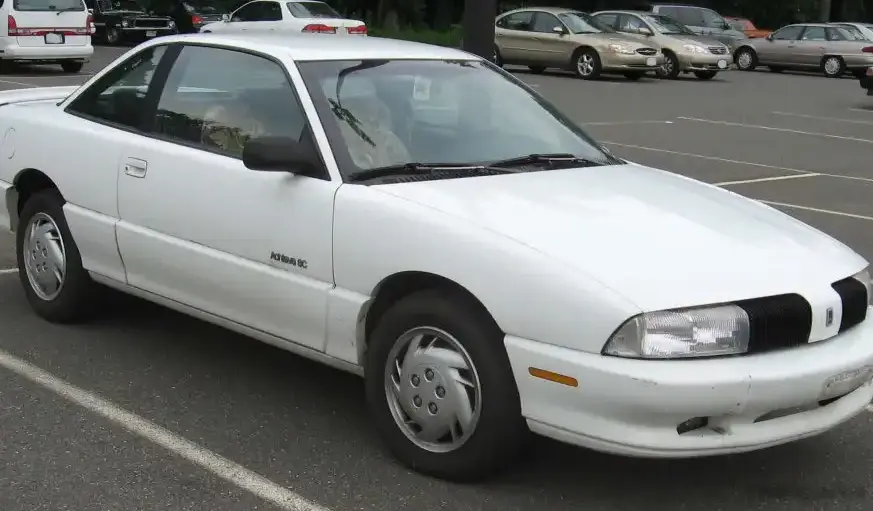
The Oldsmobile Achieva Coupe 2.3i, produced from 1991 to 1993, represented a key offering in Oldsmobile’s lineup during a period of significant redesign for the brand. Positioned as a sporty, yet affordable, coupe, the Achieva aimed to attract buyers seeking a blend of style, comfort, and reasonable performance. It was part of the first generation of the Achieva, sharing its N-body platform with other GM vehicles like the Buick Skylark and Pontiac Grand Am. The 2.3i variant, equipped with a 2.3-liter inline-four engine and a three-speed automatic transmission, served as a mid-range option, offering a balance between the base model and the more powerful, albeit less common, V6-equipped versions.
Technical Specifications
| Brand | Oldsmobile |
| Model | Achieva |
| Generation | Achieva Coupe |
| Type (Engine) | 2.3 i (117 Hp) Automatic |
| Start of production | 1991 |
| End of production | 1993 |
| Powertrain Architecture | Internal Combustion engine |
| Body type | Coupe |
| Seats | 5 |
| Doors | 2 |
| Fuel consumption (urban) | 13 l/100 km (18.1 US mpg, 21.7 UK mpg, 7.7 km/l) |
| Fuel consumption (extra urban) | 7 l/100 km (33.6 US mpg, 40.4 UK mpg, 14.3 km/l) |
| Fuel Type | Petrol (Gasoline) |
| Acceleration 0 – 100 km/h | 13 sec |
| Acceleration 0 – 62 mph | 13 sec |
| Acceleration 0 – 60 mph | 12.4 sec |
| Maximum speed | 170 km/h (105.63 mph) |
| Weight-to-power ratio | 10.5 kg/Hp, 95.1 Hp/tonne |
| Weight-to-torque ratio | 6.5 kg/Nm, 154.5 Nm/tonne |
| Power | 117 Hp @ 5200 rpm |
| Power per litre | 51.8 Hp/l |
| Torque | 190 Nm @ 3200 rpm (140.14 lb.-ft. @ 3200 rpm) |
| Engine layout | Front, Transverse |
| Engine Model/Code | L40 |
| Engine displacement | 2260 cm3 (137.91 cu. in.) |
| Number of cylinders | 4 |
| Engine configuration | Inline |
| Cylinder Bore | 92 mm (3.62 in.) |
| Piston Stroke | 85 mm (3.35 in.) |
| Compression ratio | 9.5:1 |
| Number of valves per cylinder | 2 |
| Fuel injection system | Multi-port manifold injection |
| Engine aspiration | Naturally aspirated engine |
| Engine oil capacity | 3.8 l (4.02 US qt | 3.34 UK qt) |
| Coolant | 9.8 l (10.36 US qt | 8.62 UK qt) |
| Kerb Weight | 1230 kg (2711.69 lbs.) |
| Trunk (boot) space – minimum | 395 l (13.95 cu. ft.) |
| Fuel tank capacity | 57 l (15.06 US gal | 12.54 UK gal) |
| Length | 4770 mm (187.8 in.) |
| Width | 1715 mm (67.52 in.) |
| Height | 1350 mm (53.15 in.) |
| Wheelbase | 2625 mm (103.35 in.) |
| Front track | 1415 mm (55.71 in.) |
| Rear (Back) track | 1440 mm (56.69 in.) |
| Drivetrain Architecture | The Internal combustion engine (ICE) drives the front wheels of the vehicle. |
| Drive wheel | Front wheel drive |
| Number of gears and type of gearbox | 3 gears, automatic transmission |
| Front suspension | Coil spring |
| Rear suspension | Coil spring |
| Front brakes | Ventilated discs |
| Rear brakes | Drum |
| Assisting systems | ABS (Anti-lock braking system), Hydraulic Steering |
| Tires size | 195/65 R15 |
| Wheel rims size | 15 |
Powertrain & Engine Architecture
The heart of the Achieva 2.3i was the L40 engine, a 2.3-liter inline-four cylinder powerplant. This engine utilized a cast iron block and an aluminum cylinder head, a common configuration for GM’s four-cylinder engines of the era. Fuel delivery was handled by a multi-port fuel injection system, contributing to improved efficiency and smoother operation compared to earlier carbureted designs. The engine featured a two-valve-per-cylinder valvetrain, operated by a single overhead camshaft. The three-speed automatic transmission, a TH125C, was a relatively simple and robust unit, designed for durability rather than outright performance. It featured a torque converter for smooth engagement and a traditional planetary gearset for shifting. The transmission was electronically controlled, offering a degree of adaptability to driving conditions.
Driving Characteristics
The 117 horsepower and 140 lb-ft of torque produced by the 2.3-liter engine, when paired with the three-speed automatic, resulted in adequate, but not exhilarating, performance. Acceleration from 0 to 60 mph took around 12.4 seconds, making it competitive with other coupes in its class, but noticeably slower than the V6-equipped Achieva. The automatic transmission’s gear ratios were geared towards fuel economy and comfortable cruising, rather than aggressive acceleration. The transmission’s shift points were generally smooth, but could feel somewhat sluggish during quick maneuvers. The Achieva 2.3i was best suited for everyday commuting and highway driving, where its relaxed demeanor and reasonable fuel economy were appreciated.
Equipment & Trim Levels
The Achieva 2.3i typically came standard with features like air conditioning, power steering, a basic AM/FM radio, and cloth upholstery. Optional extras included a more advanced sound system, power windows and locks, cruise control, and a sunroof. Interior trim was generally functional and durable, with a focus on practicality rather than luxury. The dashboard layout was straightforward and easy to use, with clearly marked controls. The base trim level offered a relatively spartan interior, while higher trim levels added features like upgraded upholstery and additional convenience items.
Chassis & Braking
The Achieva Coupe utilized a front-wheel-drive layout with independent coil spring suspension at all four corners. The front suspension featured MacPherson struts, while the rear suspension employed a semi-independent twist-beam design. This setup provided a comfortable ride, but didn’t offer particularly sporty handling characteristics. Braking duties were handled by ventilated discs at the front and drum brakes at the rear. An anti-lock braking system (ABS) was available as an option, enhancing safety by preventing wheel lockup during hard braking. The Achieva’s steering was hydraulically assisted, providing light and easy steering effort.
Market Reception & Comparison
The Achieva 2.3i was generally well-received by critics as a practical and affordable coupe. However, its performance was often criticized as being somewhat underwhelming, particularly when compared to the V6 models. Fuel economy was a strong point, with the 2.3i achieving around 18 mpg in the city and 33 mpg on the highway. Compared to competitors like the Ford Escort and Honda Civic coupes, the Achieva offered a more spacious interior and a more comfortable ride, but lacked the same level of refinement and sporty handling. The V6 Achieva offered significantly more power, but at a higher price point and with reduced fuel economy.
Legacy
The Oldsmobile Achieva, while not a groundbreaking vehicle, played a role in Oldsmobile’s attempt to modernize its image in the early 1990s. The 2.3-liter engine and three-speed automatic transmission proved to be relatively reliable, and many examples are still on the road today. However, due to its age and relatively low resale value, the Achieva 2.3i is not a particularly sought-after classic car. Parts availability is generally good, as many components were shared with other GM vehicles. The Achieva represents a snapshot of American automotive design and engineering during a transitional period, offering a blend of practicality, affordability, and modest performance.