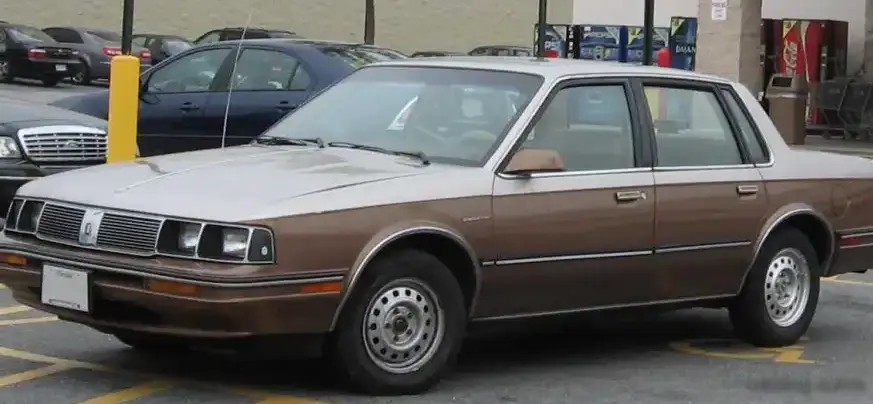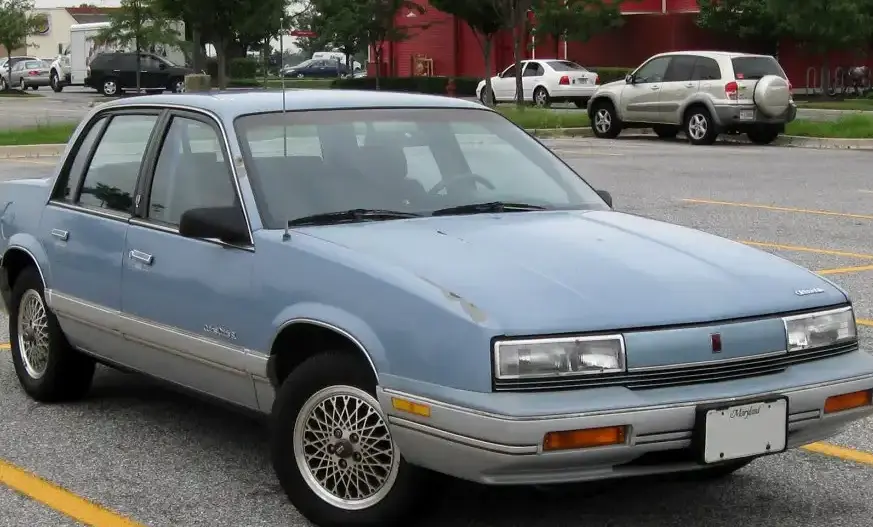
The Oldsmobile Cutlass Calais 3.3 V6, produced from 1990 to 1995, represented a significant iteration of the long-running Cutlass line. Positioned as a mid-range offering within the Calais sub-series, it aimed to provide a balance of comfort, style, and performance for the American family sedan market. This generation, built on the A-body platform (often referred to as the 88 platform), sought to modernize the Cutlass image while retaining its core values of affordability and practicality. The 3.3L V6 engine and automatic transmission combination was a popular choice, offering a step up in power from the base four-cylinder models.
Technical Specifications
| Brand | Oldsmobile |
| Model | Cutlass |
| Generation | Cutlass Calais |
| Type (Engine) | 3.3 V6 (162 Hp) |
| Start of production | 1990 year |
| End of production | 1995 year |
| Powertrain Architecture | Internal Combustion engine |
| Body type | Sedan |
| Seats | 5 |
| Doors | 4 |
| Fuel consumption (urban) | 15 l/100 km (15.7 US mpg, 18.8 UK mpg, 6.7 km/l) |
| Fuel consumption (extra urban) | 9 l/100 km (26.1 US mpg, 31.4 UK mpg, 11.1 km/l) |
| Fuel Type | Petrol (Gasoline) |
| Maximum speed | 200 km/h (124.27 mph) |
| Weight-to-power ratio | 7.4 kg/Hp, 135 Hp/tonne |
| Weight-to-torque ratio | 4.8 kg/Nm, 209.2 Nm/tonne |
| Power | 162 Hp @ 5200 rpm |
| Power per litre | 48.5 Hp/l |
| Torque | 251 Nm @ 2000 rpm (185.13 lb.-ft. @ 2000 rpm) |
| Engine layout | Front, Transverse |
| Engine displacement | 3340 cm3 (203.82 cu. in.) |
| Number of cylinders | 6 |
| Engine configuration | V-engine |
| Cylinder Bore | 93.98 mm (3.7 in.) |
| Piston Stroke | 80.26 mm (3.16 in.) |
| Compression ratio | 9:1 |
| Number of valves per cylinder | 2 |
| Fuel injection system | Multi-port manifold injection |
| Engine aspiration | Naturally aspirated engine |
| Engine oil capacity | 4.3 l (4.54 US qt | 3.78 UK qt) |
| Coolant | 10.5 l (11.1 US qt | 9.24 UK qt) |
| Kerb Weight | 1200 kg (2645.55 lbs.) |
| Trunk (boot) space – minimum | 375 l (13.24 cu. ft.) |
| Fuel tank capacity | 51 l (13.47 US gal | 11.22 UK gal) |
| Length | 4555 mm (179.33 in.) |
| Width | 1700 mm (66.93 in.) |
| Height | 1330 mm (52.36 in.) |
| Wheelbase | 2625 mm (103.35 in.) |
| Front track | 1420 mm (55.91 in.) |
| Rear (Back) track | 1410 mm (55.51 in.) |
| Drivetrain Architecture | The Internal combustion engine (ICE) drives the front wheels of the vehicle. |
| Drive wheel | Front wheel drive |
| Front suspension | Coil spring |
| Rear suspension | Leaf spring |
| Front brakes | Ventilated discs |
| Rear brakes | Drum |
| Assisting systems | ABS (Anti-lock braking system) |
| Steering type | Steering rack and pinion |
| Power steering | Hydraulic Steering |
| Tires size | 185/75 R14 |
Powertrain & Engine Architecture
The heart of the Cutlass Calais 3.3 was the 3340cc (203.82 cu. in.) 60-degree V6 engine. This engine, internally designated as the L82, was a descendant of the earlier 3.1L V6, benefitting from increased displacement for improved torque. It featured a cast iron block with aluminum cylinder heads, a configuration common for American V6 engines of the era. The engine utilized a multi-port fuel injection system, providing precise fuel delivery for optimized combustion. The valvetrain employed two valves per cylinder, operated by a single overhead camshaft. The engine was transversely mounted in the front of the vehicle, driving the front wheels.
The standard transmission for the 3.3L V6 was a 3-speed automatic transmission (likely the TH700R4 or a variant). This transmission was chosen for its smooth operation and ease of use, catering to the target audience who prioritized comfort over outright performance. While not known for its responsiveness, the automatic transmission provided adequate acceleration for everyday driving. The gear ratios were optimized for fuel efficiency and cruising comfort, rather than aggressive acceleration.
Driving Characteristics
The 162 horsepower and 185 lb-ft of torque produced by the 3.3L V6 and automatic transmission combination resulted in a driving experience that was best described as comfortable and adequate. Acceleration was not particularly brisk, with 0-60 mph times estimated around 9-10 seconds. The automatic transmission, while smooth, could feel somewhat sluggish during quick overtaking maneuvers. The emphasis was on providing a relaxed and refined driving experience, rather than sporty handling. The front-wheel-drive configuration offered predictable handling in most conditions, but lacked the dynamic capabilities of rear-wheel-drive vehicles.
Compared to the base 2.5L four-cylinder Cutlass Calais, the 3.3L V6 offered a noticeable improvement in acceleration and overall responsiveness. However, it fell short of the performance offered by the higher-end Cutlass Supreme models equipped with larger V6 engines.
Equipment & Trim Levels
The Cutlass Calais 3.3 V6 typically came standard with features such as air conditioning, power steering, power brakes, and a basic AM/FM stereo. Cloth upholstery was standard, with optional upgrades to leather available. The dashboard layout was functional and straightforward, with easy-to-read gauges. Common optional extras included a cassette player, cruise control, power windows, and power door locks. The Calais trim generally offered a slightly more upscale interior compared to the base Cutlass models, with improved materials and detailing.
Chassis & Braking
The Cutlass Calais featured an independent coil spring suspension in the front and a solid axle with leaf springs in the rear. This suspension setup prioritized ride comfort over handling precision. The front brakes were ventilated discs, providing adequate stopping power, while the rear brakes were drums. An anti-lock braking system (ABS) was often included as standard equipment, enhancing safety. The steering system was a rack-and-pinion setup with hydraulic power assist, providing relatively light and easy steering.
Market Reception & Comparison
The Cutlass Calais 3.3 V6 was generally well-received by consumers as a practical and affordable family sedan. Critics praised its comfortable ride and spacious interior, but noted its lack of sporty handling and somewhat underwhelming acceleration. Compared to other mid-size sedans of the era, such as the Ford Taurus and Honda Accord, the Cutlass Calais offered a more traditional American driving experience, prioritizing comfort and convenience over performance and refinement. Fuel economy was average for the time, falling in line with other V6-powered sedans.
Legacy
The Oldsmobile Cutlass Calais 3.3 V6, while not a particularly groundbreaking vehicle, remains a popular choice among collectors and enthusiasts seeking a classic American sedan. The 3.3L V6 engine is generally considered to be reliable, although regular maintenance is essential to prevent issues such as oil leaks and coolant system failures. Parts availability is generally good, as many components are shared with other GM vehicles of the era. Today, these Cutlass Calais models represent an affordable entry point into the world of classic American cars, offering a nostalgic driving experience and a glimpse into the automotive landscape of the early 1990s.