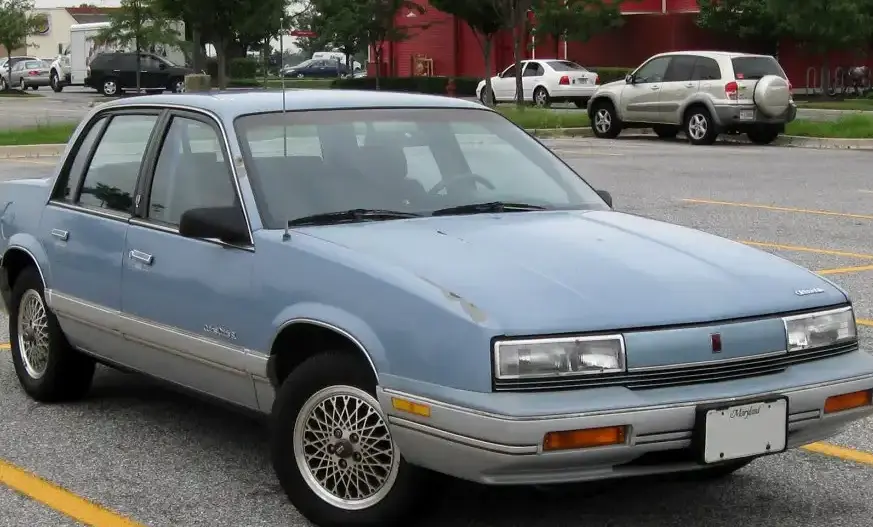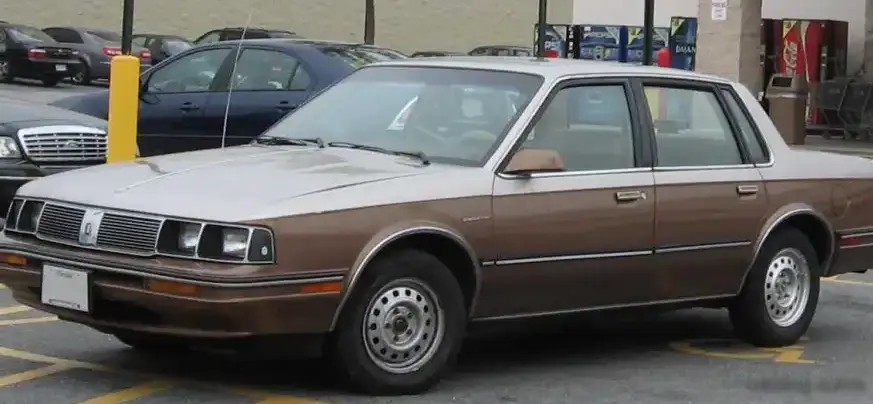
The Oldsmobile Cutlass Calais Coupe, specifically the 2.3-liter 16-valve variant producing 162 horsepower, was a key offering in the American compact car market from 1988 to 1994. Positioned as a more stylish and slightly upscale alternative to the Chevrolet Cavalier and Pontiac Sunfire, the Calais Coupe aimed to attract buyers seeking a blend of affordability, comfort, and a touch of sporty aesthetics. This generation, built on the A-body platform, represented Oldsmobile’s attempt to modernize its image and compete effectively in a segment increasingly dominated by Japanese imports. The 2.3L engine and 5-speed manual transmission combination represented a mid-range offering within the Calais lineup, slotting below the more powerful V6 options but offering a more engaging driving experience than the automatic-equipped base models.
Technical Specifications
| Brand | Oldsmobile |
| Model | Cutlass |
| Generation | Cutlass Calais Coupe |
| Type (Engine) | 2.3 16V (162 Hp) |
| Start of production | 1988 |
| End of production | 1994 |
| Powertrain Architecture | Internal Combustion engine |
| Body type | Coupe |
| Seats | 5 |
| Doors | 2 |
| Fuel consumption (urban) | 15 l/100 km (15.7 US mpg) |
| Fuel consumption (extra urban) | 9 l/100 km (26.1 US mpg) |
| Fuel Type | Petrol (Gasoline) |
| Maximum speed | 180 km/h (111.85 mph) |
| Weight-to-power ratio | 7.2 kg/Hp |
| Weight-to-torque ratio | 5.5 kg/Nm |
| Power | 162 Hp @ 6200 rpm |
| Power per litre | 71.7 Hp/l |
| Torque | 210 Nm @ 5200 rpm (154.89 lb.-ft. @ 5200 rpm) |
| Engine layout | Front, Transverse |
| Engine displacement | 2260 cm3 (137.91 cu. in.) |
| Number of cylinders | 4 |
| Engine configuration | Inline |
| Cylinder Bore | 92 mm (3.62 in.) |
| Piston Stroke | 85 mm (3.35 in.) |
| Compression ratio | 9.5:1 |
| Number of valves per cylinder | 4 |
| Fuel injection system | Multi-port manifold injection |
| Engine aspiration | Naturally aspirated engine |
| Valvetrain | DOHC |
| Engine oil capacity | 4.3 l (4.54 US qt | 3.78 UK qt) |
| Coolant | 10.5 l (11.1 US qt | 9.24 UK qt) |
| Kerb Weight | 1160 kg (2557.36 lbs.) |
| Trunk (boot) space | 375 l (13.24 cu. ft.) |
| Fuel tank capacity | 51 l (13.47 US gal | 11.22 UK gal) |
| Length | 4555 mm (179.33 in.) |
| Width | 1700 mm (66.93 in.) |
| Height | 1330 mm (52.36 in.) |
| Wheelbase | 2625 mm (103.35 in.) |
| Front track | 1420 mm (55.91 in.) |
| Rear track | 1410 mm (55.51 in.) |
| Drivetrain Architecture | Front wheel drive |
| Number of gears | 5 gears, manual transmission |
| Front suspension | Coil spring |
| Rear suspension | Leaf spring |
| Front brakes | Ventilated discs |
| Rear brakes | Drum |
| Assisting systems | ABS (Anti-lock braking system) |
| Steering type | Steering rack and pinion |
| Power steering | Hydraulic Steering |
| Tires size | 195/70 R14 |
Powertrain & Engine Architecture
The heart of this Cutlass Calais Coupe is the 2.3-liter inline-four cylinder engine, designated as the 231 cubic inch engine. This engine, part of the GM’s Tech IV family, featured a double overhead camshaft (DOHC) valvetrain with four valves per cylinder, contributing to its relatively high output for its displacement. Multi-port fuel injection delivered precise fuel metering, enhancing both performance and efficiency. The engine’s 9.5:1 compression ratio was a compromise between performance and the fuel quality available at the time. Paired with this engine was a robust, but not particularly sophisticated, five-speed manual transmission. This transmission provided a more direct connection to the engine than the available automatic, appealing to drivers who prioritized control and fuel economy. The engine’s transverse mounting within the front-wheel-drive configuration was typical for vehicles of this era, maximizing interior space.
Driving Characteristics
The 162-horsepower 2.3-liter engine, coupled with the five-speed manual transmission, offered a reasonably engaging driving experience. While not a sports car, the Calais Coupe provided adequate acceleration for everyday driving, with a 0-60 mph time estimated around 8-9 seconds. The five-speed gearbox allowed drivers to keep the engine in its optimal power band, maximizing performance. The gear ratios were fairly well-spaced, providing good flexibility for both city and highway driving. Compared to the automatic transmission-equipped versions, the manual offered a more responsive feel and better control. However, it lacked the refinement of the later, more advanced manual transmissions found in European vehicles. The front-wheel-drive layout contributed to predictable handling, but also exhibited some degree of torque steer under hard acceleration.
Equipment & Trim Levels
The Cutlass Calais Coupe 2.3 16V typically came standard with features such as air conditioning, a basic AM/FM stereo, cloth upholstery, and power steering. The interior design was functional but somewhat dated, even for the early 1990s. Optional extras included upgraded sound systems, cruise control, power windows and locks, and a sunroof. The Calais trim level generally offered a slightly more refined interior than the base Cutlass models, with better quality materials and more attention to detail. Exterior features included color-keyed bumpers and side moldings, and alloy wheels were often an optional upgrade.
Chassis & Braking
The Cutlass Calais Coupe utilized a fairly conventional chassis design for a front-wheel-drive vehicle of its time. The front suspension employed coil springs and MacPherson struts, while the rear suspension featured a leaf spring setup. This combination provided a comfortable ride, but handling was not particularly sharp. The front brakes were ventilated discs, offering adequate stopping power, while the rear brakes were drums, which were less effective. Anti-lock brakes (ABS) were available as an option, enhancing safety. The steering system was a rack-and-pinion setup with hydraulic power assist, providing reasonably precise steering feel.
Market Reception & Comparison
The Cutlass Calais Coupe 2.3 16V received mixed reviews from automotive critics. While the engine was praised for its performance, the car’s overall design and interior quality were often criticized as being uninspired. Fuel economy was considered average for the segment, with the manual transmission offering a slight advantage over the automatic. Compared to the V6-powered Calais models, the 2.3-liter version offered a more affordable entry point, but at the expense of performance. It competed with other compact coupes such as the Ford Escort, Mazda MX-6, and Toyota Celica, but often lagged behind in terms of refinement and driving dynamics.
Legacy
The Oldsmobile Cutlass Calais Coupe 2.3 16V, while not a standout performer, remains a relatively affordable and accessible classic car. The 2.3-liter engine is generally considered reliable, although regular maintenance is essential. Parts availability is decent, as many components are shared with other GM vehicles of the era. Today, these cars are often sought after by enthusiasts looking for a nostalgic reminder of the 1990s, or as a project car for restoration or modification. While not highly collectible, well-maintained examples can command a reasonable price on the used car market. The Cutlass Calais Coupe represents a transitional period for Oldsmobile, as the brand attempted to adapt to changing market demands and compete with increasingly sophisticated foreign rivals.