
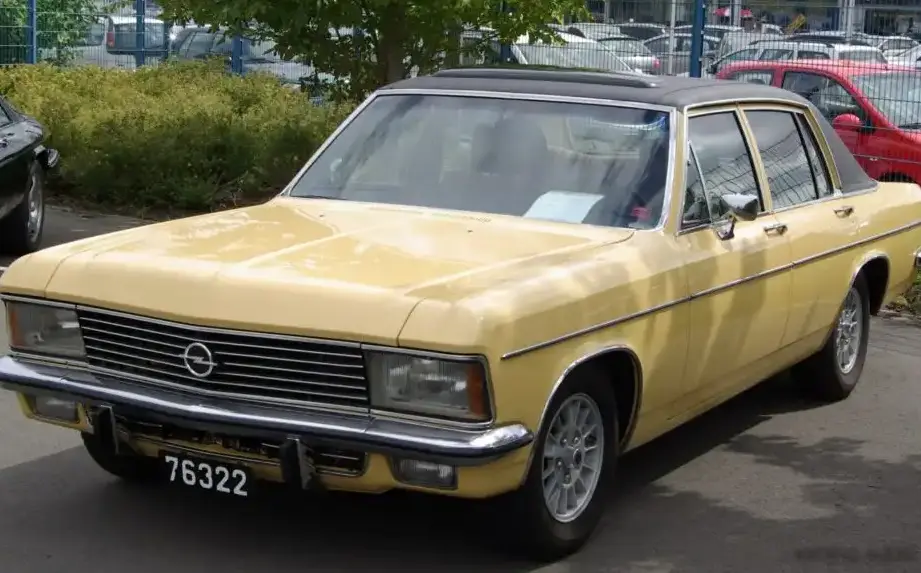
The Opel Admiral B 2.8, produced between 1975 and 1976, represented a significant iteration of Opel’s flagship saloon. Positioned as a luxury vehicle within the Opel range, the Admiral B aimed to compete with offerings from Ford and other European manufacturers. This particular variant, equipped with the 2.8-liter engine producing 140 horsepower, was a mid-range offering within the Admiral B lineup, slotting below the more powerful fuel-injected versions but offering a more accessible price point than those higher-spec models. The Admiral B was built upon Opel’s K-platform, shared with other large Opel models of the era, and was a key part of Opel’s strategy to provide a comfortable and well-equipped vehicle for the discerning European driver.
Technical Specifications
| Brand | Opel |
| Model | Admiral |
| Generation | Admiral B |
| Type (Engine) | 2.8 (140 Hp) |
| Start of production | 1975 |
| End of production | 1976 |
| Powertrain Architecture | Internal Combustion engine |
| Body type | Sedan |
| Seats | 5 |
| Doors | 4 |
| Fuel Type | Petrol (Gasoline) |
| Maximum speed | 185 km/h (114.95 mph) |
| Weight-to-power ratio | 10.7 kg/Hp, 93.6 Hp/tonne |
| Weight-to-torque ratio | 6.8 kg/Nm, 147.8 Nm/tonne |
| Power | 140 Hp |
| Power per litre | 50.3 Hp/l |
| Torque | 221 Nm @ 3400-3800 rpm (163 lb.-ft. @ 3400-3800 rpm) |
| Engine Model/Code | 28H |
| Engine displacement | 2784 cm3 (169.89 cu. in.) |
| Number of cylinders | 6 |
| Engine configuration | Inline |
| Cylinder Bore | 92 mm (3.62 in.) |
| Piston Stroke | 69.8 mm (2.75 in.) |
| Compression ratio | 9:1 |
| Number of valves per cylinder | 2 |
| Fuel injection system | Carburettor |
| Engine aspiration | Naturally aspirated engine |
| Valvetrain | SOHC |
| Engine oil capacity | 4.5 l (4.76 US qt | 3.96 UK qt) |
| Coolant | 8.7 l (9.19 US qt | 7.65 UK qt) |
| Kerb Weight | 1495 kg (3295.91 lbs.) |
| Max. weight | 1980 kg (4365.15 lbs.) |
| Max load | 485 kg (1069.24 lbs.) |
| Trunk (boot) space – maximum | 475 l (16.77 cu. ft.) |
| Fuel tank capacity | 80 l (21.13 US gal | 17.6 UK gal) |
| Permitted trailer load with brakes (12%) | 1900 kg (4188.78 lbs.) |
| Permitted trailer load without brakes | 750 kg (1653.47 lbs.) |
| Length | 4907 mm (193.19 in.) |
| Width | 1852 mm (72.91 in.) |
| Height | 1450 mm (57.09 in.) |
| Wheelbase | 2845 mm (112.01 in.) |
| Front track | 1505 mm (59.25 in.) |
| Rear (Back) track | 1505 mm (59.25 in.) |
| Ride height (ground clearance) | 150 mm (5.91 in.) |
| Drag coefficient (Cd) | 0.45 |
| Minimum turning circle (turning diameter) | 11.8 m (38.71 ft.) |
| Drivetrain Architecture | The Internal combustion engine (ICE) drives the rear wheels of the vehicle. |
| Drive wheel | Rear wheel drive |
| Number of gears and type of gearbox | 4 gears, manual transmission |
| Front brakes | Ventilated discs |
| Rear brakes | Drum |
Powertrain & Engine Architecture
The heart of the Admiral B 2.8 was the 2784cc inline-six cylinder engine, designated the 28H. This engine featured a single overhead camshaft (SOHC) valvetrain operating two valves per cylinder. Unlike some of its contemporaries, the 2.8-liter engine utilized a carburettor fuel system, rather than fuel injection, which was a cost-saving measure. The carburettor provided adequate fuel delivery for the engine’s 140 horsepower output, peaking at 3400-3800 rpm, and 163 lb-ft of torque. The engine’s bore and stroke measured 92mm x 69.8mm respectively, contributing to its relatively long-stroke design. The four-speed manual transmission was standard, delivering power to the rear wheels. The engine was known for its smooth operation and relatively quiet character, typical of inline-six configurations.
Driving Characteristics
The 2.8-liter engine delivered a respectable, but not exhilarating, driving experience. Acceleration was adequate, but the car’s substantial weight of approximately 3296 lbs meant that it wasn’t particularly nimble. The four-speed manual transmission offered a reasonable spread of gears, but the engine’s torque peak at 3400-3800 rpm meant that frequent shifting was often required to maintain optimal power delivery. Compared to the higher-output, fuel-injected versions of the Admiral B, this variant felt noticeably less responsive. However, it offered a more relaxed and fuel-efficient driving experience, making it suitable for long-distance cruising. The car wasn’t designed for sporty handling, prioritizing comfort and a smooth ride over aggressive cornering.
Equipment & Trim Levels
The Admiral B 2.8 was generally well-equipped for its time, reflecting its positioning as a luxury vehicle. Standard features included comfortable cloth upholstery, a wood-trimmed dashboard, and a comprehensive instrument panel. Power steering was often included, though not always standard. Optional extras included a sunroof, upgraded audio systems, and more luxurious interior trim options. The Admiral B aimed to provide a comfortable and refined interior environment, with a focus on passenger space and convenience. The trim level of the 2.8-liter model was typically positioned as a mid-range offering, providing a good balance of features and affordability. It lacked some of the more opulent features found in the top-tier, fuel-injected models, but still offered a comfortable and well-appointed cabin.
Chassis & Braking
The Admiral B utilized a traditional body-on-frame construction, providing a robust and durable chassis. The suspension consisted of independent front suspension with coil springs and a live axle rear suspension with leaf springs. The braking system featured ventilated disc brakes at the front and drum brakes at the rear. While adequate for the car’s weight and performance, the braking system wasn’t particularly sophisticated by modern standards. The car’s relatively long wheelbase contributed to a comfortable ride, but also resulted in a noticeable amount of body roll during cornering. Stabilizer bars were fitted to both the front and rear axles to help mitigate this body roll. The suspension was tuned for comfort, absorbing bumps and providing a smooth ride on most road surfaces.
Market Reception & Comparison
The Opel Admiral B 2.8 received generally positive reviews from automotive critics. It was praised for its comfortable ride, spacious interior, and smooth engine operation. However, some critics noted that the carburetted engine lacked the refinement and performance of fuel-injected alternatives. Compared to other trims in the Admiral B lineup, the 2.8-liter model offered a more affordable entry point into the Admiral B range, but at the expense of some performance and prestige. Fuel economy was typical for a large saloon of the era, and reliability was generally good, although maintenance costs could be relatively high due to the car’s complex mechanical systems. It represented a good value proposition for buyers seeking a comfortable and spacious luxury car without the higher price tag of the more powerful models.
Legacy
The Opel Admiral B 2.8, while not the most powerful or technologically advanced version of the Admiral B, remains a fondly remembered classic car. The 28H engine, while carburetted, proved to be a durable and reliable unit when properly maintained. Today, the Admiral B 2.8 is a relatively rare sight on the road, and well-maintained examples are sought after by classic car enthusiasts. Parts availability can be a challenge, but a dedicated community of Opel enthusiasts exists to support owners. The Admiral B represents a significant chapter in Opel’s history, showcasing the company’s commitment to building comfortable, well-equipped, and stylish automobiles. Its blend of comfort, space, and relative affordability made it a popular choice for families and discerning drivers alike.
