
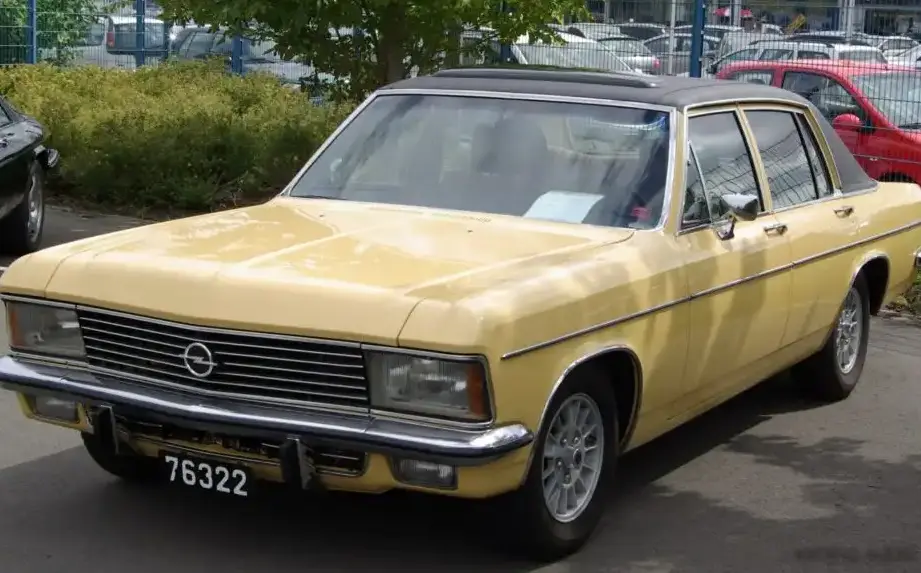
The Opel Admiral B 2.8 E Automatic, produced between 1975 and 1978, represented a significant iteration of Opel’s flagship sedan. Positioned as a luxury vehicle within the Opel range, the Admiral B aimed to compete with offerings from Ford and other European manufacturers. This particular variant, equipped with the 2.8-liter inline-six engine and a three-speed automatic transmission, was intended to provide a comfortable and refined driving experience, appealing to buyers prioritizing ease of use over outright performance. It was part of the broader Admiral B series (1968-1977), which itself was a successor to the earlier Admiral models and represented Opel’s attempt to establish a strong presence in the upper-midsize segment.
Technical Specifications
| Brand | Opel |
| Model | Admiral |
| Generation | Admiral B |
| Type (Engine) | 2.8 E (160 Hp) Automatic |
| Start of production | 1975 |
| End of production | 1978 |
| Powertrain Architecture | Internal Combustion engine |
| Body type | Sedan |
| Seats | 5 |
| Doors | 4 |
| Fuel Type | Petrol (Gasoline) |
| Maximum speed | 185 km/h (114.95 mph) |
| Weight-to-power ratio | 9.6 kg/Hp, 104.6 Hp/tonne |
| Weight-to-torque ratio | 6.8 kg/Nm, 147.1 Nm/tonne |
| Power | 160 Hp @ 5600 rpm |
| Power per litre | 57.5 Hp/l |
| Torque | 225 Nm @ 3000-3200 rpm (165.95 lb.-ft. @ 3000-3200 rpm) |
| Engine Model/Code | 28E |
| Engine displacement | 2784 cm3 (169.89 cu. in.) |
| Number of cylinders | 6 |
| Engine configuration | Inline |
| Cylinder Bore | 92 mm (3.62 in.) |
| Piston Stroke | 69.8 mm (2.75 in.) |
| Compression ratio | 9:1 |
| Fuel injection system | Multi-port manifold injection |
| Engine aspiration | Naturally aspirated engine |
| Valvetrain | SOHC |
| Engine oil capacity | 4.5 l (4.76 US qt | 3.96 UK qt) |
| Kerb Weight | 1530 kg (3373.07 lbs.) |
| Max. weight | 2020 kg (4453.34 lbs.) |
| Max load | 490 kg (1080.27 lbs.) |
| Trunk (boot) space – maximum | 475 l (16.77 cu. ft.) |
| Fuel tank capacity | 80 l (21.13 US gal | 17.6 UK gal) |
| Permitted trailer load with brakes (12%) | 1900 kg (4188.78 lbs.) |
| Permitted trailer load without brakes | 750 kg (1653.47 lbs.) |
| Length | 4907 mm (193.19 in.) |
| Width | 1852 mm (72.91 in.) |
| Height | 1450 mm (57.09 in.) |
| Wheelbase | 2845 mm (112.01 in.) |
| Front track | 1505 mm (59.25 in.) |
| Rear (Back) track | 1512 mm (59.53 in.) |
| Ride height (ground clearance) | 150 mm (5.91 in.) |
| Drag coefficient (Cd) | 0.45 |
| Minimum turning circle (turning diameter) | 11.8 m (38.71 ft.) |
| Drivetrain Architecture | The Internal combustion engine (ICE) drives the rear wheels of the vehicle. |
| Drive wheel | Rear wheel drive |
| Number of gears and type of gearbox | 3 gears, automatic transmission |
| Front brakes | Ventilated discs |
| Rear brakes | Ventilated discs |
Powertrain & Engine Architecture
The heart of the Admiral B 2.8 E Automatic was the 28E engine, a 2.8-liter (2784 cc) inline-six cylinder powerplant. This engine featured a single overhead camshaft (SOHC) valvetrain and utilized multi-port fuel injection, a relatively advanced feature for the mid-1970s. The 9:1 compression ratio contributed to the engine’s 160 horsepower output at 5600 rpm and 225 Nm (165.95 lb-ft) of torque, peaking between 3000 and 3200 rpm. The engine’s inline-six configuration provided inherent smoothness, a characteristic valued in luxury vehicles. The three-speed automatic transmission, while offering convenience, was a somewhat dated design by the late 1970s, lacking the efficiency and responsiveness of more modern automatics. It was a typical torque converter automatic, prioritizing smooth shifts over outright performance.
Driving Characteristics
The 2.8 E Automatic offered a comfortable, if not particularly sporty, driving experience. The automatic transmission, while smooth, resulted in a noticeable difference in acceleration compared to the available manual transmission options. The gear ratios were geared towards cruising comfort rather than rapid acceleration. The 0-60 mph time was estimated to be around 11-12 seconds, placing it behind more performance-oriented vehicles of the era. The rear-wheel drive configuration provided predictable handling, but the relatively heavy curb weight of 1530 kg (3373.07 lbs) limited agility. The engine’s torque delivery was relatively flat, making it suitable for relaxed highway cruising and overtaking maneuvers, but it lacked the punch of smaller, turbocharged engines that were beginning to emerge.
Equipment & Trim Levels
The Admiral B 2.8 E Automatic was well-equipped for its time, reflecting its positioning as a luxury vehicle. Standard features typically included power steering, central locking, and a high-quality interior with cloth upholstery. Leather upholstery, a sunroof, and a more advanced audio system were available as optional extras. The dashboard layout was functional and elegant, featuring woodgrain trim and analog gauges. The interior space was generous, providing comfortable seating for five passengers. Air conditioning was a popular option, particularly in warmer climates.
Chassis & Braking
The Admiral B utilized a traditional body-on-frame construction, contributing to its substantial weight. The suspension consisted of independent front suspension with coil springs and a live axle rear suspension with leaf springs. Ventilated disc brakes were fitted to all four wheels, providing adequate stopping power for the vehicle’s weight. However, the braking system lacked the sophistication of more modern anti-lock braking systems (ABS). Stabilizer bars were included both front and rear to reduce body roll during cornering, but the overall handling was biased towards comfort rather than sporty dynamics.
Market Reception & Comparison
The Opel Admiral B 2.8 E Automatic received mixed reviews from automotive critics. While praised for its comfortable ride, spacious interior, and refined engine, it was often criticized for its dated automatic transmission and relatively high price. Compared to the more sporting Opel Diplomat, the Admiral offered a more balanced blend of luxury and practicality. Against competitors like the Ford Granada and BMW 5 Series, the Admiral B offered a competitive level of equipment and comfort, but often lacked the brand prestige of its German rivals. Fuel economy was also a concern, typical for a large-displacement, naturally aspirated engine of the era.
Legacy
The Opel Admiral B 2.8 E Automatic, while not a groundbreaking vehicle, represents a significant chapter in Opel’s history. The 28E engine proved to be relatively durable, and well-maintained examples continue to be found today. However, parts availability can be a challenge, and the automatic transmission is known to require more frequent servicing than the manual counterparts. In the used car market, the Admiral B 2.8 E Automatic is appreciated by classic car enthusiasts for its retro styling, comfortable ride, and relatively straightforward mechanical design. It remains a testament to a period when large, comfortable sedans were highly valued, and Opel aimed to compete with the best in Europe.
