
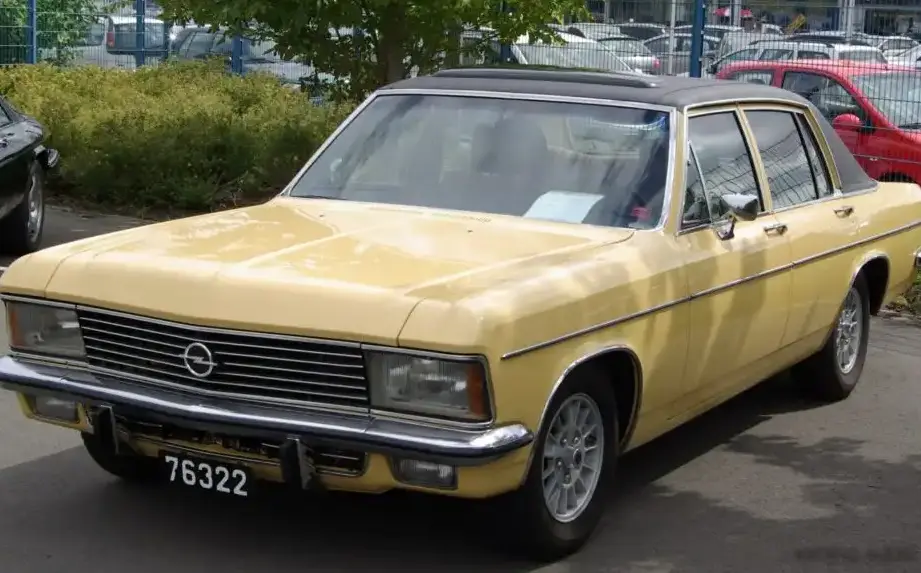
The Opel Admiral B 2.8 E Automatic, produced between 1969 and 1975, represented a significant offering in Opel’s luxury car segment. Positioned as a premium sedan, it was the flagship model, aimed at buyers seeking comfort, space, and a degree of prestige. This variant, equipped with the 2.8-liter inline-six engine and a three-speed automatic transmission, occupied a middle ground within the Admiral B range, offering a balance between performance and ease of driving compared to the manual transmission options. It was part of the broader Admiral B series (1968-1975), which aimed to modernize Opel’s image and compete with established German and British luxury brands.
Technical Specifications
| Brand | Opel |
| Model | Admiral |
| Generation | Admiral B |
| Type (Engine) | 2.8 E (165 Hp) Automatic |
| Start of production | 1969 |
| End of production | 1975 |
| Powertrain Architecture | Internal Combustion engine |
| Body type | Sedan |
| Seats | 5 |
| Doors | 4 |
| Fuel Type | Petrol (Gasoline) |
| Maximum speed | 185 km/h (114.95 mph) |
| Weight-to-power ratio | 9.3 kg/Hp, 107.8 Hp/tonne |
| Weight-to-torque ratio | 6.7 kg/Nm, 149.7 Nm/tonne |
| Power | 165 Hp |
| Power per litre | 59.3 Hp/l |
| Torque | 229 Nm @ 4100-4600 rpm (168.9 lb.-ft. @ 4100-4600 rpm) |
| Engine Model/Code | 28E |
| Engine displacement | 2784 cm3 (169.89 cu. in.) |
| Number of cylinders | 6 |
| Engine configuration | Inline |
| Cylinder Bore | 92 mm (3.62 in.) |
| Piston Stroke | 69.8 mm (2.75 in.) |
| Compression ratio | 9.5:1 |
| Fuel injection system | Multi-port manifold injection |
| Engine aspiration | Naturally aspirated engine |
| Valvetrain | SOHC |
| Engine oil capacity | 4.5 l (4.76 US qt | 3.96 UK qt) |
| Kerb Weight | 1530 kg (3373.07 lbs.) |
| Max. weight | 2020 kg (4453.34 lbs.) |
| Max load | 490 kg (1080.27 lbs.) |
| Trunk (boot) space – maximum | 475 l (16.77 cu. ft.) |
| Permitted trailer load with brakes (12%) | 1400 kg (3086.47 lbs.) |
| Permitted trailer load without brakes | 700 kg (1543.24 lbs.) |
| Length | 4907 mm (193.19 in.) |
| Width | 1852 mm (72.91 in.) |
| Height | 1450 mm (57.09 in.) |
| Wheelbase | 2845 mm (112.01 in.) |
| Front track | 1505 mm (59.25 in.) |
| Rear (Back) track | 1512 mm (59.53 in.) |
| Ride height (ground clearance) | 150 mm (5.91 in.) |
| Drag coefficient (Cd) | 0.45 |
| Minimum turning circle (turning diameter) | 11.8 m (38.71 ft.) |
| Drivetrain Architecture | The Internal combustion engine (ICE) drives the rear wheels of the vehicle. |
| Drive wheel | Rear wheel drive |
| Number of gears and type of gearbox | 3 gears, automatic transmission |
| Front brakes | Ventilated discs |
| Rear brakes | Ventilated discs |
Powertrain & Engine Architecture
The heart of the Admiral B 2.8 E Automatic was the 28E engine, a 2.8-liter (2784 cc) inline-six cylinder powerplant. This engine featured a single overhead camshaft (SOHC) valvetrain and utilized multi-port fuel injection, a relatively advanced feature for the time. The engine produced 165 horsepower and 229 Nm (168.9 lb-ft) of torque, peaking between 4100 and 4600 rpm. The automatic transmission was a three-speed unit, providing smooth, if not particularly rapid, gear changes. The transmission was designed for comfortable cruising rather than sporty acceleration. The engine’s inline-six configuration contributed to a relatively smooth and refined driving experience, a key selling point for the Admiral. The engine block itself was cast iron, known for its durability, while the cylinder head was aluminum, helping to reduce weight. The fuel injection system, while not electronic, was a significant improvement over carbureted engines, offering better fuel atomization and improved throttle response.
Driving Characteristics
The 2.8 E Automatic offered a comfortable and relaxed driving experience. The automatic transmission, while lacking the responsiveness of a manual, suited the car’s intended purpose as a luxury cruiser. Acceleration was adequate for the era, but not particularly brisk. The three-speed automatic’s gear ratios were optimized for fuel economy and smooth cruising at highway speeds. Compared to the manual transmission versions of the Admiral B, the automatic offered less driver involvement but greater convenience. It also lagged behind the performance of the larger-displacement V8 engines available in some competing models. The rear-wheel-drive configuration provided predictable handling, but the car’s considerable weight (1530 kg / 3373.07 lbs) limited its agility. Steering was relatively heavy, typical of cars from this period, but provided a solid feel on the road. The suspension, while comfortable, could exhibit some body roll during spirited cornering.
Equipment & Trim Levels
The Admiral B 2.8 E Automatic came reasonably well-equipped for its time. Standard features typically included power steering, central locking, and a high-quality radio. Interior upholstery was typically cloth, although leather was available as an optional extra. The dashboard featured woodgrain trim and a comprehensive array of gauges, including a speedometer, tachometer, fuel gauge, and temperature gauge. Optional extras included air conditioning, electric windows, and a sunroof. The trim level was generally considered to be a step above the base Admiral models, reflecting the higher price point of the 2.8 E variant. Features like a rear window defogger and a cigarette lighter were also commonly included. The overall interior ambiance was designed to convey a sense of luxury and sophistication.
Chassis & Braking
The Admiral B utilized a traditional body-on-frame construction, providing a comfortable ride but contributing to the car’s substantial weight. The suspension consisted of independent front suspension with coil springs and a live axle rear suspension with leaf springs. Braking was provided by ventilated disc brakes on all four wheels, offering adequate stopping power for the car’s weight and performance. Stabilizer bars were fitted to both the front and rear axles to reduce body roll during cornering. The steering was a recirculating ball system, providing a relatively heavy but precise feel. The chassis design prioritized ride comfort over sporty handling, making it well-suited for long-distance cruising. The use of a separate frame allowed for a more isolated passenger compartment, reducing noise and vibration.
Market Reception & Comparison
The Opel Admiral B 2.8 E Automatic was generally well-received by automotive critics, who praised its comfortable ride, spacious interior, and refined engine. However, some critics noted that the car’s performance was not as exciting as some of its competitors, and the automatic transmission could feel sluggish at times. Compared to other trims in the Admiral B lineup, the 2.8 E Automatic offered a good balance between performance and convenience. It was more affordable than the V8-powered models but offered more power and refinement than the smaller-engined versions. Fuel economy, while not a primary concern for buyers in this segment, was reasonable for a car of its size and engine displacement. It competed with models like the Ford Zephyr, Vauxhall Viscount, and various British offerings from Rover and Triumph.
Legacy
The Opel Admiral B, while not a particularly rare car today, has gained a following among classic car enthusiasts. The 2.8 E Automatic variant is considered a desirable model due to its smooth engine and comfortable driving experience. The inline-six engine is known for its reliability, although regular maintenance is essential to keep it running smoothly. Parts availability can be a challenge, but a network of specialist suppliers exists to cater to the classic Opel market. The Admiral B represents a significant chapter in Opel’s history, showcasing the company’s ambition to compete in the luxury car segment. Today, well-maintained examples of the 2.8 E Automatic are sought after by collectors and enthusiasts who appreciate its classic styling and refined character. The car’s enduring appeal lies in its combination of comfort, style, and mechanical simplicity.
