
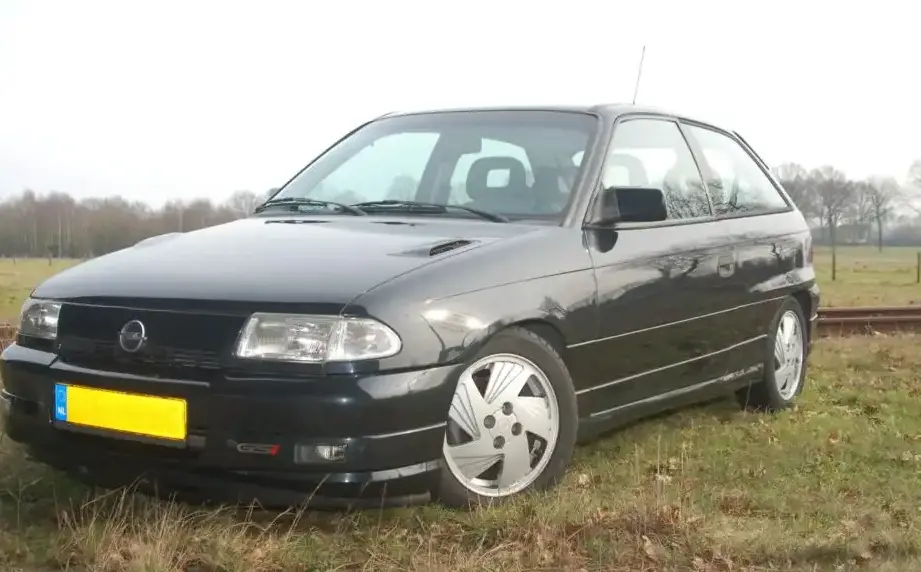
The Opel Astra F 1.7 D, produced from October 1991 to July 1992, represented an entry-level diesel offering within the broader Astra F range (1991-1998). Positioned as the most economical variant, it catered to buyers prioritizing fuel efficiency over outright performance. This model, powered by a naturally aspirated 1.7-liter diesel engine producing 57 horsepower, was primarily sold in European markets, offering a practical and affordable compact hatchback option. It was a key component of the Astra F’s initial launch, aiming to capture a segment of the market seeking a no-frills, reliable vehicle.
Technical Specifications
| Brand | Opel |
| Model | Astra |
| Generation | Astra F |
| Type (Engine) | 1.7 D (57 Hp) |
| Start of production | October, 1991 |
| End of production | July, 1992 |
| Powertrain Architecture | Internal Combustion engine |
| Body type | Hatchback |
| Seats | 5 |
| Doors | 5 |
| Fuel consumption (urban) | 6.7 l/100 km (35.1 US mpg, 42.2 UK mpg, 14.9 km/l) |
| Fuel consumption (extra urban) | 4.2 l/100 km (56 US mpg, 67.3 UK mpg, 23.8 km/l) |
| Fuel consumption (combined) | 6 l/100 km (39.2 US mpg, 47.1 UK mpg, 16.7 km/l) |
| Fuel Type | Diesel |
| Acceleration 0 – 100 km/h | 18.5 sec |
| Acceleration 0 – 62 mph | 18.5 sec |
| Acceleration 0 – 60 mph | 17.6 sec |
| Maximum speed | 153 km/h (95.07 mph) |
| Weight-to-power ratio | 17.6 kg/Hp, 56.7 Hp/tonne |
| Weight-to-torque ratio | 9.6 kg/Nm, 104.5 Nm/tonne |
| Power | 57 Hp @ 4600 rpm |
| Power per litre | 33.5 Hp/l |
| Torque | 105 Nm @ 2400 rpm (77.44 lb.-ft. @ 2400 rpm) |
| Engine layout | Front, Transverse |
| Engine Model/Code | 17D |
| Engine displacement | 1699 cm3 (103.68 cu. in.) |
| Number of cylinders | 4 |
| Engine configuration | Inline |
| Cylinder Bore | 82.5 mm (3.25 in.) |
| Piston Stroke | 79.5 mm (3.13 in.) |
| Compression ratio | 23:1 |
| Number of valves per cylinder | 2 |
| Fuel injection system | Precombustion chamber injection |
| Engine aspiration | Naturally aspirated engine |
| Valvetrain | SOHC |
| Engine oil capacity | 5 l (5.28 US qt | 4.4 UK qt) |
| Coolant capacity | 7.8 l (8.24 US qt | 6.86 UK qt) |
| Kerb Weight | 1005 kg (2215.65 lbs.) |
| Max. weight | 1515 kg (3340 lbs.) |
| Max load | 510 kg (1124.36 lbs.) |
| Trunk (boot) space – minimum | 360 l (12.71 cu. ft.) |
| Trunk (boot) space – maximum | 1200 l (42.38 cu. ft.) |
| Fuel tank capacity | 52 l (13.74 US gal | 11.44 UK gal) |
| Length | 4051 mm (159.49 in.) |
| Width | 1688 mm (66.46 in.) |
| Width including mirrors | 1795 mm (70.67 in.) |
| Height | 1410 mm (55.51 in.) |
| Wheelbase | 2517 mm (99.09 in.) |
| Front track | 1430 mm (56.3 in.) |
| Rear (Back) track | 1429 mm (56.26 in.) |
| Ride height (ground clearance) | 135 mm (5.31 in.) |
| Drag coefficient (Cd) | 0.32 |
| Minimum turning circle | 10.5 m (34.45 ft.) |
| Drivetrain Architecture | The Internal combustion engine (ICE) drives the front wheels of the vehicle. |
| Drive wheel | Front wheel drive |
| Number of gears and type of gearbox | 5 gears, manual transmission |
| Front suspension | Independent, type McPherson with coil spring and anti-roll bar |
| Rear suspension | Spring Strut, Coil spring, Torsion |
| Front brakes | Ventilated discs |
| Rear brakes | Drum |
| Assisting systems | ABS (Anti-lock braking system) |
| Steering type | Steering rack and pinion |
| Tires size | 175/70 R13 82T; 175/65 R14 82T |
| Wheel rims size | 5.5J x 13 ET49; 5.5J x 14 ET49 |
Powertrain & Engine Architecture
The heart of the Astra F 1.7 D is the 17D engine, a 1.7-liter inline-four diesel. This engine utilized a precombustion chamber injection system, a common technology for diesel engines of the era. This system involved injecting fuel into a precombustion chamber, where it partially ignited before entering the main combustion chamber, promoting more complete combustion. The engine featured a single overhead camshaft (SOHC) valvetrain operating two valves per cylinder. The 17D engine was known for its robustness and simplicity, prioritizing reliability over high performance. The five-speed manual transmission was the only gearbox option available with this engine, geared towards maximizing fuel economy rather than providing sporty acceleration.
Driving Characteristics
The 1.7 D-powered Astra F offered a utilitarian driving experience. With only 57 horsepower, acceleration was slow, taking approximately 18.5 seconds to reach 62 mph. The engine’s torque peak of 105 Nm (77.44 lb-ft) at 2400 rpm provided adequate pulling power for everyday driving, but overtaking required careful planning. The five-speed gearbox was well-matched to the engine’s characteristics, with relatively long gear ratios designed to keep the engine within its optimal operating range. Compared to the more powerful gasoline variants (like the 1.8 or 2.0-liter engines) or even the later 1.7 TDI, the 1.7 D felt significantly underpowered. However, it excelled in fuel economy, making it a popular choice for high-mileage drivers.
Equipment & Trim Levels
The 1.7 D Astra F was typically offered in a base trim level, focusing on essential features. Standard equipment generally included basic steel wheels, cloth upholstery, manual windows and door locks, and a simple instrument cluster. Optional extras were limited, often including power steering, a radio/cassette player, and upgraded interior trim. The interior was functional and durable, prioritizing practicality over luxury. The dashboard layout was straightforward, with clearly labeled controls. Air conditioning was rarely fitted to this base model.
Chassis & Braking
The Astra F 1.7 D utilized a McPherson strut front suspension with a torsion beam rear suspension. This setup provided a comfortable ride, although handling was not particularly sporty. The front brakes were ventilated discs, offering adequate stopping power, while the rear brakes were drums, a cost-saving measure common in entry-level models. An anti-lock braking system (ABS) was available as an option, enhancing safety. The chassis was designed to balance affordability with structural integrity, providing a solid foundation for the vehicle.
Market Reception & Comparison
The Astra F 1.7 D was well-received in markets where fuel economy was a primary concern. Critics acknowledged its affordability and reliability, but often noted its lack of performance. Compared to the gasoline-powered Astra F models, the 1.7 D offered significantly better fuel economy but considerably slower acceleration. The later introduction of the 1.7 TDI diesel engine provided a more refined and powerful alternative, eventually overshadowing the 1.7 D in popularity. However, the 1.7 D remained a popular choice for budget-conscious buyers and those covering long distances.
Legacy
The Opel Astra F 1.7 D powertrain, while not known for its excitement, proved to be remarkably durable. Many examples remain on the road today, testament to the engine’s robust construction. In the used car market, these models are valued for their simplicity and low running costs. Maintenance is relatively straightforward, and parts availability remains good. However, potential buyers should be aware of the age-related issues common to older diesel engines, such as injector wear and potential for rust. The 1.7 D Astra F represents a practical and economical choice for those seeking a classic, no-frills hatchback.
