
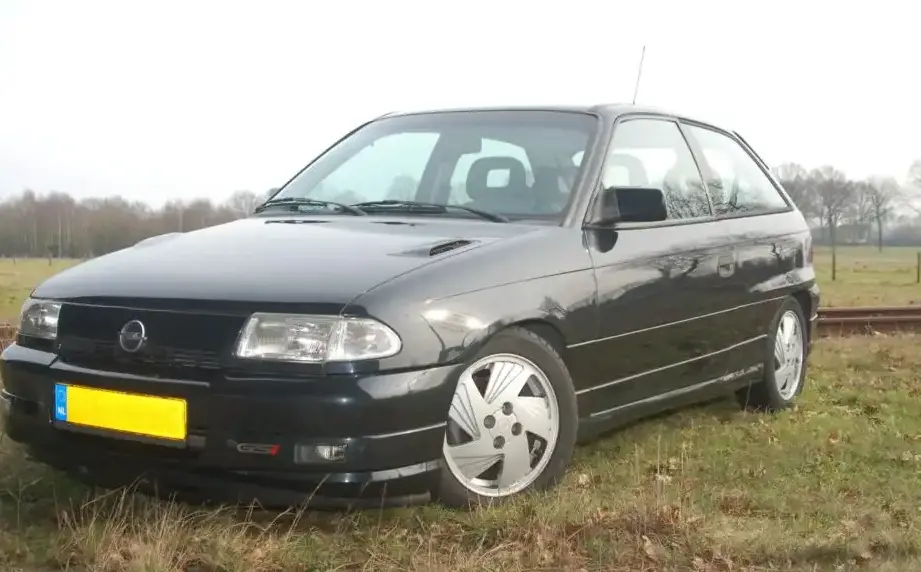
The Opel Astra F 1.7 D, producing 60 horsepower, was a mainstay of the Astra F range from its introduction in August 1992 until July 1994. Positioned as the entry-level diesel variant, it offered economical transportation within the broader Astra F generation (1991-1998), which represented a significant step forward for Opel in terms of design, safety, and technology. This model was primarily aimed at buyers in Europe seeking a practical and fuel-efficient hatchback, and it played a crucial role in establishing the Astra F as a popular choice in the compact car segment.
Technical Specifications
| Brand | Opel |
| Model | Astra |
| Generation | Astra F |
| Type (Engine) | 1.7 D (60 Hp) |
| Start of production | August, 1992 |
| End of production | July, 1994 |
| Powertrain Architecture | Internal Combustion engine |
| Body type | Hatchback |
| Seats | 5 |
| Doors | 3-5 |
| Fuel consumption (urban) | 6.7 l/100 km (35.1 US mpg, 42.2 UK mpg, 14.9 km/l) |
| Fuel consumption (extra urban) | 4.2 l/100 km (56 US mpg, 67.3 UK mpg, 23.8 km/l) |
| Fuel consumption (combined) | 5.6 l/100 km (42 US mpg, 50.4 UK mpg, 17.9 km/l) |
| CO2 emissions | 148 g/km |
| Fuel Type | Diesel |
| Acceleration 0 – 100 km/h | 18.5 sec |
| Acceleration 0 – 62 mph | 18.5 sec |
| Acceleration 0 – 60 mph | 17.6 sec |
| Maximum speed | 153 km/h (95.07 mph) |
| Emission standard | Euro 1 |
| Weight-to-power ratio | 17.1 kg/Hp, 58.5 Hp/tonne |
| Weight-to-torque ratio | 9.8 kg/Nm, 102.4 Nm/tonne |
| Power | 60 Hp @ 4600 rpm |
| Power per litre | 35.3 Hp/l |
| Torque | 105 Nm @ 2400-2600 rpm (77.44 lb.-ft. @ 2400-2600 rpm) |
| Engine layout | Front, Transverse |
| Engine Model/Code | 17DR |
| Engine displacement | 1699 cm3 (103.68 cu. in.) |
| Number of cylinders | 4 |
| Engine configuration | Inline |
| Cylinder Bore | 82.5 mm (3.25 in.) |
| Piston Stroke | 79.5 mm (3.13 in.) |
| Compression ratio | 23:1 |
| Number of valves per cylinder | 2 |
| Fuel injection system | Precombustion chamber injection |
| Engine aspiration | Naturally aspirated engine |
| Valvetrain | SOHC |
| Engine oil capacity | 5 l (5.28 US qt | 4.4 UK qt) |
| Coolant | 7.8 l (8.24 US qt | 6.86 UK qt) |
| Kerb Weight | 1025/1045 kg (2259.74 lbs.) |
| Max. weight | 1535 kg (3384.1 lbs.) |
| Max load | 490-510 kg (1080.27 – 1124.36 lbs.) |
| Trunk (boot) space – minimum | 360 l (12.71 cu. ft.) |
| Trunk (boot) space – maximum | 1200 l (42.38 cu. ft.) |
| Fuel tank capacity | 52 l (13.74 US gal | 11.44 UK gal) |
| Length | 4051 mm (159.49 in.) |
| Width | 1688 mm (66.46 in.) |
| Width including mirrors | 1795 mm (70.67 in.) |
| Height | 1410 mm (55.51 in.) |
| Wheelbase | 2517 mm (99.09 in.) |
| Front track | 1430/1424 mm (56.3 in.) |
| Rear (Back) track | 1429/1423 mm (56.26 in.) |
| Ride height (ground clearance) | 135 mm (5.31 in.) |
| Drag coefficient (Cd) | 0.32 |
| Minimum turning circle | 10.5 m (34.45 ft.) |
| Drivetrain Architecture | The Internal combustion engine (ICE) drives the front wheels of the vehicle. |
| Drive wheel | Front wheel drive |
| Number of gears and type of gearbox | 5 gears, manual transmission |
| Front brakes | Ventilated discs |
| Rear brakes | Drum |
| Steering type | Steering rack and pinion |
| Tires size | 175/70 R13 82T; 175/65 R14 82T |
| Wheel rims size | 5.5J x 13 ET49; 5.5J x 14 ET49 |
INTRODUCTION
The Opel Astra F 1.7 D represented a crucial entry point into the Astra F range for budget-conscious buyers. Introduced in 1992, it offered a practical and economical solution for everyday transportation. The Astra F itself was a significant model for Opel, replacing the Astra GTE and moving the brand further upmarket in terms of build quality, safety features, and overall refinement. The 1.7 D variant, while not known for its performance, was highly regarded for its fuel efficiency and durability, making it a popular choice for high-mileage drivers. It was available in both 3-door and 5-door hatchback configurations.
Powertrain & Engine Architecture
The heart of the Astra F 1.7 D is the 17DR engine, a 1.7-liter inline-four diesel engine. This engine utilized a precombustion chamber injection system, a common technology for diesel engines of the era. This system involved injecting fuel into a precombustion chamber, where it partially ignited before entering the main combustion chamber, promoting more complete combustion and reducing emissions (for the time). The engine featured a single overhead camshaft (SOHC) valvetrain, operating two valves per cylinder. The 17DR engine produced 60 horsepower at 4600 rpm and 105 Nm (77.44 lb-ft) of torque between 2400 and 2600 rpm. The engine’s relatively low compression ratio of 23:1 contributed to its durability, but also limited its power output. The engine was transversely mounted in the front of the vehicle, driving the front wheels.
Driving Characteristics
The Astra F 1.7 D, with its 60 horsepower and 5-speed manual transmission, was not designed for spirited driving. Acceleration was leisurely, taking approximately 18.5 seconds to reach 100 km/h (62 mph). Its strength lay in its fuel economy and relaxed cruising ability. The gear ratios were optimized for efficiency rather than performance, meaning the engine needed to be revved to extract the most from it. Compared to the more powerful petrol variants (like the 1.8 or 2.0-liter engines) or even the later 1.7 TDI, the 1.7 D felt significantly slower. However, it offered a smoother and more predictable power delivery than some of the more highly-tuned diesel options.
Equipment & Trim Levels
The 1.7 D typically represented the base trim level within the Astra F range. Standard equipment was relatively basic, focusing on essential features. This included cloth upholstery, a simple dashboard layout, and manual windows and door locks. Power steering was often an optional extra. Higher trim levels, such as the GLS, added features like central locking, electric windows, and upgraded interior trim. Optional extras for the 1.7 D could include a sunroof, alloy wheels, and a radio/cassette player.
Chassis & Braking
The Astra F 1.7 D utilized a MacPherson strut front suspension and a torsion beam rear suspension. The rear brakes were drum brakes, a cost-saving measure common in entry-level models. Front brakes were ventilated discs. The suspension setup was tuned for comfort and ride quality, prioritizing a smooth ride over sporty handling. Stabilizer bars were present, but were typically smaller in diameter compared to those found on higher-spec Astra F models. The relatively light weight of the 1.7 D (around 1025-1045 kg) helped to mitigate the limitations of the braking system.
Market Reception & Comparison
The Astra F 1.7 D was generally well-received as a practical and economical choice. Critics praised its fuel efficiency and durability, but noted its lack of performance. Compared to the petrol-powered Astra F models, the 1.7 D offered significantly better fuel economy, but at the expense of acceleration and overall driving enjoyment. The later introduction of the 1.7 TDI diesel engine offered a more refined and powerful alternative, but also came at a higher price point. The 1.7 D remained a popular choice for those prioritizing economy and reliability.
Legacy
The Opel Astra F 1.7 D powertrain has proven to be remarkably durable, with many examples still on the road today. While maintenance costs can increase with age, the engine is generally considered to be relatively reliable. In the used car market, the 1.7 D is often sought after by those looking for a simple, affordable, and fuel-efficient vehicle. Its straightforward mechanical design makes it relatively easy to maintain and repair. However, potential buyers should be aware of the age-related issues common to older diesel engines, such as injector wear and potential issues with the precombustion chambers.
