
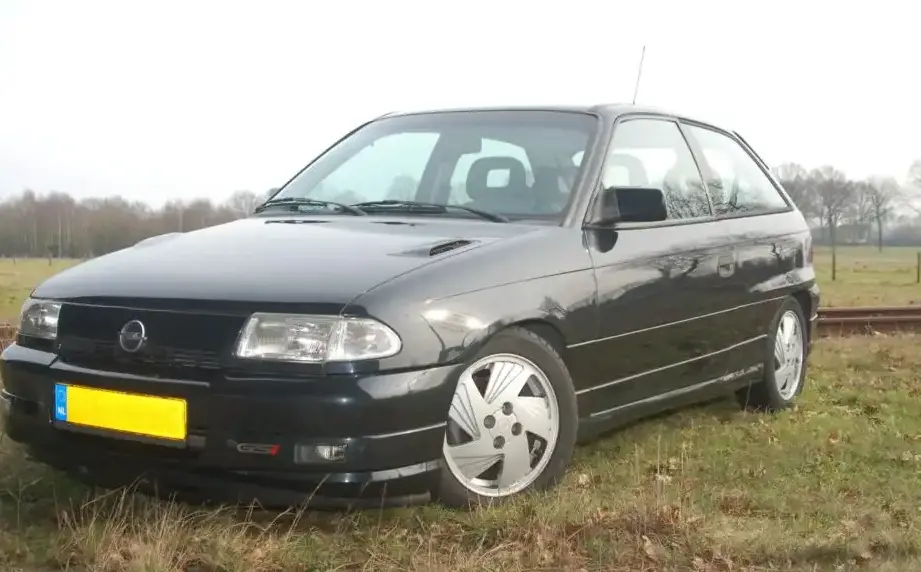
The Opel Astra F 1.7 Turbo, produced between October 1991 and July 1994, represented a notable offering within the broader Astra F range (1991-1998). Positioned as a mid-range variant, it aimed to bridge the gap between the base models and the more powerful, often gasoline-fueled, options. This particular version, powered by the X17DT engine, was primarily marketed in Europe as an efficient and relatively sporty diesel option, offering a blend of performance and economy that appealed to a wide range of buyers. The Astra F itself was a significant model for Opel, representing a substantial leap forward in design, safety, and technology compared to its predecessor, the Astra GTE.
Technical Specifications
| Brand | Opel |
| Model | Astra |
| Generation | Astra F |
| Type (Engine) | 1.7 Turbo (82 Hp) |
| Start of production | October, 1991 |
| End of production | July, 1994 |
| Powertrain Architecture | Internal Combustion engine |
| Body type | Hatchback |
| Seats | 5 |
| Doors | 3-5 |
| Fuel consumption (urban) | 6.7 l/100 km (35.1 US mpg, 42.2 UK mpg, 14.9 km/l) |
| Fuel consumption (extra urban) | 4.8 l/100 km (49 US mpg, 58.9 UK mpg, 20.8 km/l) |
| Fuel consumption (combined) | 6.6 l/100 km (35.6 US mpg, 42.8 UK mpg, 15.2 km/l) |
| Fuel Type | Diesel |
| Acceleration 0 – 100 km/h | 13.5 sec |
| Acceleration 0 – 62 mph | 13.5 sec |
| Acceleration 0 – 60 mph | 12.8 sec |
| Maximum speed | 173 km/h (107.5 mph) |
| Weight-to-power ratio | 13 kg/Hp, 77 Hp/tonne |
| Weight-to-torque ratio | 6.3 kg/Nm, 157.7 Nm/tonne |
| Power | 82 Hp @ 4400 rpm |
| Power per litre | 48.6 Hp/l |
| Torque | 168 Nm @ 2400 rpm (123.91 lb.-ft. @ 2400 rpm) |
| Engine layout | Front, Transverse |
| Engine Model/Code | X17DT |
| Engine displacement | 1686 cm3 (102.89 cu. in.) |
| Number of cylinders | 4 |
| Engine configuration | Inline |
| Cylinder Bore | 79 mm (3.11 in.) |
| Piston Stroke | 86 mm (3.39 in.) |
| Compression ratio | 22:1 |
| Number of valves per cylinder | 2 |
| Fuel injection system | Precombustion chamber injection |
| Engine aspiration | Turbocharger, Intercooler |
| Valvetrain | SOHC |
| Engine oil capacity | 4.5 l (4.76 US qt | 3.96 UK qt) |
| Coolant | 6.8 l (7.19 US qt | 5.98 UK qt) |
| Kerb Weight | 1065/1085 kg (2347.92 lbs.) |
| Max. weight | 1575 kg (3472.28 lbs.) |
| Max load | 490-510 kg (1080.27 – 1124.36 lbs.) |
| Trunk (boot) space – minimum | 360 l (12.71 cu. ft.) |
| Trunk (boot) space – maximum | 1200 l (42.38 cu. ft.) |
| Fuel tank capacity | 52 l (13.74 US gal | 11.44 UK gal) |
| Length | 4051 mm (159.49 in.) |
| Width | 1688 mm (66.46 in.) |
| Width including mirrors | 1795 mm (70.67 in.) |
| Height | 1410 mm (55.51 in.) |
| Wheelbase | 2517 mm (99.09 in.) |
| Front track | 1430 mm (56.3 in.) |
| Rear (Back) track | 1429 mm (56.26 in.) |
| Ride height (ground clearance) | 135 mm (5.31 in.) |
| Drag coefficient (Cd) | 0.32 |
| Minimum turning circle | 10.5 m (34.45 ft.) |
| Drivetrain Architecture | The Internal combustion engine (ICE) drives the front wheels of the vehicle. |
| Drive wheel | Front wheel drive |
| Number of gears and type of gearbox | 5 gears, manual transmission |
| Front suspension | Wishbone |
| Rear suspension | Suspension with traction connecting levers |
| Front brakes | Ventilated discs |
| Rear brakes | Drum |
| Assisting systems | ABS (Anti-lock braking system) |
| Steering type | Steering rack and pinion |
| Tires size | 175/70 R13 82T; 175/65 R14 82T |
| Wheel rims size | 5.5J x 13 ET49; 5.5J x 14 ET49 |
Powertrain & Engine Architecture
The heart of the Astra F 1.7 Turbo was the X17DT engine, a 1.7-liter inline-four cylinder diesel. This engine utilized a precombustion chamber injection system, a common technology for diesel engines of the era, designed to improve combustion efficiency and reduce noise. A turbocharger with an intercooler was employed to boost power output, bringing it to 82 horsepower at 4400 rpm and 168 Nm (124 lb-ft) of torque at 2400 rpm. The engine featured a single overhead camshaft (SOHC) valvetrain with two valves per cylinder. The 5-speed manual transmission was the only gearbox option available with this engine, providing a balance between fuel economy and drivability. The engine’s transverse mounting and front-wheel-drive configuration were standard for the Astra F.
Driving Characteristics
The 1.7 Turbo offered a noticeable step up in performance compared to the naturally aspirated diesel engines available in the Astra F range. While not a sports car by any means, the turbocharger provided a useful boost of power for overtaking and highway cruising. Acceleration from 0-60 mph took around 12.8 seconds, and the top speed was approximately 107.5 mph. The gear ratios in the 5-speed manual transmission were well-suited to the engine’s torque curve, providing adequate acceleration in each gear. Compared to the higher-output gasoline engines (like the 2.0L 16V), the 1.7 Turbo lacked outright speed but offered significantly better fuel economy. The turbo lag was noticeable, but not overly intrusive, and the engine provided a reasonably smooth and refined driving experience for a diesel of its time.
Equipment & Trim Levels
The Astra F 1.7 Turbo typically came equipped with a reasonable level of standard features. These included power steering, central locking, and a basic stereo system. Interior upholstery was typically cloth, and the dashboard featured a functional, if somewhat utilitarian, design. Optional extras included electric windows, a sunroof, and upgraded audio systems. Trim levels varied slightly depending on the market, but generally, the 1.7 Turbo occupied a mid-range position, offering more features than the base models but lacking the luxury appointments of the higher-spec versions.
Chassis & Braking
The Astra F 1.7 Turbo utilized a relatively simple chassis design. The front suspension featured independent wishbones, while the rear suspension employed a torsion beam setup with traction connecting levers. This configuration provided a good balance between ride comfort and handling. The braking system consisted of ventilated discs on the front wheels and drum brakes on the rear. Anti-lock braking system (ABS) was available as an option, enhancing safety. The steering was rack and pinion, providing precise and responsive control.
Market Reception & Comparison
The Astra F 1.7 Turbo was generally well-received by automotive critics as a practical and economical choice. It offered a good compromise between performance and fuel efficiency, making it an attractive option for drivers who covered long distances or prioritized running costs. Compared to the gasoline-powered Astra F models, the 1.7 Turbo offered superior fuel economy, but lacked the same level of refinement and outright performance. Against competitors like the Volkswagen Golf and Ford Escort, the Astra F 1.7 Turbo held its own, offering a competitive package in terms of price, features, and fuel efficiency.
Legacy
The X17DT engine, while not known for being particularly groundbreaking, proved to be a relatively reliable unit when properly maintained. The Astra F 1.7 Turbo has become a popular choice among classic car enthusiasts and budget-conscious buyers. Parts availability is generally good, and the engine is relatively straightforward to work on. However, like all older diesel engines, it is susceptible to wear and tear, and regular maintenance is essential to ensure long-term reliability. Today, the Astra F 1.7 Turbo represents a piece of automotive history, offering a glimpse into the era of efficient and practical European motoring.
