
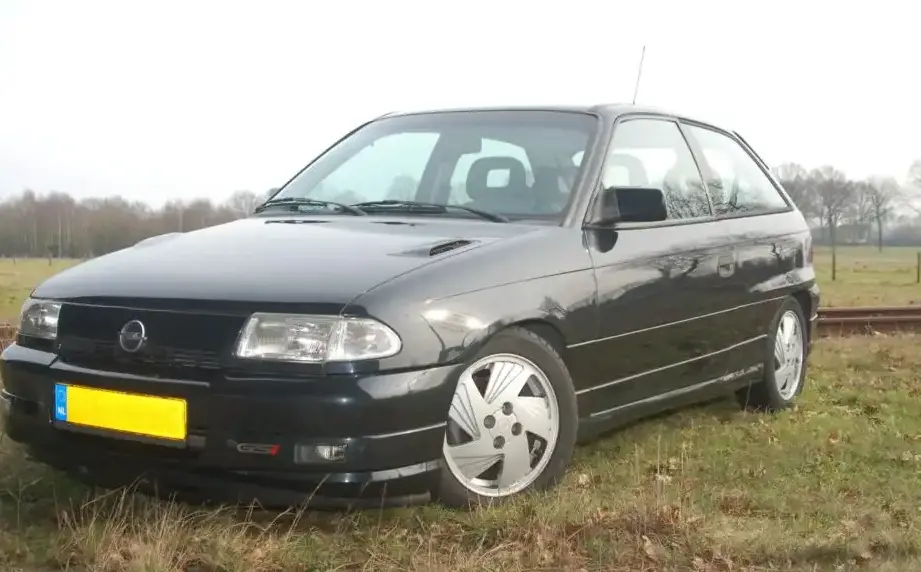
The Opel Astra F 1.8i (90 hp) was a popular variant of the Astra F series, produced between October 1991 and July 1994. Positioned as a mid-range offering within the lineup, it aimed to provide a balance between affordability, practicality, and reasonable performance. This model played a significant role in Opel’s success in the European compact car market, offering a gasoline-powered alternative to the diesel options and serving as a stepping stone to the more powerful Astra variants. It was available in both 3-door and 5-door hatchback body styles, catering to a wide range of buyers.
Technical Specifications
| Brand | Opel |
| Model | Astra |
| Generation | Astra F |
| Type (Engine) | 1.8i (90 Hp) |
| Start of production | October, 1991 |
| End of production | July, 1994 |
| Powertrain Architecture | Internal Combustion engine |
| Body type | Hatchback |
| Seats | 5 |
| Doors | 3-5 |
| Fuel consumption (urban) | 9.9 l/100 km (23.8 US mpg) |
| Fuel consumption (extra urban) | 5.6 l/100 km (42 US mpg) |
| Fuel consumption (combined) | 7.2 l/100 km (32.7 US mpg) |
| Fuel Type | Petrol (Gasoline) |
| Acceleration 0 – 100 km/h | 12.5 sec |
| Acceleration 0 – 62 mph | 12.5 sec |
| Acceleration 0 – 60 mph | 11.9 sec |
| Maximum speed | 180 km/h (111.85 mph) |
| Emission standard | Euro 1 |
| Weight-to-power ratio | 11.3 kg/Hp |
| Weight-to-torque ratio | 7 kg/Nm |
| Power | 90 Hp @ 5400 rpm |
| Torque | 145 Nm @ 3000 rpm (106.95 lb.-ft. @ 3000 rpm) |
| Engine layout | Front, Transverse |
| Engine Model/Code | C18NZ |
| Engine displacement | 1796 cm3 (109.6 cu. in.) |
| Number of cylinders | 4 |
| Engine configuration | Inline |
| Cylinder Bore | 84.8 mm (3.34 in.) |
| Piston Stroke | 79.5 mm (3.13 in.) |
| Compression ratio | 9.2:1 |
| Number of valves per cylinder | 2 |
| Fuel injection system | Single-point injection |
| Engine aspiration | Naturally aspirated engine |
| Valvetrain | SOHC |
| Engine oil capacity | 4 l (4.23 US qt | 3.52 UK qt) |
| Coolant capacity | 7 l (7.4 US qt | 6.16 UK qt) |
| Kerb Weight | 1015/1035 kg (2237.69 lbs.) |
| Max. weight | 1530 kg (3373.07 lbs.) |
| Max load | 495-515 kg (1091.29 – 1135.38 lbs.) |
| Trunk (boot) space – minimum | 360 l (12.71 cu. ft.) |
| Trunk (boot) space – maximum | 1200 l (42.38 cu. ft.) |
| Fuel tank capacity | 52 l (13.74 US gal | 11.44 UK gal) |
| Length | 4051 mm (159.49 in.) |
| Width | 1688 mm (66.46 in.) |
| Width including mirrors | 1795 mm (70.67 in.) |
| Height | 1410 mm (55.51 in.) |
| Wheelbase | 2517 mm (99.09 in.) |
| Front track | 1424 mm (56.06 in.) |
| Rear track | 1423 mm (56.02 in.) |
| Ride height (ground clearance) | 135 mm (5.31 in.) |
| Drag coefficient (Cd) | 0.32 |
| Minimum turning circle | 10.5 m (34.45 ft.) |
| Drivetrain Architecture | Front wheel drive |
| Number of gears | 5 |
| Gearbox type | Manual transmission |
| Front suspension | Wishbone |
| Rear suspension | Suspension with traction connecting levers |
| Front brakes | Ventilated discs |
| Rear brakes | Drum |
| Assisting systems | ABS (Anti-lock braking system) |
| Steering type | Steering rack and pinion |
| Tires size | 175/65 R14 |
| Wheel rims size | 5.5J x 14 |
Powertrain & Engine Architecture
The heart of the Astra F 1.8i was the C18NZ engine, an inline four-cylinder gasoline engine displacing 1796cc. This engine featured a single-point fuel injection system (throttle body injection), a relatively simple and cost-effective technology for the time. The cylinder head employed a single overhead camshaft (SOHC) design, operating two valves per cylinder. The C18NZ was known for its robustness and relative simplicity, making it easier to maintain compared to more complex multi-point injection systems. The engine produced 90 horsepower at 5400 rpm and 145 Nm (107 lb-ft) of torque at 3000 rpm. The standard transmission was a five-speed manual, but a four-speed automatic transmission was also offered, though less common. The automatic transmission was a traditional hydraulic unit, offering smooth but not particularly sporty shifts.
Driving Characteristics
The 1.8i with the manual transmission offered adequate performance for everyday driving. Acceleration to 60 mph took around 11.9 seconds, and top speed was approximately 112 mph. The automatic version was noticeably slower, with a 0-60 mph time closer to 13 seconds. The engine’s torque curve was relatively flat, providing usable power across a wide range of engine speeds. However, it lacked the punch of the more powerful 2.0-liter 16V engines available in the Astra F range. The automatic transmission, while convenient, contributed to a less engaging driving experience and slightly higher fuel consumption. Gear ratios were optimized for fuel efficiency rather than outright performance.
Equipment & Trim Levels
The Astra F 1.8i typically came equipped with basic features such as power steering, central locking, and an adjustable steering column. Interior upholstery was usually cloth, with a simple dashboard layout. Optional extras included electric windows, a sunroof, and upgraded audio systems. Trim levels varied depending on the market, but generally, the 1.8i sat in the middle of the range, offering more features than the base models but fewer than the higher-spec versions like the GSi. Air conditioning was often an optional extra.
Chassis & Braking
The Astra F 1.8i utilized a MacPherson strut front suspension and a torsion beam rear suspension. The front brakes were ventilated discs, providing good stopping power, while the rear brakes were typically drum brakes, a cost-saving measure for this trim level. ABS (Anti-lock Braking System) was available as an option, enhancing safety. The suspension setup was tuned for comfort, providing a relatively smooth ride, although it wasn’t particularly sporty. Stabilizer bars were fitted to both the front and rear axles to reduce body roll during cornering.
Market Reception & Comparison
The Astra F 1.8i was generally well-received by automotive critics as a practical and reliable family car. It offered a good balance of price, fuel economy, and usability. Compared to the more powerful Astra variants, such as the 2.0-liter 16V, it lacked performance but was more affordable to purchase and insure. The 1.8i also offered a more refined driving experience than the base 1.4-liter models. Fuel economy was respectable for the time, averaging around 33 mpg on the combined cycle. The diesel versions of the Astra F were often favored by those prioritizing fuel efficiency, while the 1.8i appealed to drivers who preferred the smoother power delivery of a gasoline engine.
Legacy
The Opel Astra F 1.8i (90 hp) has proven to be a relatively reliable car over the long term. The C18NZ engine is known for its durability, and parts availability remains good. Today, these cars are increasingly sought after by classic car enthusiasts and collectors. While not a particularly rare or valuable model, well-maintained examples are becoming harder to find. The Astra F 1.8i represents a significant milestone in Opel’s history, showcasing the brand’s commitment to producing affordable and practical vehicles for the mass market. Its simple design and robust engineering have ensured its continued presence on roads and in the hearts of many car enthusiasts.
