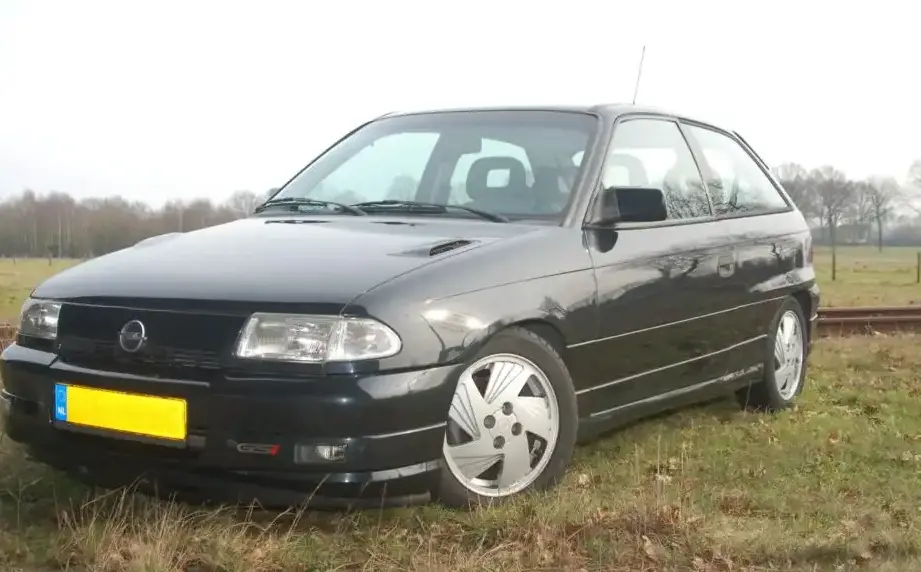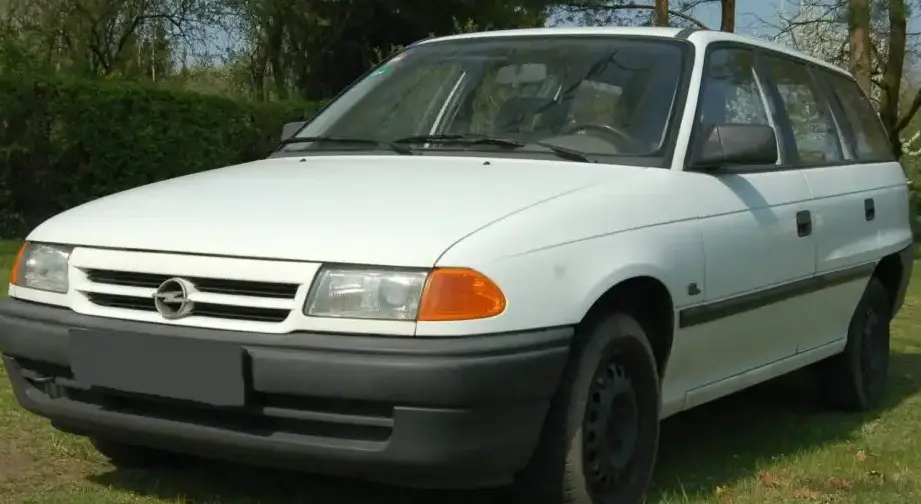
The Opel Astra F Caravan 1.7 Turbo, produced between October 1991 and July 1994, represented a compelling offering in the European compact estate (wagon) market. Positioned as a practical and relatively economical choice within the broader Astra F range, it aimed to provide a balance between cargo capacity, fuel efficiency, and a modest level of performance. This variant utilized Opel’s X17DT engine, a turbocharged diesel, paired with a five-speed manual transmission. It served as a workhorse option, appealing to families and those requiring a versatile vehicle for both daily commuting and load-carrying duties. The Astra F generation (1991-1998) was a significant model for Opel, representing a substantial leap forward in design, safety, and technology compared to its predecessor.
Technical Specifications
| Brand | Opel |
| Model | Astra |
| Generation | Astra F Caravan |
| Type (Engine) | 1.7 Turbo (82 Hp) |
| Start of production | October, 1991 |
| End of production | July, 1994 |
| Powertrain Architecture | Internal Combustion engine |
| Body type | Station wagon (estate) |
| Seats | 5 |
| Doors | 5 |
| Fuel consumption (urban) | 7.9 l/100 km (29.8 US mpg, 35.8 UK mpg, 12.7 km/l) |
| Fuel consumption (extra urban) | 5.9 l/100 km (39.9 US mpg, 47.9 UK mpg, 16.9 km/l) |
| Fuel consumption (combined) | 7.3 l/100 km (32.2 US mpg, 38.7 UK mpg, 13.7 km/l) |
| Fuel Type | Diesel |
| Acceleration 0 – 100 km/h | 14.8 sec |
| Acceleration 0 – 62 mph | 14.8 sec |
| Acceleration 0 – 60 mph | 14.1 sec |
| Maximum speed | 168 km/h (104.39 mph) |
| Weight-to-power ratio | 13.8 kg/Hp, 72.6 Hp/tonne |
| Weight-to-torque ratio | 6.7 kg/Nm, 148.7 Nm/tonne |
| Power | 82 Hp @ 4400 rpm |
| Power per litre | 48.6 Hp/l |
| Torque | 168 Nm @ 2400 rpm (123.91 lb.-ft. @ 2400 rpm) |
| Engine layout | Front, Transverse |
| Engine Model/Code | X17DT |
| Engine displacement | 1686 cm3 (102.89 cu. in.) |
| Number of cylinders | 4 |
| Engine configuration | Inline |
| Cylinder Bore | 79 mm (3.11 in.) |
| Piston Stroke | 86 mm (3.39 in.) |
| Compression ratio | 22:1 |
| Number of valves per cylinder | 2 |
| Fuel injection system | Precombustion chamber injection |
| Engine aspiration | Turbocharger |
| Valvetrain | SOHC |
| Engine oil capacity | 4.5 l (4.76 US qt | 3.96 UK qt) |
| Coolant | 6.8 l (7.19 US qt | 5.98 UK qt) |
| Kerb Weight | 1130 kg (2491.22 lbs.) |
| Max. weight | 1635 kg (3604.56 lbs.) |
| Max load | 505 kg (1113.33 lbs.) |
| Trunk (boot) space – minimum | 500 l (17.66 cu. ft.) |
| Trunk (boot) space – maximum | 1630 l (57.56 cu. ft.) |
| Fuel tank capacity | 50 l (13.21 US gal | 11 UK gal) |
| Length | 4278 mm (168.43 in.) |
| Width | 1688 mm (66.46 in.) |
| Width including mirrors | 1795 mm (70.67 in.) |
| Height | 1475 mm (58.07 in.) |
| Wheelbase | 2517 mm (99.09 in.) |
| Front track | 1430 mm (56.3 in.) |
| Rear (Back) track | 1429 mm (56.26 in.) |
| Ride height (ground clearance) | 135 mm (5.31 in.) |
| Drag coefficient (Cd) | 0.34 |
| Minimum turning circle | 10.5 m (34.45 ft.) |
| Drivetrain Architecture | ICE, Front wheel drive |
| Drive wheel | Front wheel drive |
| Number of gears | 5 gears, manual transmission |
| Front suspension | Wishbone |
| Rear suspension | Coil spring |
| Front brakes | Ventilated discs |
| Rear brakes | Drum |
| Assisting systems | ABS (Anti-lock braking system) |
| Steering type | Steering rack and pinion |
| Power steering | Hydraulic Steering |
| Tires size | 175/70 R13 82T; 175/65 R14 82T |
| Wheel rims size | 5.5J x 13 ET49; 5.5J x 14 ET49 |
Powertrain & Engine Architecture
The heart of the Astra F Caravan 1.7 Turbo was the X17DT engine, a 1.7-liter inline-four cylinder diesel. This engine utilized a precombustion chamber injection system, a common technology for diesel engines of the era, designed to improve combustion efficiency and reduce noise. The addition of a turbocharger significantly boosted power output compared to naturally aspirated diesel options. The turbocharger, a Garrett unit in many cases, provided increased air intake, allowing for a higher fuel burn and thus more power. The engine featured a single overhead camshaft (SOHC) valvetrain, operating two valves per cylinder. The five-speed manual transmission was a standard offering, providing a reasonable spread of gears for both fuel economy and performance. The transmission was a conventional design, known for its durability and relatively simple maintenance requirements.
Driving Characteristics
The 1.7 Turbo, with its 82 horsepower and 168 Nm (124 lb-ft) of torque, offered a modest but usable level of performance. Acceleration to 60 mph took around 14.1 seconds, and top speed was approximately 104 mph. While not a sporty performer, the turbocharger provided a noticeable boost in power at lower engine speeds, making it reasonably responsive for everyday driving. The five-speed manual transmission allowed drivers to keep the engine in its optimal power band. Compared to the gasoline-powered Astra F variants, the 1.7 Turbo offered significantly better fuel economy, but at the expense of outright acceleration. Compared to higher-output diesel versions, such as the 2.0-liter models, the 1.7 Turbo felt less powerful, particularly when fully loaded or tackling steep inclines.
Equipment & Trim Levels
The 1.7 Turbo Caravan typically came with a fairly basic level of equipment, reflecting its position as a value-oriented model. Standard features generally included power steering, central locking, and a basic stereo system. Interior upholstery was typically cloth, and the dashboard featured a functional, if somewhat utilitarian, design. Optional extras included power windows, a sunroof, and upgraded audio systems. Trim levels varied slightly depending on the market, but generally focused on adding comfort and convenience features rather than significantly altering the car’s performance.
Chassis & Braking
The Astra F Caravan featured a conventional chassis layout with independent wishbone suspension at the front and a coil spring rear suspension. The front brakes were ventilated discs, providing adequate stopping power, while the rear brakes were drums. ABS (Anti-lock Braking System) was often included as standard equipment, enhancing safety. The suspension was tuned for comfort and ride quality, prioritizing a smooth ride over sporty handling. Stabilizer bars were fitted to both the front and rear axles to reduce body roll during cornering.
Market Reception & Comparison
The Astra F Caravan 1.7 Turbo was generally well-received as a practical and economical estate car. Critics praised its fuel efficiency and spacious interior, but noted its relatively modest performance. Compared to gasoline-powered Astra F models, the 1.7 Turbo offered significantly better fuel economy, making it a popular choice for high-mileage drivers. However, it lacked the refinement and responsiveness of the gasoline engines. Against competitors like the Ford Escort Estate and Volkswagen Passat Estate, the Astra F Caravan offered a competitive package in terms of price, space, and fuel economy.
Legacy
The X17DT engine, while not known for being particularly high-performance, proved to be relatively durable and reliable. Astra F Caravans with this engine are still found on the roads today, often with high mileage. The 1.7 Turbo’s simplicity and robust construction contribute to its longevity. In the used car market, these models are often sought after by those looking for an affordable and practical estate car. Maintenance is generally straightforward, and parts availability remains reasonably good. However, potential buyers should be aware of the typical wear and tear associated with older diesel engines, such as turbocharger issues and injector problems.