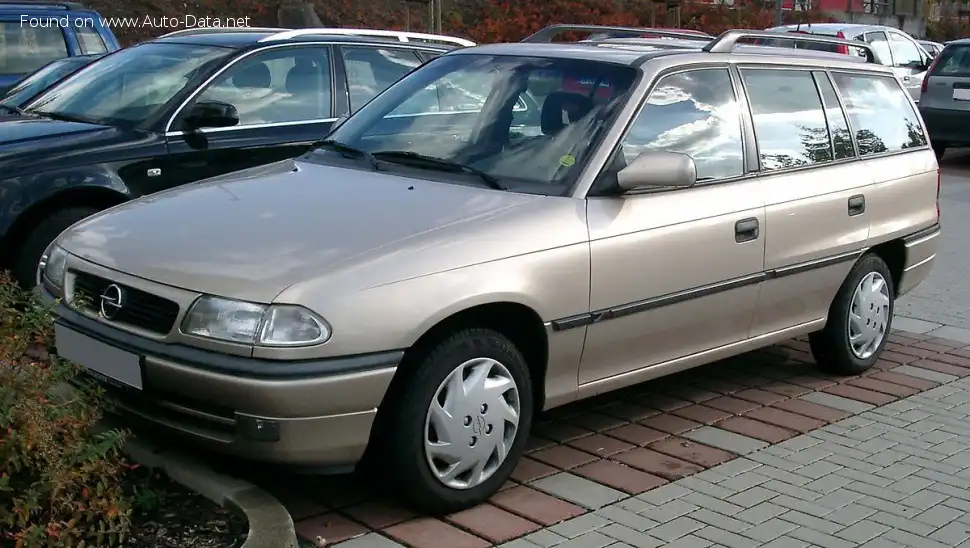
The Opel Astra F Caravan 1.6i Ecotec 16V, produced from August 1994 to December 1997, represented a practical and relatively affordable option within the broader Astra F range. This variant, a five-door station wagon (estate), was positioned as a mid-range offering, appealing to families and those requiring substantial cargo space. It was part of the facelifted Astra F series, incorporating minor cosmetic and mechanical updates compared to the earlier models. The Astra F generation, launched in 1991, was Opel’s entry in the competitive compact family car segment, and the Caravan body style offered increased versatility over the hatchback.
Technical Specifications
| Brand | Opel |
| Model | Astra |
| Generation | Astra F Caravan (facelift 1994) |
| Type (Engine) | 1.6i Ecotec 16V (101 Hp) |
| Start of production | August, 1994 |
| End of production | December, 1997 |
| Powertrain Architecture | Internal Combustion engine |
| Body type | Station wagon (estate) |
| Seats | 5 |
| Doors | 5 |
| Fuel consumption (urban) | 8.7 l/100 km (27 US mpg, 32.5 UK mpg, 11.5 km/l) |
| Fuel consumption (extra urban) | 5.7 l/100 km (41.3 US mpg, 49.6 UK mpg, 17.5 km/l) |
| Fuel consumption (combined) | 7.5 l/100 km (31.4 US mpg, 37.7 UK mpg, 13.3 km/l) |
| Fuel Type | Petrol (Gasoline) |
| Acceleration 0 – 100 km/h | 12 sec |
| Acceleration 0 – 62 mph | 12 sec |
| Acceleration 0 – 60 mph | 11.4 sec |
| Maximum speed | 185 km/h (114.95 mph) |
| Emission standard | Euro 2 |
| Weight-to-power ratio | 11 kg/Hp, 91 Hp/tonne |
| Weight-to-torque ratio | 7.5 kg/Nm, 133.3 Nm/tonne |
| Power | 101 Hp @ 6200 rpm |
| Power per litre | 63.2 Hp/l |
| Torque | 148 Nm @ 3500 rpm (109.16 lb.-ft. @ 3500 rpm) |
| Engine layout | Front, Transverse |
| Engine Model/Code | X16XEL |
| Engine displacement | 1598 cm3 (97.52 cu. in.) |
| Number of cylinders | 4 |
| Engine configuration | Inline |
| Cylinder Bore | 79 mm (3.11 in.) |
| Piston Stroke | 81.5 mm (3.21 in.) |
| Compression ratio | 10.5:1 |
| Number of valves per cylinder | 4 |
| Fuel injection system | Multi-port manifold injection |
| Engine aspiration | Naturally aspirated engine |
| Valvetrain | DOHC |
| Engine oil capacity | 3.5 l (3.7 US qt | 3.08 UK qt) |
| Coolant | 5.9 l (6.23 US qt | 5.19 UK qt) |
| Kerb Weight | 1110 kg (2447.13 lbs.) |
| Max. weight | 1595 kg (3516.37 lbs.) |
| Max load | 485 kg (1069.24 lbs.) |
| Trunk (boot) space – minimum | 500 l (17.66 cu. ft.) |
| Trunk (boot) space – maximum | 1630 l (57.56 cu. ft.) |
| Fuel tank capacity | 50 l (13.21 US gal | 11 UK gal) |
| Length | 4278 mm (168.43 in.) |
| Width | 1696 mm (66.77 in.) |
| Width including mirrors | 1852 mm (72.91 in.) |
| Height | 1525 mm (60.04 in.) |
| Wheelbase | 2517 mm (99.09 in.) |
| Front track | 1424 mm (56.06 in.) |
| Rear (Back) track | 1423 mm (56.02 in.) |
| Ride height (ground clearance) | 135 mm (5.31 in.) |
| Drag coefficient (Cd) | 0.34 |
| Minimum turning circle | 10.5 m (34.45 ft.) |
| Drivetrain Architecture | The Internal combustion engine (ICE) drives the front wheels of the vehicle. |
| Drive wheel | Front wheel drive |
| Number of gears and type of gearbox | 5 gears, manual transmission |
| Front brakes | Disc |
| Rear brakes | Drum |
| Steering type | Steering rack and pinion |
| Tires size | 175/65 R14 82H |
| Wheel rims size | 5.5J x 14 ET 49 |
Powertrain & Engine Architecture
The heart of the Astra F Caravan 1.6i Ecotec was the X16XEL engine, a 1.6-liter inline-four cylinder powerplant. This engine belonged to Opel’s ‘Ecotec’ family, designed with a focus on fuel efficiency and reduced emissions. The X16XEL featured multi-port fuel injection and a double overhead camshaft (DOHC) valvetrain, operating with four valves per cylinder. This configuration allowed for improved breathing and a broader powerband. The engine produced 101 horsepower at 6200 rpm and 148 Nm (109 lb-ft) of torque at 3500 rpm. The engine’s 10.5:1 compression ratio contributed to its efficiency. The transmission was typically a five-speed manual, although a four-speed automatic was also available, albeit less common. The automatic transmission, while offering convenience, did impact acceleration and fuel economy.
Driving Characteristics
The 1.6i Ecotec with the manual transmission provided adequate, though not exhilarating, performance. Acceleration from 0 to 60 mph took around 11.4 seconds, and top speed was approximately 115 mph. The engine felt responsive enough for everyday driving, but lacked the punch of the higher-spec 2.0-liter variants. The automatic transmission further dulled performance, adding a noticeable delay in response. Gear ratios were geared towards fuel economy rather than outright acceleration. Handling was typical for a front-wheel-drive station wagon of the era – safe and predictable, but not particularly sporty. The Caravan’s longer wheelbase and softer suspension setup prioritized ride comfort over sharp cornering.
Equipment & Trim Levels
The 1.6i Ecotec Caravan typically came with a reasonable level of standard equipment. This included central locking, power steering, and an adjustable steering column. Interior upholstery was usually cloth, with a relatively simple dashboard layout. Optional extras included air conditioning, electric windows, and a sunroof. Higher trim levels, such as the ‘GL’ or ‘CD’, added features like alloy wheels, upgraded interior trim, and a more comprehensive stereo system. The base trim was fairly spartan, focusing on providing a functional and affordable family vehicle.
Chassis & Braking
The Astra F Caravan utilized a MacPherson strut front suspension and a torsion beam rear suspension. This setup provided a good balance between ride comfort and handling. Braking was typically accomplished with disc brakes on the front wheels and drum brakes on the rear. The drum brakes on the rear were a cost-saving measure, and while adequate for normal driving, they lacked the stopping power of disc brakes. Stabilizer bars were fitted to both the front and rear axles to reduce body roll during cornering. The Caravan’s weight, around 1110 kg (2447 lbs), was relatively moderate for a station wagon of its size.
Market Reception & Comparison
The Astra F Caravan 1.6i Ecotec was generally well-received as a practical and economical family car. Critics praised its spacious interior, comfortable ride, and reasonable fuel economy. However, the engine was often criticized for being underpowered, particularly when paired with the automatic transmission. Compared to the 2.0-liter versions, the 1.6i offered significantly less performance. The 1.9 TDI diesel variant provided superior fuel economy and torque, but at the expense of refinement. The 1.6i Ecotec represented a good compromise for buyers prioritizing affordability and fuel efficiency over outright performance.
Legacy
The X16XEL engine proved to be a relatively reliable unit, although regular maintenance is crucial. Common issues include oil leaks and occasional sensor failures. The automatic transmission, while generally durable, can be prone to wear and tear with high mileage. Today, the Astra F Caravan 1.6i Ecotec is a relatively affordable classic car, appealing to those seeking a practical and nostalgic vehicle. Parts availability is generally good, and the car’s simple mechanical design makes it relatively easy to maintain. While not a performance icon, the 1.6i Ecotec Caravan remains a testament to Opel’s commitment to providing functional and affordable transportation for families.