
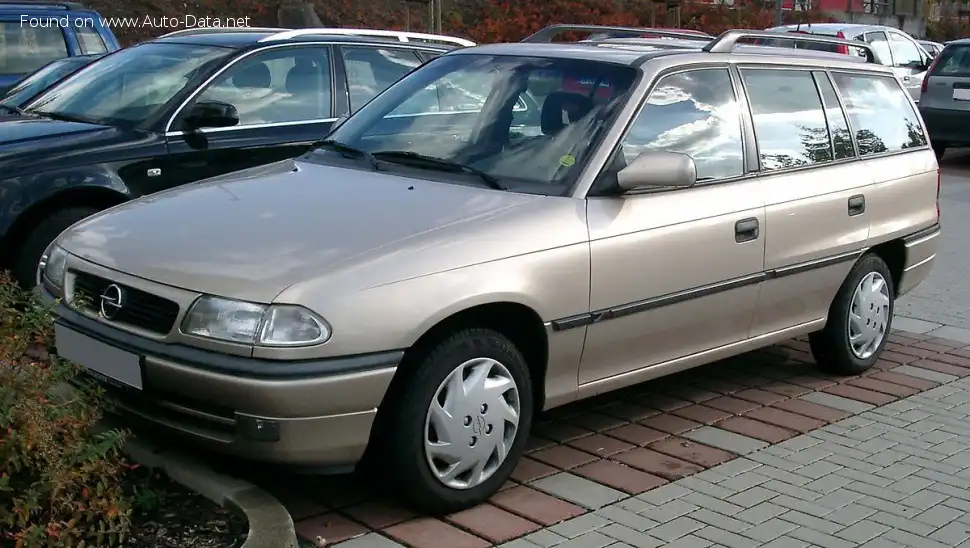
The Opel Astra F Caravan 1.7 TD, produced from August 1994 to December 1997, represented a practical and economical choice within the broader Astra F range. This variant, a station wagon (estate) body style, was positioned as a budget-friendly option, appealing to families and those requiring a versatile vehicle for both passenger and cargo transport. It was part of the facelifted Astra F series, denoted by subtle styling updates compared to the earlier models. The 1.7 TD specifically targeted buyers prioritizing fuel efficiency and low running costs over outright performance.
Technical Specifications
| Brand | Opel |
| Model | Astra |
| Generation | Astra F Caravan (facelift 1994) |
| Type (Engine) | 1.7 TD (68 Hp) |
| Start of production | August, 1994 |
| End of production | December, 1997 |
| Powertrain Architecture | Internal Combustion engine |
| Body type | Station wagon (estate) |
| Seats | 5 |
| Doors | 5 |
| Fuel consumption (urban) | 7.1 l/100 km (33.1 US mpg, 39.8 UK mpg, 14.1 km/l) |
| Fuel consumption (extra urban) | 5.4 l/100 km (43.6 US mpg, 52.3 UK mpg, 18.5 km/l) |
| Fuel consumption (combined) | 6.6 l/100 km (35.6 US mpg, 42.8 UK mpg, 15.2 km/l) |
| Fuel Type | Diesel |
| Acceleration 0 – 100 km/h | 16.5 sec |
| Acceleration 0 – 62 mph | 16.5 sec |
| Acceleration 0 – 60 mph | 15.7 sec |
| Maximum speed | 160 km/h (99.42 mph) |
| Weight-to-power ratio | 16.4 kg/Hp, 61 Hp/tonne |
| Weight-to-torque ratio | 8.4 kg/Nm, 118.4 Nm/tonne |
| Power | 68 Hp @ 4500 rpm |
| Power per litre | 40 Hp/l |
| Torque | 132 Nm @ 2400 rpm (97.36 lb.-ft. @ 2400 rpm) |
| Engine layout | Front, Transverse |
| Engine Model/Code | X17DTL |
| Engine displacement | 1700 cm3 (103.74 cu. in.) |
| Number of cylinders | 4 |
| Engine configuration | Inline |
| Cylinder Bore | 82.5 mm (3.25 in.) |
| Piston Stroke | 79.5 mm (3.13 in.) |
| Compression ratio | 22:1 |
| Number of valves per cylinder | 2 |
| Fuel injection system | Precombustion chamber injection |
| Engine aspiration | Turbocharger |
| Valvetrain | SOHC |
| Engine oil capacity | 4.5 l (4.76 US qt | 3.96 UK qt) |
| Coolant | 6.8 l (7.19 US qt | 5.98 UK qt) |
| Kerb Weight | 1115 kg (2458.15 lbs.) |
| Max. weight | 1615 kg (3560.47 lbs.) |
| Max load | 500 kg (1102.31 lbs.) |
| Trunk (boot) space – minimum | 500 l (17.66 cu. ft.) |
| Trunk (boot) space – maximum | 1630 l (57.56 cu. ft.) |
| Fuel tank capacity | 50 l (13.21 US gal | 11 UK gal) |
| Length | 4278 mm (168.43 in.) |
| Width | 1696 mm (66.77 in.) |
| Width including mirrors | 1852 mm (72.91 in.) |
| Height | 1525 mm (60.04 in.) |
| Wheelbase | 2517 mm (99.09 in.) |
| Front track | 1430 mm (56.3 in.) |
| Rear (Back) track | 1429 mm (56.26 in.) |
| Ride height (ground clearance) | 135 mm (5.31 in.) |
| Drag coefficient (Cd) | 0.34 |
| Minimum turning circle | 10.5 m (34.45 ft.) |
| Drivetrain Architecture | The Internal combustion engine (ICE) drives the front wheels of the vehicle. |
| Drive wheel | Front wheel drive |
| Number of gears and type of gearbox | 5 gears, manual transmission |
| Front brakes | Ventilated discs |
| Rear brakes | Drum |
| Steering type | Steering rack and pinion |
| Tires size | 175/70 R13 82T; 175/65 R14 82T |
| Wheel rims size | 5.5J x 13 ET49; 5.5J x 14 ET49 |
Powertrain & Engine Architecture
The heart of the Astra F Caravan 1.7 TD was the X17DTL engine, a 1.7-liter inline-four cylinder diesel. This engine utilized a precombustion chamber injection system, a common technology for diesel engines of the era. This system involved injecting fuel into a precombustion chamber, where it partially ignited before entering the main combustion chamber, promoting more complete combustion. The engine was turbocharged, which significantly improved power output compared to naturally aspirated diesel engines of similar displacement. The single overhead camshaft (SOHC) valvetrain operated two valves per cylinder. The five-speed manual transmission was the standard offering, providing a relatively long-geared setup optimized for fuel economy. The transmission’s ratios were geared towards maximizing efficiency rather than providing rapid acceleration.
Driving Characteristics
The 1.7 TD-equipped Astra F Caravan was not known for its blistering performance. With 68 horsepower and 132 Nm (97 lb-ft) of torque, acceleration was modest, taking around 16.5 seconds to reach 62 mph. However, the engine’s torque characteristics made it reasonably tractable for everyday driving. The turbocharger provided a noticeable boost in power at lower engine speeds, aiding in overtaking and hill climbing. The long gearing of the manual transmission further emphasized fuel efficiency, but also meant that the engine often needed to be worked hard to maintain speed on highways. Compared to the more powerful gasoline variants, such as the 1.8 or 2.0-liter engines, the 1.7 TD offered a significantly different driving experience, prioritizing economy and practicality over sporty performance.
Equipment & Trim Levels
The 1.7 TD Caravan typically came with a fairly basic level of equipment. Standard features generally included power steering, central locking, and a basic stereo system. Interior upholstery was typically cloth, and the dashboard featured a functional, if somewhat utilitarian, design. Optional extras included power windows, air conditioning, and upgraded stereo systems. The trim level was generally considered entry-level within the Astra F Caravan range, focusing on providing essential features at an affordable price point. The emphasis was on practicality and value for money.
Chassis & Braking
The Astra F Caravan 1.7 TD utilized a MacPherson strut front suspension and a torsion beam rear suspension. The front brakes were ventilated discs, providing adequate stopping power, while the rear brakes were drums, a cost-saving measure common in this segment. The suspension setup was tuned for comfort and stability, rather than sporty handling. Stabilizer bars were typically fitted to both the front and rear axles, helping to reduce body roll during cornering. The relatively lightweight nature of the 1.7 TD engine contributed to a balanced chassis, although the overall handling characteristics were not particularly dynamic.
Market Reception & Comparison
The Astra F Caravan 1.7 TD was generally well-received as a practical and economical family vehicle. Critics praised its fuel efficiency and low running costs, but noted its lack of outright performance. Compared to the gasoline-powered Astra F models, the 1.7 TD offered significantly better fuel economy, but at the expense of acceleration and refinement. It competed with other diesel-powered station wagons of the time, such as the Ford Escort Estate TD and the Volkswagen Golf Estate TDI. The Opel offered a competitive price point and a spacious interior, making it a popular choice for budget-conscious buyers.
Legacy
The X17DTL engine, while not known for being particularly sophisticated, proved to be relatively durable and reliable. Properly maintained examples of the Astra F Caravan 1.7 TD can still be found on the road today. The engine’s simplicity and robust construction contribute to its longevity. In the used car market, these vehicles are often sought after by those looking for an affordable and economical classic car. While parts availability may be becoming more challenging, the Astra F Caravan 1.7 TD remains a testament to Opel’s commitment to providing practical and reliable transportation.

