
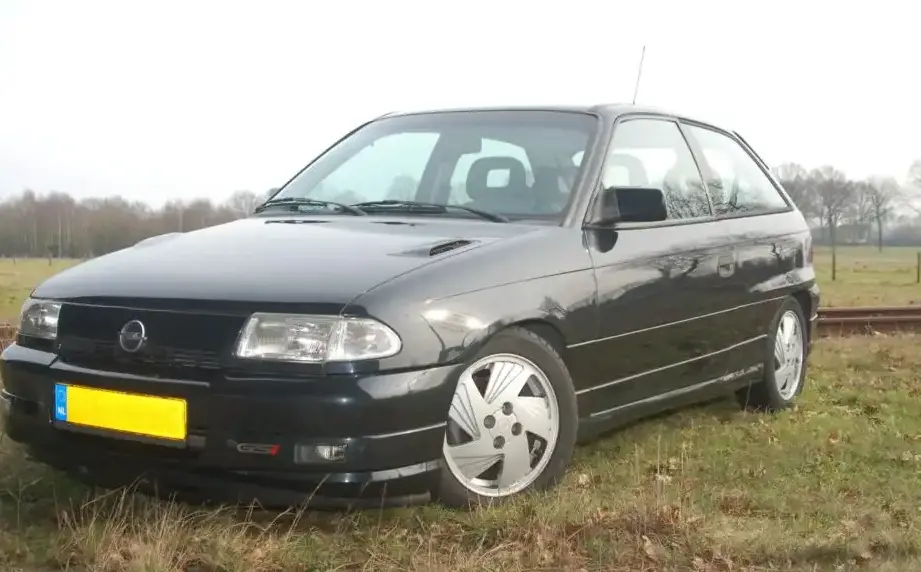
The Opel Astra F GSi 2.0 16V, produced from October 1991 to July 1994, represented the performance-oriented variant of the popular Astra F hatchback. Positioned as the flagship trim, it offered a significant step up in power and handling compared to lower-spec models. This model played a crucial role in establishing the Astra F as a desirable compact car in the European market, appealing to drivers seeking a blend of practicality and sporty driving dynamics. It was a key competitor to models like the Volkswagen Golf GTI and Ford Escort XR3i.
Technical Specifications
| Brand | Opel |
| Model | Astra |
| Generation | Astra F |
| Type | GSi 2.0 16V (150 Hp) |
| Start of production | October, 1991 |
| End of production | July, 1994 |
| Powertrain Architecture | Internal Combustion engine |
| Body type | Hatchback |
| Seats | 5 |
| Doors | 3 |
| Fuel consumption (urban) | 10.2 l/100 km (23.1 US mpg, 27.7 UK mpg, 9.8 km/l) |
| Fuel consumption (extra urban) | 5.9 l/100 km (39.9 US mpg, 47.9 UK mpg, 16.9 km/l) |
| Fuel consumption (combined) | 7.4 l/100 km (31.8 US mpg, 38.2 UK mpg, 13.5 km/l) |
| Fuel Type | Petrol (Gasoline) |
| Acceleration 0 – 100 km/h | 8 sec |
| Acceleration 0 – 62 mph | 8 sec |
| Acceleration 0 – 60 mph | 7.6 sec |
| Maximum speed | 220 km/h (136.7 mph) |
| Emission standard | Euro 1 |
| Weight-to-power ratio | 7.3 kg/Hp, 136.4 Hp/tonne |
| Weight-to-torque ratio | 5.6 kg/Nm, 178.2 Nm/tonne |
| Power | 150 Hp @ 6000 rpm |
| Power per litre | 75.1 Hp/l |
| Torque | 196 Nm @ 4600 rpm (144.56 lb.-ft. @ 4600 rpm) |
| Engine layout | Front, Transverse |
| Engine Model/Code | C20XE |
| Engine displacement | 1998 cm3 (121.93 cu. in.) |
| Number of cylinders | 4 |
| Engine configuration | Inline |
| Cylinder Bore | 86 mm (3.39 in.) |
| Piston Stroke | 86 mm (3.39 in.) |
| Compression ratio | 10.5:1 |
| Number of valves per cylinder | 4 |
| Fuel injection system | Multi-port manifold injection |
| Engine aspiration | Naturally aspirated engine |
| Valvetrain | DOHC |
| Engine oil capacity | 4.5 l (4.76 US qt | 3.96 UK qt) |
| Coolant capacity | 6.9 l (7.29 US qt | 6.07 UK qt) |
| Kerb Weight | 1100 kg (2425.08 lbs.) |
| Max. weight | 1595 kg (3516.37 lbs.) |
| Max load | 495 kg (1091.29 lbs.) |
| Trunk (boot) space – minimum | 360 l (12.71 cu. ft.) |
| Trunk (boot) space – maximum | 1200 l (42.38 cu. ft.) |
| Fuel tank capacity | 52 l (13.74 US gal | 11.44 UK gal) |
| Length | 4086 mm (160.87 in.) |
| Width | 1688 mm (66.46 in.) |
| Width including mirrors | 1795 mm (70.67 in.) |
| Height | 1410 mm (55.51 in.) |
| Wheelbase | 2517 mm (99.09 in.) |
| Front track | 1430 mm (56.3 in.) |
| Rear track | 1432 mm (56.38 in.) |
| Drag coefficient (Cd) | 0.30 |
| Minimum turning circle | 10.5 m (34.45 ft.) |
| Drivetrain Architecture | Front wheel drive |
| Number of gears | 5 gears, manual transmission |
| Front suspension | Independent type McPherson |
| Rear suspension | Suspension with traction connecting levers |
| Front brakes | Ventilated discs |
| Rear brakes | Disc |
| Assisting systems | ABS (Anti-lock braking system) |
| Steering type | Steering rack and pinion |
| Tires size | 205/50 R15 |
| Wheel rims size | 6J x 15 ET49 |
Introduction
The Opel Astra F GSi 2.0 16V was a performance-focused variant of the Astra F, produced between 1991 and 1994. It sat at the top of the Astra F range, offering a more engaging driving experience than the standard models. Built on the GM T-platform (internally known as 1HX0/A3), the GSi 2.0 16V was designed to appeal to enthusiasts who wanted a practical, yet sporty, hatchback. It was a popular choice in Europe, offering a compelling alternative to rivals like the Volkswagen Golf GTI and Ford Escort XR3i.
Powertrain & Engine Architecture
The heart of the Astra F GSi 2.0 16V was the C20XE engine, a 1998cc inline-four cylinder powerplant. This engine was a member of Opel’s ‘E’ family of engines, known for their durability and performance potential. The C20XE featured a dual overhead camshaft (DOHC) valvetrain with four valves per cylinder, contributing to its high-revving nature. Fuel delivery was handled by a Bosch Motronic multi-port fuel injection system, optimizing fuel efficiency and power output. The engine produced 150 horsepower at 6000 rpm and 196 Nm (144.56 lb-ft) of torque at 4600 rpm. The GSi 2.0 16V was exclusively offered with a five-speed manual transmission, providing precise gear changes and enhancing the driving experience. The transmission was designed to handle the engine’s power output and deliver responsive acceleration.
Driving Characteristics
The Astra F GSi 2.0 16V offered a noticeably more engaging driving experience than the standard Astra F models. The 150 hp engine provided brisk acceleration, with a 0-60 mph time of around 7.6 seconds and a top speed of 136.7 mph. The five-speed manual transmission allowed drivers to fully exploit the engine’s powerband. The suspension was tuned for a sportier ride, offering improved handling and reduced body roll compared to the standard Astra. While not as overtly aggressive as some of its rivals, the GSi 2.0 16V provided a balanced and enjoyable driving experience, suitable for both daily commuting and spirited driving on winding roads. The gear ratios were well-matched to the engine’s characteristics, providing strong acceleration in each gear.
Equipment & Trim Levels
The GSi 2.0 16V came equipped with a range of features designed to enhance both comfort and performance. Standard equipment included sports seats with distinctive upholstery, a leather-wrapped steering wheel, and power windows. The dashboard featured a unique instrument cluster with additional gauges, including a rev counter. Optional extras included a sunroof, air conditioning, and upgraded audio systems. The interior trim was generally well-appointed, reflecting the GSi’s position as the flagship model. Exterior features included a body-colored rear spoiler, side skirts, and unique alloy wheels.
Chassis & Braking
The Astra F GSi 2.0 16V featured a McPherson strut front suspension and a torsion beam rear suspension. The suspension was specifically tuned to provide a firmer ride and improved handling. The braking system consisted of ventilated disc brakes at the front and solid disc brakes at the rear. An anti-lock braking system (ABS) was standard, enhancing safety and control during hard braking. The chassis was reinforced compared to the standard Astra F, providing increased rigidity and improving handling characteristics. The steering was a rack and pinion system, offering precise and responsive steering feel.
Market Reception & Comparison
The Astra F GSi 2.0 16V was generally well-received by automotive critics. It was praised for its strong engine, responsive handling, and well-equipped interior. Compared to the base Astra models, the GSi 2.0 16V offered a significant performance upgrade. Compared to rivals like the Volkswagen Golf GTI, the Astra GSi 2.0 16V was often seen as offering a good balance of performance and value. The GTI typically offered slightly more refined handling, while the Astra GSi provided a more raw and engaging driving experience. Fuel economy was respectable for a performance hatchback of its era, averaging around 31.8 US mpg on the combined cycle. Reliability was generally good, although regular maintenance was essential to ensure the longevity of the engine and other components.
Legacy
The Opel Astra F GSi 2.0 16V has become a popular classic car among enthusiasts. The C20XE engine is known for its durability and tunability, making it a favorite among those who enjoy modifying their vehicles. Well-maintained examples are increasingly sought after by collectors. While some age-related issues are common, such as corrosion and wear on suspension components, the Astra F GSi 2.0 16V remains a capable and enjoyable car to drive. Its blend of practicality, performance, and affordability has ensured its enduring appeal in the used car market.
