Technical Specifications
| Brand | Opel |
| Model | Astra |
| Generation | Astra G |
| Type (Engine) | 1.2 16V (65 Hp) |
| Start of production | March, 1998 |
| End of production | June, 2000 |
| Powertrain Architecture | Internal Combustion engine |
| Body type | Hatchback |
| Seats | 5 |
| Doors | 3-5 |
| Fuel consumption (urban) | 8 l/100 km (29.4 US mpg, 35.3 UK mpg, 12.5 km/l) |
| Fuel consumption (extra urban) | 5 l/100 km (47 US mpg, 56.5 UK mpg, 20 km/l) |
| Fuel consumption (combined) | 6.1 l/100 km (38.6 US mpg, 46.3 UK mpg, 16.4 km/l) |
| CO2 emissions | 147 g/km |
| Fuel Type | Petrol (Gasoline) |
| Acceleration 0 – 100 km/h | 16 sec |
| Acceleration 0 – 62 mph | 16 sec |
| Acceleration 0 – 60 mph | 15.2 sec |
| Maximum speed | 165 km/h (102.53 mph) |
| Emission standard | Euro 2 |
| Weight-to-power ratio | 16.5 kg/Hp, 60.7 Hp/tonne |
| Weight-to-torque ratio | 9.7 kg/Nm, 102.8 Nm/tonne |
| Power | 65 Hp @ 5600 rpm |
| Power per litre | 54.2 Hp/l |
| Torque | 110 Nm @ 4000 rpm (81.13 lb.-ft. @ 4000 rpm) |
| Engine layout | Front, Transverse |
| Engine Model/Code | X12XE |
| Engine displacement | 1199 cm3 (73.17 cu. in.) |
| Number of cylinders | 4 |
| Engine configuration | Inline |
| Cylinder Bore | 72.5 mm (2.85 in.) |
| Piston Stroke | 72.6 mm (2.86 in.) |
| Compression ratio | 10.1:1 |
| Number of valves per cylinder | 4 |
| Fuel injection system | Multi-port manifold injection |
| Engine aspiration | Naturally aspirated engine |
| Valvetrain | DOHC |
| Engine oil capacity | 3.5 l (3.7 US qt | 3.08 UK qt) |
| Coolant | 5.2 l (5.49 US qt | 4.58 UK qt) |
| Kerb Weight | 1070 kg (2358.95 lbs.) |
| Max. weight | 1515 kg (3340 lbs.) |
| Max load | 445 kg (981.06 lbs.) |
| Trunk (boot) space – minimum | 370 l (13.07 cu. ft.) |
| Trunk (boot) space – maximum | 1180 l (41.67 cu. ft.) |
| Fuel tank capacity | 52 l (13.74 US gal | 11.44 UK gal) |
| Max. roof load | 100 kg (220.46 lbs.) |
| Permitted trailer load with brakes (12%) | 700 kg (1543.24 lbs.) |
| Permitted trailer load without brakes | 540 kg (1190.5 lbs.) |
| Permitted towbar download | 75 kg (165.35 lbs.) |
| Length | 4110 mm (161.81 in.) |
| Width | 1709 mm (67.28 in.) |
| Width including mirrors | 1989 mm (78.31 in.) |
| Height | 1425 mm (56.1 in.) |
| Wheelbase | 2606 mm (102.6 in.) |
| Front track | 1464 mm (57.64 in.) |
| Rear (Back) track | 1452 mm (57.17 in.) |
| Front overhang | 791 mm (31.14 in.) |
| Rear overhang | 713 mm (28.07 in.) |
| Ride height (ground clearance) | 160 mm (6.3 in.) |
| Drag coefficient (Cd) | 0.32 |
| Minimum turning circle (turning diameter) | 10.8 m (35.43 ft.) |
| Drivetrain Architecture | The Internal combustion engine (ICE) drives the front wheels of the vehicle. |
| Drive wheel | Front wheel drive |
| Number of gears and type of gearbox | 5 gears, manual transmission |
| Front suspension | Independent, type McPherson with coil spring and anti-roll bar |
| Rear suspension | Semi-independent, coil spring |
| Front brakes | Ventilated discs |
| Rear brakes | Disc |
| Assisting systems | ABS (Anti-lock braking system) |
| Steering type | Steering rack and pinion |
| Power steering | Hydraulic Steering |
| Tires size | 175/70 R14 |
| Wheel rims size | 6J x 14 ET34 |
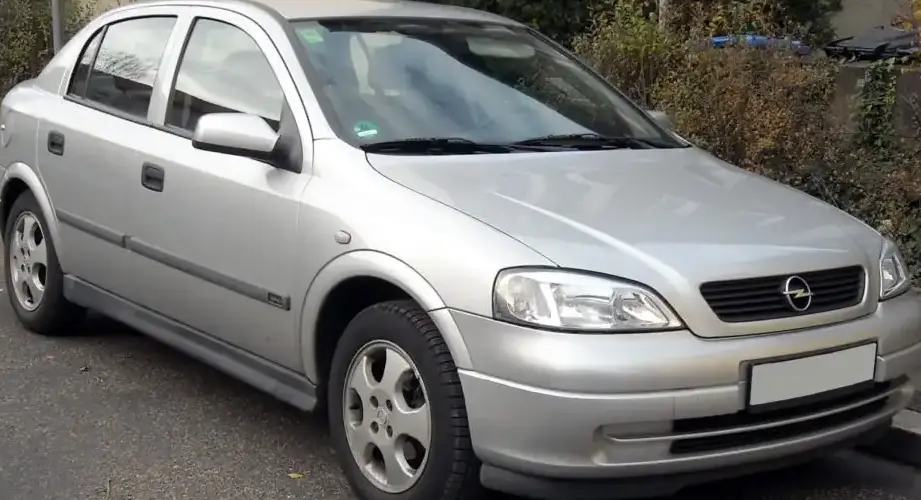
The Opel Astra G 1.2 16V, produced between March 1998 and June 2000, represented the entry-level offering within the broader Astra G range (1998-2004). Positioned as the most economical variant, it was designed to appeal to first-time car buyers, those on a tight budget, or individuals prioritizing fuel efficiency for urban commuting. The Astra G itself was a significant model for Opel, representing a substantial step forward in design, safety, and technology compared to its predecessor, the Astra F. The 1.2 16V played a crucial role in attracting a wider customer base to the Astra G platform, particularly in European markets where smaller displacement engines were favored due to tax incentives and fuel costs.
Powertrain & Engine Architecture
The heart of the Astra G 1.2 16V was the Opel-designed X12XE engine, a 1.199-liter (73.17 cubic inches) inline-four cylinder gasoline engine. This engine was a member of Opel’s Ecotec family, known for its focus on efficiency and reduced emissions. The X12XE featured a dual overhead camshaft (DOHC) valvetrain operating four valves per cylinder, enhancing volumetric efficiency. Fuel delivery was managed by a multi-port fuel injection system, a standard technology of the era. The engine produced 65 horsepower at 5600 rpm and 81.13 lb.-ft. of torque at 4000 rpm. The engine was mounted transversely in the front of the vehicle, driving the front wheels. While a 5-speed manual transmission was the standard offering, a 4-speed automatic transmission was available as an option, though less frequently chosen. This automatic was a conventional hydraulic automatic, offering smooth shifts but at the expense of some fuel economy compared to the manual.
Driving Characteristics
The driving experience in the 1.2 16V Astra G was characterized by its practicality and ease of use, rather than outright performance. Acceleration was modest, with a 0-60 mph time of approximately 15.2 seconds. The manual transmission provided a more engaging driving experience and slightly better acceleration than the automatic. The automatic transmission, while comfortable, noticeably reduced responsiveness. The engine required frequent downshifts when overtaking or tackling inclines. The gear ratios in the manual transmission were optimized for fuel economy, while the automatic prioritized smooth, comfortable shifts. Steering was light and precise, making it easy to maneuver in urban environments. The suspension, while basic, provided a reasonably comfortable ride on most road surfaces, absorbing bumps and imperfections adequately.
Equipment & Trim Levels
The 1.2 16V Astra G typically came equipped with a fairly basic set of standard features. Power steering, central locking, and an adjustable steering column were generally included. Interior upholstery was typically cloth, and the dashboard design was functional and straightforward. Optional extras included air conditioning, electric front windows, and an upgraded audio system. Trim levels were relatively limited for this base model; variations primarily stemmed from the addition of optional packages. Opel focused on keeping the base price low, so luxury features were minimized. The emphasis was on providing a reliable and affordable vehicle for everyday transportation.
Chassis & Braking
The Astra G 1.2 16V utilized a McPherson strut suspension setup at the front, providing a good balance of handling and ride comfort. The rear suspension employed a semi-independent torsion beam, a cost-effective solution that offered acceptable ride quality. Braking duties were handled by ventilated discs on the front wheels and solid discs on the rear. Anti-lock Braking System (ABS) was standard equipment, enhancing safety by preventing wheel lockup during emergency braking. The vehicle’s relatively light weight – around 2359 lbs – helped to offset the modest braking power.
Market Reception & Comparison
The Astra G 1.2 16V was generally well-received as an affordable and economical option within the compact hatchback segment. Critics praised its fuel efficiency and ease of driving, but consistently noted its lack of power. Compared to other Astra G variants, such as the 1.6-liter or 1.8-liter models, the 1.2 offered significantly less performance. The 1.7 DTi diesel version provided superior fuel economy but lacked the refinement of the gasoline engine. The 1.2 16V was primarily targeted at buyers who prioritized low running costs and practicality over driving excitement. Its reliability was generally considered good, although the automatic transmission, over time, could be susceptible to issues if not properly maintained.
Legacy
The Opel Astra G 1.2 16V remains a relatively common sight on European roads today, often found as an affordable used car option. The X12XE engine is known for its durability, provided it receives regular maintenance. The automatic transmission, if well-maintained, can offer years of service, but the manual gearbox is generally considered the more robust choice. The Astra G 1.2 16V represents a practical and economical entry point into the Astra G family, offering a blend of fuel efficiency, reliability, and ease of use. Its simplicity and relatively low maintenance costs continue to make it an appealing option for budget-conscious buyers seeking a dependable and affordable hatchback.