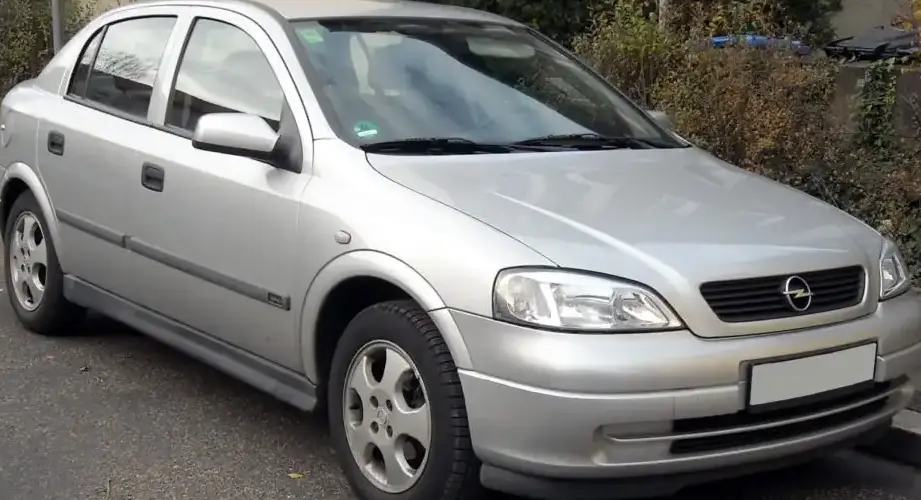
The Opel Astra G 1.2 16V, producing 75 horsepower, was a variant of the Astra G (1998-2009) model range manufactured between 2000 and 2002. Positioned as an entry-level offering, it aimed to provide affordable transportation within the compact hatchback segment, primarily in European markets. This version utilized the Z12XE engine and was typically paired with a five-speed manual transmission, though an automatic option was also available. It represented a balance between fuel efficiency and basic functionality, catering to buyers prioritizing economy over outright performance.
Technical Specifications
| Brand | Opel |
| Model | Astra |
| Generation | Astra G |
| Type (Engine) | 1.2 16V (75 Hp) |
| Start of production | July, 2000 |
| End of production | 2002 |
| Powertrain Architecture | Internal Combustion engine |
| Body type | Hatchback |
| Seats | 5 |
| Doors | 3-5 |
| Fuel consumption (urban) | 8 l/100 km (29.4 US mpg, 35.3 UK mpg, 12.5 km/l) |
| Fuel consumption (extra urban) | 5-5.2 l/100 km (47 – 45.2 US mpg, 56.5 – 54.3 UK mpg, 20 – 19.2 km/l) |
| Fuel consumption (combined) | 6.1-6.2 l/100 km (38.6 – 37.9 US mpg, 46.3 – 45.6 UK mpg, 16.4 – 16.1 km/l) |
| CO2 emissions | 147-149 g/km |
| Fuel Type | Petrol (Gasoline) |
| Acceleration 0 – 100 km/h | 15 sec |
| Acceleration 0 – 62 mph | 15 sec |
| Acceleration 0 – 60 mph | 14.3 sec |
| Maximum speed | 170 km/h (105.63 mph) |
| Emission standard | Euro 4 |
| Weight-to-power ratio | 14 kg/Hp, 71.4 Hp/tonne |
| Weight-to-torque ratio | 9.5 kg/Nm, 104.8 Nm/tonne |
| Power | 75 Hp @ 5600 rpm |
| Power per litre | 62.6 Hp/l |
| Torque | 110 Nm @ 4000 rpm (81.13 lb.-ft. @ 4000 rpm) |
| Engine layout | Front, Transverse |
| Engine Model/Code | Z12XE |
| Engine displacement | 1199 cm3 (73.17 cu. in.) |
| Number of cylinders | 4 |
| Engine configuration | Inline |
| Cylinder Bore | 72.5 mm (2.85 in.) |
| Piston Stroke | 72.6 mm (2.86 in.) |
| Compression ratio | 10.1:1 |
| Number of valves per cylinder | 4 |
| Fuel injection system | Multi-port manifold injection |
| Engine aspiration | Naturally aspirated engine |
| Valvetrain | DOHC |
| Engine oil capacity | 3.5 l (3.7 US qt | 3.08 UK qt) |
| Coolant capacity | 5.2 l (5.49 US qt | 4.58 UK qt) |
| Kerb Weight | 1050-1070 kg (2314.85 – 2358.95 lbs.) |
| Max. weight | 1570-1590 kg (3461.26 – 3505.35 lbs.) |
| Max load | 520 kg (1146.4 lbs.) |
| Trunk (boot) space – minimum | 370 l (13.07 cu. ft.) |
| Trunk (boot) space – maximum | 1180 l (41.67 cu. ft.) |
| Fuel tank capacity | 52 l (13.74 US gal | 11.44 UK gal) |
| Max. roof load | 100 kg (220.46 lbs.) |
| Permitted trailer load with brakes (12%) | 750 kg (1653.47 lbs.) |
| Permitted trailer load without brakes | 550 kg (1212.54 lbs.) |
| Permitted towbar download | 75 kg (165.35 lbs.) |
| Length | 4110 mm (161.81 in.) |
| Width | 1709 mm (67.28 in.) |
| Width including mirrors | 1989 mm (78.31 in.) |
| Height | 1425 mm (56.1 in.) |
| Wheelbase | 2606 mm (102.6 in.) |
| Front track | 1464 mm (57.64 in.) |
| Rear track | 1452 mm (57.17 in.) |
| Front overhang | 791 mm (31.14 in.) |
| Rear overhang | 713 mm (28.07 in.) |
| Ride height (ground clearance) | 130 mm (5.12 in.) |
| Drag coefficient (Cd) | 0.28 |
| Minimum turning circle | 10.55 m (34.61 ft.) |
| Drivetrain Architecture | The Internal combustion engine (ICE) drives the front wheels of the vehicle. |
| Drive wheel | Front wheel drive |
| Number of gears and type of gearbox | 5 gears, manual transmission |
| Front suspension | Independent, type McPherson with coil spring and anti-roll bar |
| Rear suspension | Semi-independent, coil spring |
| Front brakes | Ventilated discs, 256 mm |
| Rear brakes | Disc, 240 mm |
| Assisting systems | ABS (Anti-lock braking system) |
| Steering type | Steering rack and pinion |
| Power steering | Electric Steering |
| Tires size | 175/70 R14 |
| Wheel rims size | 5.5J x 14 |
Powertrain & Engine Architecture
The heart of the Astra G 1.2 16V was the Z12XE engine, a 1.2-liter inline-four cylinder gasoline engine. This engine featured a double overhead camshaft (DOHC) valvetrain with four valves per cylinder, contributing to its relatively efficient breathing for its displacement. It employed multi-port fuel injection, delivering fuel directly into the intake ports. The Z12XE was known for its simplicity and relatively low maintenance requirements. The engine’s 75 horsepower output was achieved at 5600 rpm, while peak torque of 110 Nm (81.13 lb-ft) arrived at 4000 rpm. The five-speed manual transmission was the most common pairing, offering a reasonable spread of gears for everyday driving. An optional four-speed automatic transmission was available, but it impacted acceleration and fuel economy.
Driving Characteristics
The 1.2 16V Astra G, particularly with the manual transmission, offered a light and nimble driving experience. However, with only 75 horsepower, acceleration was modest. 0-60 mph took around 14.3 seconds, and top speed was limited to 170 km/h (105.63 mph). The automatic transmission further dulled performance, with noticeably slower acceleration due to its less efficient power transfer. The gear ratios were tuned for fuel economy rather than outright speed. In typical driving conditions, the engine felt adequate for city commuting and highway cruising, but overtaking maneuvers required careful planning. Compared to the more powerful 1.6L or 1.8L versions of the Astra G, the 1.2 felt significantly underpowered.
Equipment & Trim Levels
The 1.2 16V Astra G typically came with a basic level of equipment. Standard features generally included power steering, central locking, front airbags, and an adjustable steering column. Interior upholstery was typically cloth, and the dashboard featured a simple, functional design. Optional extras included air conditioning, electric windows, and a radio/cassette player. Trim levels varied slightly depending on the market, but the 1.2 16V generally represented the entry point to the Astra G range. It was often marketed towards first-time car buyers or those seeking a cost-effective and reliable vehicle.
Chassis & Braking
The Astra G 1.2 16V utilized a McPherson strut front suspension and a semi-independent coil spring rear suspension. This setup provided a comfortable ride quality, although it wasn’t particularly sporty. Front brakes were ventilated discs, while rear brakes were solid discs. Anti-lock Braking System (ABS) was standard, enhancing safety. The relatively light weight of the 1.2 engine helped to contribute to balanced handling. Stabilizer bars were fitted to both the front and rear axles, reducing body roll during cornering.
Market Reception & Comparison
The Astra G 1.2 16V was generally well-received as an affordable and economical option. Critics praised its fuel efficiency and ease of driving, but noted its lack of performance. Compared to the 1.6L and 1.8L Astra G models, the 1.2 offered significantly less power and a slower driving experience. However, it also boasted lower running costs and insurance premiums. The 1.6L offered a better balance of performance and economy, while the 1.8L catered to those prioritizing power. The 1.2 16V was often compared to other small hatchbacks in its class, such as the Ford Fiesta and Volkswagen Polo, and generally held its own in terms of value for money.
Legacy
The Z12XE engine, while not known for its high performance, proved to be a relatively reliable unit. With proper maintenance, these engines can accumulate high mileage. The Astra G 1.2 16V remains a popular choice in the used car market, particularly for budget-conscious buyers. Parts availability is generally good, and maintenance costs are relatively low. However, potential buyers should be aware of the engine’s limited power output and the potential for wear and tear on the automatic transmission if equipped. The Astra G 1.2 16V represents a practical and economical choice for those seeking a simple and reliable compact hatchback.