Technical Specifications
| Brand | Opel |
| Model | Astra |
| Generation | Astra G |
| Type (Engine) | 1.6 (85 Hp) |
| Start of production | July, 2000 |
| End of production | 2002 |
| Powertrain Architecture | Internal Combustion engine |
| Body type | Hatchback |
| Seats | 5 |
| Doors | 3-5 |
| Fuel consumption (urban) | 9.6 l/100 km (24.5 US mpg, 29.4 UK mpg, 10.4 km/l) |
| Fuel consumption (extra urban) | 5.6 l/100 km (42 US mpg, 50.4 UK mpg, 17.9 km/l) |
| Fuel consumption (combined) | 7.1 l/100 km (33.1 US mpg, 39.8 UK mpg, 14.1 km/l) |
| CO2 emissions | 171 g/km |
| Fuel Type | Petrol (Gasoline) |
| Acceleration 0 – 100 km/h | 13 sec |
| Acceleration 0 – 62 mph | 13 sec |
| Acceleration 0 – 60 mph | 12.4 sec |
| Maximum speed | 180 km/h (111.85 mph) |
| Emission standard | Euro 3 |
| Weight-to-power ratio | 12.6 kg/Hp, 79.6 Hp/tonne |
| Weight-to-torque ratio | 7.7 kg/Nm, 129.2 Nm/tonne |
| Power | 85 Hp @ 5400 rpm |
| Power per litre | 53.2 Hp/l |
| Torque | 138 Nm @ 2600 rpm (101.78 lb.-ft. @ 2600 rpm) |
| Engine layout | Front, Transverse |
| Engine Model/Code | Z16SE |
| Engine displacement | 1598 cm3 (97.52 cu. in.) |
| Number of cylinders | 4 |
| Engine configuration | Inline |
| Cylinder Bore | 79 mm (3.11 in.) |
| Piston Stroke | 81.5 mm (3.21 in.) |
| Compression ratio | 9.6:1 |
| Number of valves per cylinder | 2 |
| Fuel injection system | Multi-port manifold injection |
| Engine aspiration | Naturally aspirated engine |
| Valvetrain | SOHC |
| Engine oil capacity | 3.5 l (3.7 US qt | 3.08 UK qt) |
| Coolant | 5.9 l (6.23 US qt | 5.19 UK qt) |
| Kerb Weight | 1068 kg (2354.54 lbs.) |
| Max. weight | 1620 kg (3571.49 lbs.) |
| Max load | 552 kg (1216.95 lbs.) |
| Trunk (boot) space – minimum | 370 l (13.07 cu. ft.) |
| Trunk (boot) space – maximum | 1180 l (41.67 cu. ft.) |
| Fuel tank capacity | 52 l (13.74 US gal | 11.44 UK gal) |
| Max. roof load | 100 kg (220.46 lbs.) |
| Permitted trailer load with brakes (12%) | 1000 kg (2204.62 lbs.) |
| Permitted trailer load without brakes | 570 kg (1256.63 lbs.) |
| Permitted towbar download | 75 kg (165.35 lbs.) |
| Length | 4110 mm (161.81 in.) |
| Width | 1709 mm (67.28 in.) |
| Width including mirrors | 1989 mm (78.31 in.) |
| Height | 1425 mm (56.1 in.) |
| Wheelbase | 2606 mm (102.6 in.) |
| Front track | 1464 mm (57.64 in.) |
| Rear (Back) track | 1452 mm (57.17 in.) |
| Front overhang | 791 mm (31.14 in.) |
| Rear overhang | 713 mm (28.07 in.) |
| Ride height (ground clearance) | 130 mm (5.12 in.) |
| Drag coefficient (Cd) | 0.28 |
| Minimum turning circle (turning diameter) | 10.8 m (35.43 ft.) |
| Drivetrain Architecture | The Internal combustion engine (ICE) drives the front wheels of the vehicle. |
| Drive wheel | Front wheel drive |
| Number of gears and type of gearbox | 5 gears, manual transmission |
| Front suspension | Independent, type McPherson with coil spring and anti-roll bar |
| Rear suspension | Semi-independent, coil spring |
| Front brakes | Ventilated discs |
| Rear brakes | Drum |
| Assisting systems | ABS (Anti-lock braking system) |
| Steering type | Steering rack and pinion |
| Power steering | Hydraulic Steering |
| Tires size | 185/65 R15 H |
| Wheel rims size | 6J x 15 ET49 |
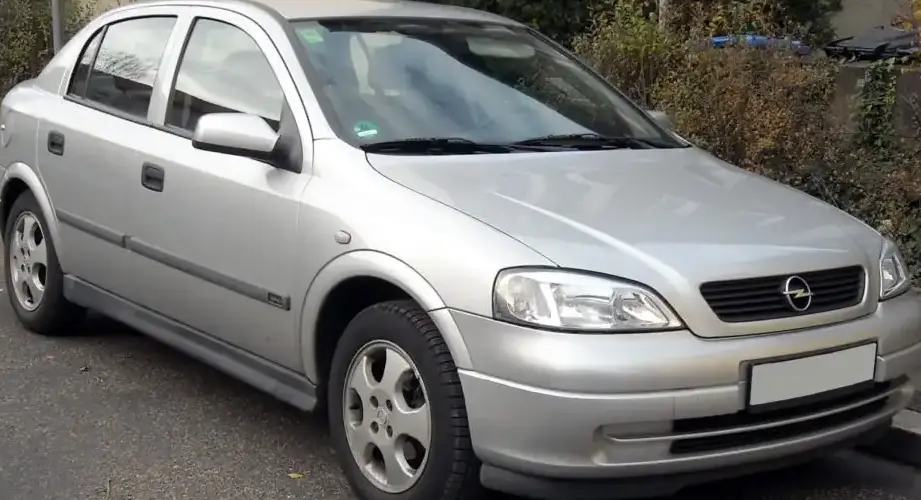
The Opel Astra G 1.6, producing 85 horsepower, was a mainstay of the Astra G range produced between 2000 and 2002. Positioned as an entry-level offering, it served as the most accessible variant within the broader Astra G generation (1998-2004), which was based on the GM240/H platform. This model aimed to provide affordable and practical transportation, appealing to budget-conscious buyers and those prioritizing fuel efficiency over outright performance. It was primarily sold in European markets, where the Astra was a consistently popular compact car, competing with models like the Volkswagen Golf, Ford Focus, and Peugeot 306.
Powertrain & Engine Architecture
The Astra G 1.6 utilized the Z16SE engine, a 1.6-liter inline-four cylinder petrol engine. This engine was a common sight in various Opel and Vauxhall models of the period. The Z16SE featured a single overhead camshaft (SOHC) valvetrain operating two valves per cylinder. Fuel delivery was managed by a multi-port fuel injection system, providing adequate, though not exceptional, combustion control. The engine produced 85 horsepower at 5400 rpm and 138 Nm (101.78 lb-ft) of torque at 2600 rpm. The engine’s relatively simple design prioritized reliability and affordability over high performance. The 5-speed manual transmission was the standard pairing, offering a reasonable spread of gears for everyday driving. The transmission itself was a conventional design, known for its durability and relatively low maintenance requirements.
Driving Characteristics
The 1.6-liter engine, coupled with the manual transmission, provided adequate, but not exhilarating, performance. Acceleration from 0 to 100 km/h (0-62 mph) took around 13 seconds, making it suitable for urban and suburban driving but less ideal for frequent highway overtaking. The engine’s torque curve was relatively flat, providing usable power across a reasonable rev range. Compared to the more powerful 1.8-liter and 2.0-liter variants, the 1.6 felt noticeably slower, particularly when fully loaded. However, it offered a more forgiving driving experience for less experienced drivers. The gear ratios were tuned for fuel efficiency, resulting in a slightly less responsive feel than the sportier models. The steering was light and easy to use, making it well-suited for city driving, but lacked the precision of higher-spec Astras.
Equipment & Trim Levels
The 1.6-liter Astra G typically came with a basic level of equipment. Standard features generally included power steering, central locking, front airbags, and an adjustable steering column. Interior upholstery was typically cloth, and the dashboard featured a functional, if somewhat basic, design. Optional extras included air conditioning, electric windows, and an upgraded audio system. Trim levels varied slightly depending on the market, but the 1.6 generally represented the entry point to the Astra G range. It was often marketed towards first-time car buyers or those seeking a practical and economical vehicle. The base trim often lacked features like alloy wheels or a trip computer, focusing on essential functionality.
Chassis & Braking
The Astra G 1.6 featured a McPherson strut front suspension and a semi-independent coil spring rear suspension. This setup provided a comfortable ride quality, although it wasn’t particularly sporty. The front brakes were ventilated discs, offering adequate stopping power, while the rear brakes were drums, a cost-saving measure common in this segment. ABS (Anti-lock Braking System) was standard, enhancing safety. The chassis was designed to balance affordability with structural integrity, providing a reasonably stable platform for everyday driving. The suspension was tuned for comfort rather than handling, resulting in a slightly softer ride compared to the more performance-oriented Astra variants.
Market Reception & Comparison
The Astra G 1.6 was generally well-received as a practical and affordable compact car. Critics praised its fuel efficiency and comfortable ride, but noted its lack of outright performance. Compared to the higher-output variants, such as the 1.8-liter and 2.0-liter models, the 1.6 offered a more economical option, but at the expense of driving excitement. The 1.6 also provided a more affordable alternative to diesel-powered Astras, appealing to buyers who preferred petrol engines. Fuel economy was a key selling point, with combined fuel consumption figures around 7.1 l/100 km (33.1 US mpg). The 1.8-liter offered a noticeable performance boost, while the diesel models provided superior fuel economy, but at a higher initial cost.
Legacy
The Z16SE engine, found in the Astra G 1.6, is generally considered a reliable unit, although it is prone to some age-related issues such as oil leaks and sensor failures. The Astra G 1.6 remains a relatively affordable option in the used car market, appealing to buyers seeking a cheap and practical vehicle. While it may not offer the performance or features of more modern cars, it provides a dependable and economical means of transportation. Its simplicity and relatively low maintenance costs contribute to its continued popularity among budget-conscious car owners. Parts availability remains good, and the engine is relatively easy to work on for those with basic mechanical skills. Today, these Astras are often seen as reliable and inexpensive transportation for students or those needing a basic commuter car.