Technical Specifications
| Brand | Opel |
| Model | Astra |
| Generation | Astra G |
| Type (Engine) | 1.8 Ecotec 16V (116 Hp) Automatic |
| Start of production | March, 1998 |
| End of production | June, 2000 |
| Powertrain Architecture | Internal Combustion engine |
| Body type | Hatchback |
| Seats | 5 |
| Doors | 3-5 |
| Fuel consumption (urban) | 11.8 l/100 km (19.9 US mpg, 23.9 UK mpg, 8.5 km/l) |
| Fuel consumption (extra urban) | 6.3 l/100 km (37.3 US mpg, 44.8 UK mpg, 15.9 km/l) |
| Fuel consumption (combined) | 8.3 l/100 km (28.3 US mpg, 34 UK mpg, 12 km/l) |
| Fuel Type | Petrol (Gasoline) |
| Acceleration 0 – 100 km/h | 11 sec |
| Acceleration 0 – 62 mph | 11 sec |
| Acceleration 0 – 60 mph | 10.5 sec |
| Maximum speed | 195 km/h (121.17 mph) |
| Emission standard | Euro 2 |
| Weight-to-power ratio | 10.1 kg/Hp, 98.7 Hp/tonne |
| Weight-to-torque ratio | 6.9 kg/Nm, 144.7 Nm/tonne |
| Power | 116 Hp @ 5400 rpm |
| Power per litre | 64.6 Hp/l |
| Torque | 170 Nm @ 3400 rpm (125.39 lb.-ft. @ 3400 rpm) |
| Engine layout | Front, Transverse |
| Engine Model/Code | X18XE1 |
| Engine displacement | 1796 cm3 (109.6 cu. in.) |
| Number of cylinders | 4 |
| Engine configuration | Inline |
| Cylinder Bore | 80.5 mm (3.17 in.) |
| Piston Stroke | 88.2 mm (3.47 in.) |
| Compression ratio | 10.5:1 |
| Number of valves per cylinder | 4 |
| Fuel injection system | Multi-port manifold injection |
| Engine aspiration | Naturally aspirated engine |
| Valvetrain | DOHC |
| Engine oil capacity | 4.25 l (4.49 US qt | 3.74 UK qt) |
| Coolant capacity | 6.3 l (6.66 US qt | 5.54 UK qt) |
| Kerb Weight | 1175 kg (2590.43 lbs.) |
| Max. weight | 1685 kg (3714.79 lbs.) |
| Max load | 510 kg (1124.36 lbs.) |
| Trunk (boot) space – minimum | 370 l (13.07 cu. ft.) |
| Trunk (boot) space – maximum | 1180 l (41.67 cu. ft.) |
| Fuel tank capacity | 52 l (13.74 US gal | 11.44 UK gal) |
| Max. roof load | 100 kg (220.46 lbs.) |
| Permitted towbar download | 75 kg (165.35 lbs.) |
| Length | 4110 mm (161.81 in.) |
| Width | 1709 mm (67.28 in.) |
| Width including mirrors | 1989 mm (78.31 in.) |
| Height | 1425 mm (56.1 in.) |
| Wheelbase | 2606 mm (102.6 in.) |
| Front track | 1464 mm (57.64 in.) |
| Rear track | 1452 mm (57.17 in.) |
| Front overhang | 791 mm (31.14 in.) |
| Rear overhang | 713 mm (28.07 in.) |
| Ride height (ground clearance) | 130 mm (5.12 in.) |
| Drag coefficient (Cd) | 0.28 |
| Minimum turning circle | 10.8 m (35.43 ft.) |
| Drivetrain Architecture | ICE, Front wheel drive |
| Drive wheel | Front wheel drive |
| Number of gears | 4 |
| Gearbox type | automatic transmission |
| Front suspension | Independent, McPherson with coil spring and anti-roll bar |
| Rear suspension | Semi-independent, coil spring |
| Front brakes | Ventilated discs |
| Rear brakes | Disc |
| Assisting systems | ABS (Anti-lock braking system) |
| Steering type | Steering rack and pinion |
| Power steering | Hydraulic |
| Tires size | 195/60 R15 |
| Wheel rims size | 6.5J x 15 ET45 |
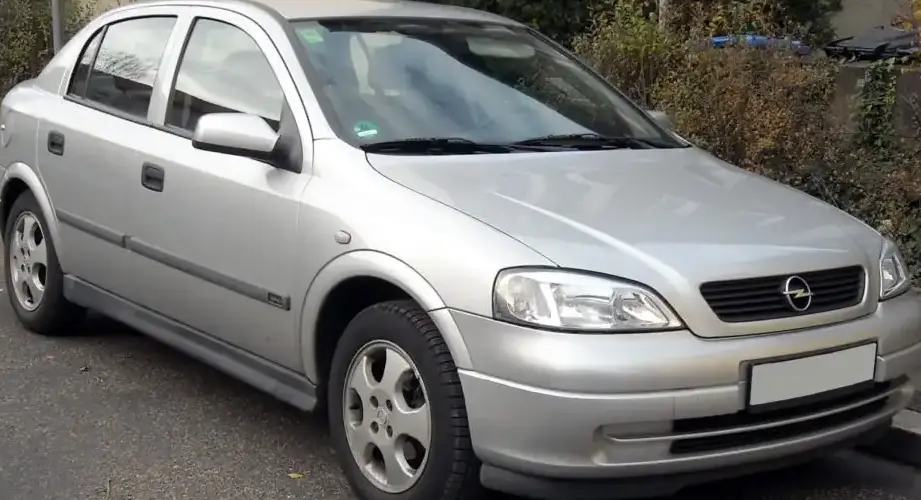
The Opel Astra G 1.8 Ecotec 16V Automatic, produced between March 1998 and June 2000, was a popular mid-range offering within the broader Astra G (1998-2004) lineup. Positioned as a comfortable and practical choice, it aimed to balance performance with ease of use, particularly appealing to drivers seeking an automatic transmission. This variant was available in both 3-door and 5-door hatchback body styles, fitting into the compact family car segment in Europe. It utilized the GM/Opel’s 1HX0 platform, shared with other models like the Zafira and Vectra.
Powertrain & Engine Architecture
The heart of this Astra variant was the X18XE1, a 1.8-liter inline-four cylinder engine. This engine belonged to Opel’s ‘Ecotec’ family, designed for efficiency and refinement. It featured a dual overhead camshaft (DOHC) valvetrain with four valves per cylinder, contributing to its relatively good breathing characteristics for the time. Fuel delivery was handled by a multi-port fuel injection system, providing precise fuel metering. The X18XE1 produced 116 horsepower at 5400 rpm and 170 Nm (125 lb-ft) of torque at 3400 rpm. The engine was transversely mounted in the front of the vehicle. Paired with the engine was a four-speed automatic transmission, offering smooth, if not particularly sporty, gear changes. This transmission was a conventional hydraulic automatic, lacking the more advanced electronic controls found in later designs.
Driving Characteristics
The 1.8 Ecotec Automatic offered a comfortable and predictable driving experience. Acceleration from 0-60 mph took around 10.5 seconds, and top speed was approximately 121 mph. While not a performance-oriented setup, the engine provided adequate power for everyday driving and highway cruising. The automatic transmission, while convenient, did slightly diminish the engine’s responsiveness compared to the available five-speed manual gearbox. Gear ratios were tuned for fuel economy and smooth operation, rather than outright acceleration. Compared to the more powerful 2.0-liter 16V or the torquey diesel options, this variant felt less eager, but it offered a more relaxed and refined driving experience.
Equipment & Trim Levels
The 1.8 Ecotec Automatic typically came with a reasonable level of standard equipment. This included power steering, central locking, electric front windows, and an adjustable steering column. Interior upholstery was usually cloth, with a relatively simple dashboard layout. Optional extras included air conditioning, alloy wheels, a sunroof, and upgraded audio systems. Trim levels varied slightly depending on the market, but generally, this engine/transmission combination represented a mid-range offering, bridging the gap between the base models and the more luxurious trims.
Chassis & Braking
The Astra G utilized an independent McPherson strut suspension at the front, providing decent handling and ride comfort. The rear suspension was a semi-independent torsion beam setup, a cost-effective solution that offered a reasonable compromise between comfort and handling. Braking consisted of ventilated discs at the front and solid discs at the rear. Anti-lock Braking System (ABS) was standard, enhancing safety. The chassis was designed to balance weight distribution and provide a stable platform for everyday driving. Stabilizer bars were fitted front and rear to reduce body roll during cornering.
Market Reception & Comparison
The Astra G 1.8 Ecotec Automatic was generally well-received by automotive critics as a practical and comfortable family car. It was praised for its refined engine, comfortable ride, and reasonable fuel economy (around 28.3 US mpg combined). However, some critics noted that the automatic transmission could feel sluggish at times, and the overall driving experience lacked the engagement of the manual gearbox. Compared to the 1.6-liter base engine, the 1.8 offered a noticeable performance improvement. Compared to the more expensive 2.0-liter models, it provided a more affordable entry point into the Astra G range.
Legacy
The X18XE1 engine, when properly maintained, proved to be a relatively reliable unit. The four-speed automatic transmission, while not as sophisticated as later designs, also demonstrated reasonable durability. Today, Astra G 1.8 Ecotec Automatics are relatively common on the used car market, often representing a good value for money. However, potential buyers should be aware of potential issues such as oil leaks, corrosion, and wear and tear on suspension components. Overall, this variant remains a popular choice for those seeking a comfortable, affordable, and relatively reliable compact hatchback.