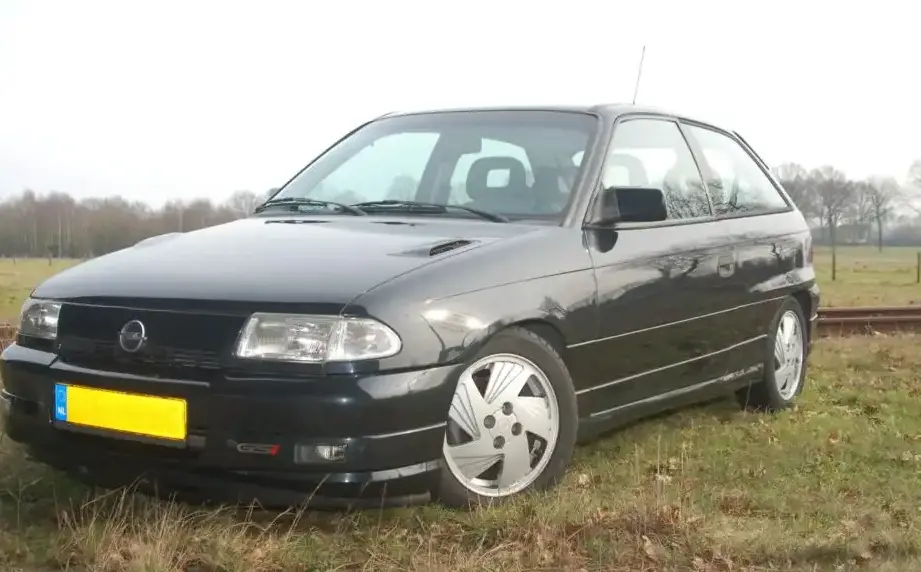
The Opel Astra G Cabrio 2.0i 16V Turbo, produced from January 2002 to November 2002, represented a performance-oriented variant within the Astra G Cabriolet range. Positioned as a premium offering, it combined the open-air enjoyment of a convertible with a potent turbocharged engine. This model was primarily marketed in Europe, offering a sporty alternative to more mainstream Astra Cabrio configurations. It was built on the GM’s 1HX0 platform, shared with other models like the Zafira and Vectra.
Technical Specifications
| Brand | Opel |
| Model | Astra |
| Generation | Astra G Cabrio |
| Type (Engine) | 2.0i 16V Turbo (192 Hp) |
| Start of production | January, 2002 |
| End of production | November, 2002 |
| Powertrain Architecture | Internal Combustion engine |
| Body type | Cabriolet |
| Seats | 4 |
| Doors | 2 |
| Fuel consumption (urban) | 12.5 l/100 km (18.8 US mpg, 22.6 UK mpg, 8 km/l) |
| Fuel consumption (extra urban) | 6.8 l/100 km (34.6 US mpg, 41.5 UK mpg, 14.7 km/l) |
| Fuel consumption (combined) | 8.9 l/100 km (26.4 US mpg, 31.7 UK mpg, 11.2 km/l) |
| CO2 emissions | 214 g/km |
| Fuel Type | Petrol (Gasoline) |
| Acceleration 0 – 100 km/h | 8 sec |
| Acceleration 0 – 62 mph | 8 sec |
| Acceleration 0 – 60 mph | 7.6 sec |
| Maximum speed | 242 km/h (150.37 mph) |
| Weight-to-power ratio | 7.4 kg/Hp, 135.7 Hp/tonne |
| Weight-to-torque ratio | 5.7 kg/Nm, 176.7 Nm/tonne |
| Power | 192 Hp @ 5400 rpm |
| Power per litre | 96.1 Hp/l |
| Torque | 250 Nm @ 1950-5300 rpm (184.39 lb.-ft. @ 1950-5300 rpm) |
| Engine layout | Front, Transverse |
| Engine Model/Code | Z20LET |
| Engine displacement | 1998 cm3 (121.93 cu. in.) |
| Number of cylinders | 4 |
| Engine configuration | Inline |
| Cylinder Bore | 86 mm (3.39 in.) |
| Piston Stroke | 86 mm (3.39 in.) |
| Compression ratio | 8.8:1 |
| Number of valves per cylinder | 4 |
| Fuel injection system | Multi-port manifold injection |
| Engine aspiration | Turbocharger, Intercooler |
| Valvetrain | DOHC |
| Engine oil capacity | 4.25 l (4.49 US qt | 3.74 UK qt) |
| Coolant | 7.4 l (7.82 US qt | 6.51 UK qt) |
| Kerb Weight | 1415 kg (3119.54 lbs.) |
| Max. weight | 1835 kg (4045.48 lbs.) |
| Max load | 420 kg (925.94 lbs.) |
| Trunk (boot) space – minimum | 330 l (11.65 cu. ft.) |
| Fuel tank capacity | 52 l (13.74 US gal | 11.44 UK gal) |
| Length | 4267 mm (167.99 in.) |
| Width | 1709 mm (67.28 in.) |
| Width including mirrors | 1989 mm (78.31 in.) |
| Height | 1390 mm (54.72 in.) |
| Wheelbase | 2606 mm (102.6 in.) |
| Front track | 1467 mm (57.76 in.) |
| Rear (Back) track | 1456 mm (57.32 in.) |
| Front overhang | 812 mm (31.97 in.) |
| Rear overhang | 849 mm (33.43 in.) |
| Drag coefficient (Cd) | 0.32 |
| Minimum turning circle | 11 m (36.09 ft.) |
| Drivetrain Architecture | ICE drives front wheels |
| Drive wheel | Front wheel drive |
| Number of gears | 5 gears, manual transmission |
| Front suspension | Independent, McPherson with coil spring and anti-roll bar |
| Rear suspension | Semi-independent, coil spring |
| Front brakes | Ventilated discs |
| Rear brakes | Disc |
| Assisting systems | ABS |
| Steering type | Steering rack and pinion |
| Power steering | Hydraulic |
| Tires size | 215/40 R17 |
| Wheel rims size | 7.5J x 17 |
Powertrain & Engine Architecture
The heart of the Astra G Cabrio 2.0i 16V Turbo was the Z20LET engine, a 1998cc inline-four cylinder powerplant. This engine was a member of Opel’s ‘Ecotec’ family, known for its focus on efficiency and performance. The Z20LET featured a cast iron block and an aluminum cylinder head with dual overhead camshafts (DOHC) and four valves per cylinder. Crucially, it was equipped with a Garrett GT17 turbocharger with an intercooler, boosting power output to 192 horsepower at 5400 rpm and 250 Nm (184 lb-ft) of torque available from a low 1950 rpm through to 5300 rpm. Fuel delivery was managed by a multi-port fuel injection system. The engine’s relatively high compression ratio of 8.8:1, combined with the turbocharging, contributed to its responsive nature. The standard transmission was a five-speed manual gearbox, optimized for the engine’s powerband.
Driving Characteristics
The 2.0i 16V Turbo offered a significantly more engaging driving experience than the base Astra Cabrio models. The turbocharger provided a noticeable surge of power, making overtaking and highway cruising effortless. While not a dedicated sports car, the Astra G Cabrio Turbo delivered brisk acceleration, achieving 0-60 mph in around 7.6 seconds and a top speed of 150 mph. The five-speed manual transmission allowed drivers to fully exploit the engine’s torque, while the relatively short gear ratios kept the engine within its optimal power range. Compared to the naturally aspirated 1.8L versions, the turbo model felt considerably more powerful and responsive, though the turbo lag was noticeable at lower engine speeds. The handling was typical of a front-wheel-drive convertible, with a tendency towards understeer when pushed hard.
Equipment & Trim Levels
The 2.0i 16V Turbo typically came with a higher level of standard equipment than lower-spec Astra Cabriolets. This included features like alloy wheels (often 17-inch), sports seats, leather-wrapped steering wheel, electric windows and mirrors, and air conditioning. Optional extras could include a sunroof, upgraded audio system, and various cosmetic enhancements. Interior upholstery was generally cloth, but leather options were available. The dashboard layout was functional and driver-focused, with clear instrumentation and logically placed controls.
Chassis & Braking
The Astra G Cabrio’s chassis featured independent suspension at the front, utilizing McPherson struts with coil springs and an anti-roll bar. The rear suspension was a semi-independent torsion beam setup, also with coil springs. This configuration provided a reasonable balance between ride comfort and handling. Braking duties were handled by ventilated discs at the front and solid discs at the rear. Anti-lock Braking System (ABS) was standard, enhancing safety and control during hard braking. The steering was a hydraulic power-assisted rack and pinion system, providing precise and responsive steering feel.
Market Reception & Comparison
The Astra G Cabrio 2.0i 16V Turbo was generally well-received by automotive critics. It was praised for its strong performance, comfortable ride, and stylish design. However, some reviewers noted the presence of turbo lag and the slightly compromised handling inherent in a front-wheel-drive convertible. Compared to the naturally aspirated 1.8L models, the turbo version offered a significant performance upgrade, but at a higher price point. The 1.8L models were favored by buyers prioritizing fuel economy and affordability, while the 2.0i Turbo appealed to those seeking a more dynamic driving experience. The diesel variants, like the 1.7 TDI, offered superior fuel economy but lacked the outright performance of the turbo petrol engine.
Legacy
The Z20LET engine has proven to be a relatively robust and reliable unit when properly maintained. However, like all turbocharged engines, it is susceptible to issues related to turbocharger wear, oil leaks, and cooling system failures. Today, the Astra G Cabrio 2.0i 16V Turbo holds a modest following among enthusiasts. Well-maintained examples are becoming increasingly collectible, particularly those with low mileage and a complete service history. The combination of open-top motoring, a potent engine, and a relatively affordable price makes it an attractive option for those seeking a classic European convertible.