
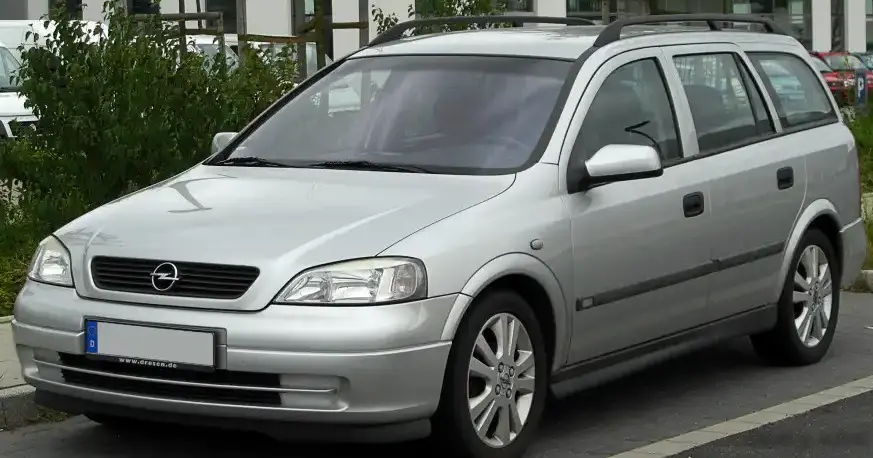
The Opel Astra G Caravan 2.0 DI 16V, produced from October 1998 to June 2000, was a diesel-powered station wagon variant within the broader Astra G (1998-2004) range. Positioned as a practical and economical option, it catered to buyers needing a spacious vehicle for family or work purposes. This model utilized a direct-injection diesel engine, offering a balance between fuel efficiency and reasonable performance for its time. It was part of the G platform (1HX0/A3), shared with other General Motors vehicles like the Zafira and, with modifications, the Saab 9-5.
Technical Specifications
| Brand | Opel |
| Model | Astra |
| Generation | Astra G Caravan |
| Type (Engine) | 2.0 DI 16V (82 Hp) |
| Start of production | October, 1998 |
| End of production | June, 2000 |
| Powertrain Architecture | Internal Combustion engine |
| Body type | Station wagon (estate) |
| Seats | 5 |
| Doors | 5 |
| Fuel consumption (urban) | 7.7 l/100 km (30.5 US mpg) |
| Fuel consumption (extra urban) | 5 l/100 km (47 US mpg) |
| Fuel consumption (combined) | 6 l/100 km (39.2 US mpg) |
| CO2 emissions | 161 g/km |
| Fuel Type | Diesel |
| Acceleration 0 – 100 km/h | 15 sec |
| Acceleration 0 – 62 mph | 15 sec |
| Acceleration 0 – 60 mph | 14.3 sec |
| Maximum speed | 170 km/h (105.63 mph) |
| Emission standard | Euro 2 |
| Weight-to-power ratio | 14.9 kg/Hp |
| Weight-to-torque ratio | 6.6 kg/Nm |
| Power | 82 Hp @ 4300 rpm |
| Torque | 185 Nm @ 1800 rpm (136.45 lb.-ft. @ 1800 rpm) |
| Engine layout | Front, Transverse |
| Engine Model/Code | X20DTL, Y20DTL |
| Engine displacement | 1995 cm3 (121.74 cu. in.) |
| Number of cylinders | 4 |
| Engine configuration | Inline |
| Cylinder Bore | 84 mm (3.31 in.) |
| Piston Stroke | 90 mm (3.54 in.) |
| Compression ratio | 18.5:1 |
| Number of valves per cylinder | 4 |
| Fuel injection system | Direct injection |
| Engine aspiration | Turbocharger |
| Valvetrain | SOHC |
| Engine oil capacity | 5.5 l (5.81 US qt | 4.84 UK qt) |
| Coolant | 7.9 l (8.35 US qt | 6.95 UK qt) |
| Kerb Weight | 1225 kg (2700.66 lbs.) |
| Max. weight | 1745 kg (3847.07 lbs.) |
| Max load | 520 kg (1146.4 lbs.) |
| Trunk (boot) space – minimum | 480 l (16.95 cu. ft.) |
| Trunk (boot) space – maximum | 1500 l (52.97 cu. ft.) |
| Fuel tank capacity | 52 l (13.74 US gal | 11.44 UK gal) |
| Max. roof load | 100 kg (220.46 lbs.) |
| Permitted trailer load with brakes (12%) | 1300 kg (2866.01 lbs.) |
| Permitted trailer load without brakes | 665 kg (1466.07 lbs.) |
| Permitted towbar download | 75 kg (165.35 lbs.) |
| Length | 4288 mm (168.82 in.) |
| Width | 1709 mm (67.28 in.) |
| Width including mirrors | 1989 mm (78.31 in.) |
| Height | 1510 mm (59.45 in.) |
| Wheelbase | 2611 mm (102.8 in.) |
| Front track | 1464 mm (57.64 in.) |
| Rear (Back) track | 1452 mm (57.17 in.) |
| Drag coefficient (Cd) | 0.31 |
| Minimum turning circle | 10.8 m (35.43 ft.) |
| Drivetrain Architecture | Front wheel drive |
| Number of gears | 5 gears, manual transmission |
| Front suspension | Independent, type McPherson with coil spring and anti-roll bar |
| Rear suspension | Semi-independent, coil spring |
| Front brakes | Ventilated discs |
| Rear brakes | Disc |
| Assisting systems | ABS (Anti-lock braking system) |
| Steering type | Steering rack and pinion |
| Power steering | Hydraulic Steering |
| Tires size | 185/65 R15; 195/60 R15 |
| Wheel rims size | 6J x 15; 6.5J x 15 |
INTRODUCTION
The Opel Astra G Caravan 2.0 DI 16V represented a practical choice within the Astra G range, specifically targeting buyers who prioritized fuel economy and cargo space. Introduced in 1998 as part of the facelifted G series, it offered a diesel alternative to the gasoline engines available. The “Caravan” designation signified the station wagon body style, providing a larger boot capacity than the hatchback version. This variant was primarily sold in Europe, where diesel engines held a significant market share due to favorable taxation and fuel costs. The 2.0 DI 16V engine, while not the most powerful in the lineup, provided adequate performance for everyday driving and long-distance journeys.
Powertrain & Engine Architecture
The heart of the Astra G Caravan 2.0 DI 16V is the X20DTL (and sometimes Y20DTL) engine, a 1995cc inline-four cylinder diesel. This engine utilizes direct injection technology, where fuel is injected directly into the combustion chamber under high pressure. This improves combustion efficiency and reduces emissions compared to indirect injection systems. The engine features a single overhead camshaft (SOHC) operating four valves per cylinder (16V). A turbocharger is employed to boost power output, increasing the air intake into the engine. The fuel injection system is electronically controlled, optimizing fuel delivery based on engine load and speed. The 2.0 DI engine produced 82 horsepower at 4300 rpm and 185 Nm (136 lb-ft) of torque at 1800 rpm. The engine was typically paired with a five-speed manual transmission, although an automatic transmission was also available, albeit less common.
Driving Characteristics
The 2.0 DI 16V-equipped Astra G Caravan offered a comfortable, if not particularly sporty, driving experience. The 82 horsepower output resulted in a 0-60 mph time of around 14.3 seconds, and a top speed of 105.63 mph. The turbocharger helped to mitigate some of the inherent lag associated with diesel engines, providing a usable amount of torque from relatively low engine speeds. The five-speed manual transmission allowed drivers to keep the engine in its optimal power band. Compared to the more powerful gasoline variants, the 2.0 DI felt noticeably slower, especially during acceleration. However, its superior fuel economy and torque made it well-suited for hauling loads or driving on highways. The automatic transmission, when equipped, further dulled acceleration but offered increased convenience.
Equipment & Trim Levels
The Astra G Caravan 2.0 DI 16V typically came with a reasonable level of standard equipment. This included power steering, central locking, electric front windows, and an adjustable steering column. Interior upholstery was generally cloth, with a functional, if somewhat basic, dashboard layout. Optional extras included air conditioning, alloy wheels, a sunroof, and upgraded audio systems. Trim levels varied depending on the market, but generally followed a progression from base models to more luxurious versions with additional features. The 2.0 DI trim often sat in the mid-range, offering a good balance of features and affordability.
Chassis & Braking
The Astra G Caravan featured an independent McPherson strut suspension at the front, providing a comfortable ride and decent handling. The rear suspension was a semi-independent torsion beam setup, which was cost-effective but less sophisticated than a fully independent system. Brakes were ventilated discs at the front and solid discs at the rear. Anti-lock Braking System (ABS) was standard, enhancing safety by preventing wheel lockup during hard braking. The chassis was designed to accommodate the increased weight of the diesel engine and the station wagon body style. Stabilizer bars were fitted to both the front and rear axles to reduce body roll during cornering.
Market Reception & Comparison
The Astra G Caravan 2.0 DI 16V was generally well-received by automotive critics as a practical and economical family car. Its fuel efficiency was a major selling point, particularly in Europe. However, some reviewers noted its relatively modest performance compared to gasoline-powered rivals. Compared to other Astra G variants, such as the 1.8-liter gasoline engine or the more powerful 2.0-liter turbocharged gasoline models, the 2.0 DI offered lower running costs but less excitement. The 1.7 DTI diesel was a lower-cost alternative, but offered even less power. The 2.0 DI provided a good compromise for those seeking a balance between economy and usability.
Legacy
The Opel Astra G Caravan 2.0 DI 16V has proven to be a relatively reliable vehicle, with many examples still on the road today. The X20DTL engine is known for its durability, although regular maintenance is essential to prevent issues such as turbocharger failure or injector problems. In the used car market, these Astras are often sought after by buyers looking for an affordable and practical estate car. Their fuel efficiency and spaciousness continue to make them a viable option for those needing a workhorse vehicle. While not a performance icon, the Astra G Caravan 2.0 DI 16V represents a solid and dependable choice for everyday transportation.

