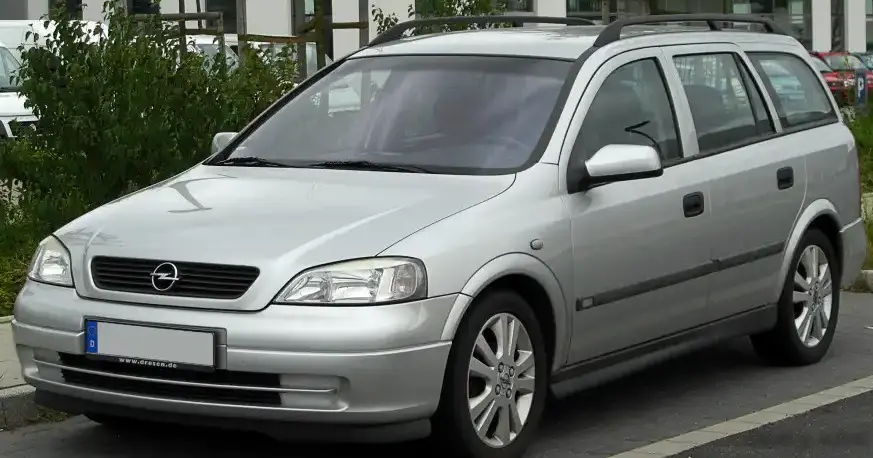
The Opel Astra G Caravan 2.0 DTI 16V, produced from July 1999 to 2002, was a station wagon variant within the broader Astra G range (1998-2004). Positioned as a practical and fuel-efficient option, it catered to buyers needing a versatile family vehicle. This particular model, powered by the 2.0-liter direct injection turbodiesel engine producing 101 horsepower, occupied a mid-range slot in the Caravan lineup, offering a balance between performance and economy. It was a key offering in the European market, where station wagons held significant popularity, providing a competitive alternative to rivals like the Ford Focus Estate and Volkswagen Passat Variant.
Technical Specifications
| Brand | Opel |
| Model | Astra |
| Generation | Astra G Caravan |
| Type (Engine) | 2.0 DTI 16V (101 Hp) |
| Start of production | July, 1999 |
| End of production | 2002 |
| Powertrain Architecture | Internal Combustion engine |
| Body type | Station wagon (estate) |
| Seats | 5 |
| Doors | 5 |
| Fuel consumption (urban) | 7.7 l/100 km (30.5 US mpg) |
| Fuel consumption (extra urban) | 4.8 l/100 km (49 US mpg) |
| Fuel consumption (combined) | 5.9 l/100 km (39.9 US mpg) |
| CO2 emissions | 159 g/km |
| Fuel Type | Diesel |
| Acceleration 0 – 100 km/h | 12.5 sec |
| Acceleration 0 – 62 mph | 12.5 sec |
| Acceleration 0 – 60 mph | 11.9 sec |
| Maximum speed | 183 km/h (113.71 mph) |
| Emission standard | Euro 3 |
| Weight-to-power ratio | 12.4 kg/Hp |
| Weight-to-torque ratio | 6.1 kg/Nm |
| Power | 101 Hp @ 4300 rpm |
| Torque | 205 Nm @ 1650-2500 rpm (151.2 lb.-ft.) |
| Engine layout | Front, Transverse |
| Engine Model/Code | Y20DTH |
| Engine displacement | 1995 cm3 (121.74 cu. in.) |
| Number of cylinders | 4 |
| Engine configuration | Inline |
| Cylinder Bore | 84 mm (3.31 in.) |
| Piston Stroke | 90 mm (3.54 in.) |
| Compression ratio | 18.5:1 |
| Number of valves per cylinder | 4 |
| Fuel injection system | Direct injection |
| Engine aspiration | Turbocharger, Intercooler |
| Valvetrain | DOHC |
| Engine oil capacity | 5.5 l (5.81 US qt | 4.84 UK qt) |
| Coolant capacity | 5.9 l (6.23 US qt | 5.19 UK qt) |
| Kerb Weight | 1250 kg (2755.78 lbs.) |
| Max. weight | 1770 kg (3902.18 lbs.) |
| Max load | 520 kg (1146.4 lbs.) |
| Trunk (boot) space – minimum | 480 l (16.95 cu. ft.) |
| Trunk (boot) space – maximum | 1500 l (52.97 cu. ft.) |
| Fuel tank capacity | 52 l (13.74 US gal | 11.44 UK gal) |
| Max. roof load | 100 kg (220.46 lbs.) |
| Permitted trailer load with brakes (12%) | 1300 kg (2866.01 lbs.) |
| Permitted trailer load without brakes | 675 kg (1488.12 lbs.) |
| Permitted towbar download | 75 kg (165.35 lbs.) |
| Length | 4288 mm (168.82 in.) |
| Width | 1709 mm (67.28 in.) |
| Width including mirrors | 1989 mm (78.31 in.) |
| Height | 1510 mm (59.45 in.) |
| Wheelbase | 2611 mm (102.8 in.) |
| Front track | 1464 mm (57.64 in.) |
| Rear track | 1452 mm (57.17 in.) |
| Drag coefficient (Cd) | 0.31 |
| Minimum turning circle | 10.8 m (35.43 ft.) |
| Drivetrain Architecture | Front wheel drive |
| Drive wheel | Front wheel drive |
| Number of gears | 5 gears, manual transmission |
| Front suspension | Independent, McPherson with coil spring and anti-roll bar |
| Rear suspension | Semi-independent, coil spring |
| Front brakes | Ventilated discs |
| Rear brakes | Disc |
| Assisting systems | ABS (Anti-lock braking system) |
| Steering type | Steering rack and pinion |
| Power steering | Hydraulic |
| Tires size | 195/60 R15; 205/50 R16 |
| Wheel rims size | 6.5J x 15 |
Powertrain & Engine Architecture
The heart of the Astra G Caravan 2.0 DTI 16V is the Y20DTH engine, a 1995cc inline-four cylinder diesel. This engine utilizes direct injection technology, where fuel is sprayed directly into the combustion chamber under high pressure. This improves combustion efficiency and reduces emissions. The ‘16V’ designation indicates the engine features four valves per cylinder (Dual Overhead Camshaft – DOHC), enhancing breathing and contributing to improved power output. A turbocharger with an intercooler is employed to force more air into the engine, boosting power and torque. The fuel injection system is electronically controlled, optimizing fuel delivery based on engine load and speed. The engine’s robust construction and relatively simple design contributed to its longevity. The 2.0 DTI was paired with a five-speed manual transmission as standard, delivering power to the front wheels.
Driving Characteristics
The 101 horsepower and 205 Nm (151 lb-ft) of torque provided by the 2.0 DTI engine delivered adequate, though not exhilarating, performance. Acceleration from 0-60 mph took around 11.9 seconds, and top speed was approximately 114 mph. The engine’s torque curve was relatively flat, providing usable power across a wide rev range, making it well-suited for everyday driving and hauling loads. Compared to the more powerful 2.0 16V petrol version, the DTI offered significantly better fuel economy but lacked the petrol engine’s responsiveness. Against the 1.7 DTI, the 2.0 DTI provided a noticeable power increase, though at the cost of slightly higher fuel consumption. The five-speed manual transmission offered precise shifts, and the gear ratios were well-matched to the engine’s characteristics.
Equipment & Trim Levels
The Astra G Caravan 2.0 DTI 16V typically came with a reasonable level of standard equipment. This included central locking, power windows, power steering, and an adjustable steering column. Interior upholstery was generally cloth, with options for upgraded materials. Air conditioning was often included, but not always standard. Optional extras included alloy wheels, a sunroof, and a CD player. Trim levels varied slightly depending on the market, but generally, the 2.0 DTI sat in the mid-range, offering more features than the base models but lacking the luxury appointments of the higher-spec versions.
Chassis & Braking
The Astra G Caravan featured independent suspension at the front, utilizing McPherson struts with coil springs and an anti-roll bar. The rear suspension was a semi-independent torsion beam setup. This configuration provided a good balance between ride comfort and handling. Braking was handled by ventilated discs at the front and solid discs at the rear. Anti-lock Braking System (ABS) was standard, enhancing safety. The chassis was designed to accommodate the increased weight of the station wagon body style and the diesel engine, providing a stable and predictable driving experience.
Market Reception & Comparison
The Astra G Caravan 2.0 DTI 16V was generally well-received by automotive critics as a practical and economical family car. Its fuel efficiency was a major selling point, particularly in Europe where diesel fuel was often cheaper than petrol. Critics praised its spacious interior and large cargo area. However, some noted that the engine was somewhat noisy and lacked the refinement of some competitors. Compared to the petrol-powered Astra G models, the DTI offered superior fuel economy but less performance. Against rivals like the Ford Focus Estate and Volkswagen Passat Variant, the Astra G Caravan 2.0 DTI 16V offered a competitive package in terms of price, space, and fuel efficiency.
Legacy
The Y20DTH engine, while not without its quirks, proved to be a relatively reliable unit when properly maintained. Common issues included turbocharger wear and potential problems with the fuel injectors. However, these were generally addressable with regular servicing. Today, the Astra G Caravan 2.0 DTI 16V can be found on the used car market at affordable prices. It remains a popular choice for those seeking a practical and economical station wagon. Its simple mechanical design and readily available parts make it relatively easy to maintain, ensuring its continued presence on the roads.