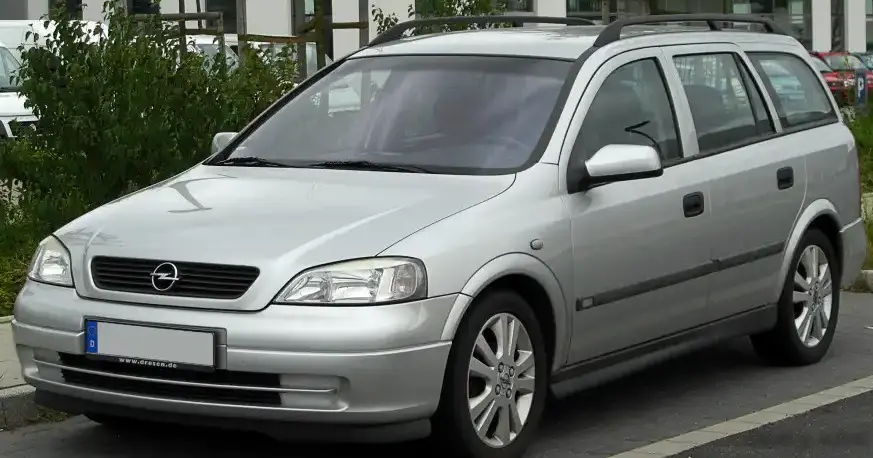
The Opel Astra G Caravan 2.0 Ecotec 16V Automatic, produced between October 1998 and June 2000, represents a practical and relatively well-equipped variant within the broader Astra G (1998-2004) range. Positioned as a mid-range offering, it catered to buyers seeking the versatility of a station wagon (estate) body style combined with a comfortable, albeit not overtly sporty, driving experience. This model was primarily sold in Europe, where the Astra G was a significant competitor in the compact family car segment. It utilized the GM/Opel T-platform, also known as the 1HX0, shared with other models like the Zafira and Vectra.
Technical Specifications
| Brand | Opel |
| Model | Astra |
| Generation | Astra G Caravan |
| Type (Engine) | 2.0 Ecotec 16V (136 Hp) Automatic |
| Start of production | October, 1998 |
| End of production | June, 2000 |
| Powertrain Architecture | Internal Combustion engine |
| Body type | Station wagon (estate) |
| Seats | 5 |
| Doors | 5 |
| Fuel consumption (urban) | 13.5 l/100 km (17.4 US mpg, 20.9 UK mpg, 7.4 km/l) |
| Fuel consumption (extra urban) | 7.3 l/100 km (32.2 US mpg, 38.7 UK mpg, 13.7 km/l) |
| Fuel consumption (combined) | 9.6 l/100 km (24.5 US mpg, 29.4 UK mpg, 10.4 km/l) |
| CO2 emissions | 231 g/km |
| Fuel Type | Petrol (Gasoline) |
| Acceleration 0 – 100 km/h | 11 sec |
| Acceleration 0 – 62 mph | 11 sec |
| Acceleration 0 – 60 mph | 10.5 sec |
| Maximum speed | 195 km/h (121.17 mph) |
| Emission standard | Euro 2 |
| Weight-to-power ratio | 9 kg/Hp, 111 Hp/tonne |
| Weight-to-torque ratio | 6.5 kg/Nm, 153.5 Nm/tonne |
| Power | 136 Hp @ 5600 rpm |
| Power per litre | 68.1 Hp/l |
| Torque | 188 Nm @ 3200 rpm (138.66 lb.-ft. @ 3200 rpm) |
| Engine layout | Front, Transverse |
| Engine Model/Code | X20XEV |
| Engine displacement | 1998 cm3 (121.93 cu. in.) |
| Number of cylinders | 4 |
| Engine configuration | Inline |
| Cylinder Bore | 86 mm (3.39 in.) |
| Piston Stroke | 86 mm (3.39 in.) |
| Compression ratio | 10.8:1 |
| Number of valves per cylinder | 4 |
| Fuel injection system | Multi-port manifold injection |
| Engine aspiration | Naturally aspirated engine |
| Valvetrain | DOHC |
| Engine oil capacity | 4.25 l (4.49 US qt | 3.74 UK qt) |
| Coolant | 6.7 l (7.08 US qt | 5.9 UK qt) |
| Kerb Weight | 1225 kg (2700.66 lbs.) |
| Max. weight | 1725 kg (3802.97 lbs.) |
| Max load | 500 kg (1102.31 lbs.) |
| Trunk (boot) space – minimum | 480 l (16.95 cu. ft.) |
| Trunk (boot) space – maximum | 1500 l (52.97 cu. ft.) |
| Fuel tank capacity | 52 l (13.74 US gal | 11.44 UK gal) |
| Max. roof load | 100 kg (220.46 lbs.) |
| Length | 4288 mm (168.82 in.) |
| Width | 1709 mm (67.28 in.) |
| Width including mirrors | 1989 mm (78.31 in.) |
| Height | 1510 mm (59.45 in.) |
| Wheelbase | 2611 mm (102.8 in.) |
| Front track | 1464 mm (57.64 in.) |
| Rear (Back) track | 1452 mm (57.17 in.) |
| Drag coefficient (Cd) | 0.31 |
| Minimum turning circle | 10.8 m (35.43 ft.) |
| Drivetrain Architecture | ICE, Front wheel drive |
| Drive wheel | Front wheel drive |
| Number of gears and type of gearbox | 4 gears, automatic transmission |
| Front suspension | Independent, type McPherson with coil spring and anti-roll bar |
| Rear suspension | Semi-independent, coil spring |
| Front brakes | Ventilated discs |
| Rear brakes | Disc |
| Assisting systems | ABS (Anti-lock braking system) |
| Steering type | Steering rack and pinion |
| Power steering | Hydraulic Steering |
| Tires size | 195/60 R15 |
| Wheel rims size | 6.5J x 15 |
INTRODUCTION
The Opel Astra G Caravan 2.0 Ecotec 16V Automatic, launched in late 1998, was a key variant in the second generation of the Astra G series. The Caravan designation signified the station wagon body style, offering increased cargo capacity compared to the hatchback. This particular model combined a 2.0-liter, 16-valve gasoline engine with a four-speed automatic transmission, aiming to provide a balance of performance and convenience for family buyers. It sat in the middle of the Caravan range, above the smaller 1.6L and 1.8L engines, but below the more powerful (and often more expensive) 2.2L direct injection variants.
Powertrain & Engine Architecture
The heart of this Astra G Caravan is the X20XEV engine, a 1998cc inline-four cylinder powerplant. This engine belongs to Opel’s ‘Ecotec’ family, designed with a focus on efficiency and reduced emissions. It features a dual overhead camshaft (DOHC) valvetrain with four valves per cylinder, contributing to its relatively high specific output. Fuel delivery is managed by a multi-port fuel injection system. The X20XEV is a naturally aspirated engine, meaning it doesn’t utilize turbocharging or supercharging. The four-speed automatic transmission, a common unit in Opel vehicles of the era, was chosen for its ease of use and suitability for everyday driving. While not known for its lightning-fast shifts, it provided smooth and predictable gear changes. The transmission control unit (TCU) manages the shift points based on throttle position and vehicle speed.
Driving Characteristics
The 136 horsepower and 188 Nm (138.66 lb-ft) of torque produced by the 2.0 Ecotec engine, coupled with the four-speed automatic, resulted in a respectable, but not exhilarating, driving experience. Acceleration from 0-60 mph took around 10.5 seconds, and top speed was approximately 121 mph. The automatic transmission, while convenient, did slightly diminish the engine’s potential compared to the available five-speed manual gearbox. Gear ratios were tuned for comfortable cruising rather than outright performance. The automatic tended to hold onto gears longer to maximize fuel efficiency, which could sometimes feel sluggish during overtaking maneuvers. Compared to the more powerful 2.2L variants, this 2.0L automatic felt noticeably less responsive, but it offered a smoother and more relaxed driving experience.
Equipment & Trim Levels
The Astra G Caravan 2.0 Ecotec Automatic typically came with a reasonable level of standard equipment. This included central locking, electric front windows, power steering, and an anti-lock braking system (ABS). Interior upholstery was usually cloth, with a fairly basic dashboard layout. Optional extras included air conditioning, alloy wheels, a sunroof, and a CD player. Higher trim levels, often denoted by names like ‘Comfort’ or ‘Elegance’, added features such as upgraded upholstery, wood trim, and more sophisticated audio systems. The Caravan body style itself was a key feature, offering a large and practical cargo area, enhanced by the ability to fold down the rear seats.
Chassis & Braking
The Astra G Caravan utilized an independent McPherson strut suspension setup at the front, providing a comfortable ride and decent handling. The rear suspension was a semi-independent torsion beam arrangement, a cost-effective solution that offered a good compromise between ride quality and space efficiency. Braking was handled by ventilated discs at the front and solid discs at the rear. The ABS system helped to maintain steering control during emergency braking situations. Stabilizer bars were fitted to both the front and rear axles to reduce body roll during cornering. The suspension tuning was generally geared towards comfort rather than sporty handling, making it well-suited for long journeys and everyday use.
Market Reception & Comparison
The Astra G Caravan 2.0 Ecotec Automatic was generally well-received by automotive critics as a practical and reliable family car. However, the automatic transmission was sometimes criticized for being somewhat dated and lacking the responsiveness of more modern units. Fuel economy, at around 24.5 US mpg combined, was considered average for its class. Compared to the 1.8L versions, the 2.0L offered a noticeable performance improvement, but at the cost of slightly higher fuel consumption. The 2.2L direct injection models provided significantly more power, but were also more expensive to purchase and maintain. The 1.7D and 1.9D diesel variants offered superior fuel economy, but lacked the refinement and power of the gasoline engines.
Legacy
The Opel Astra G Caravan 2.0 Ecotec Automatic has proven to be a relatively durable and reliable vehicle. The X20XEV engine is known for its longevity, provided it receives regular maintenance. Common issues include oil leaks and occasional sensor failures. The automatic transmission, while not particularly sophisticated, is generally robust. Today, these cars are readily available on the used car market at affordable prices. They represent a practical and economical option for buyers seeking a spacious and reliable estate car. While not a performance icon, the Astra G Caravan 2.0 Ecotec Automatic remains a testament to Opel’s commitment to building functional and dependable family vehicles.