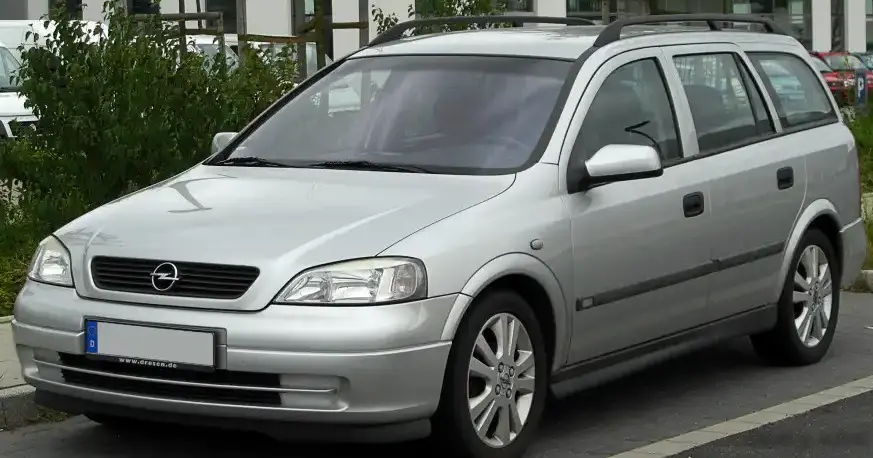
The Opel Astra G Caravan 2.2 16V, produced from 2001 to 2002, represented a higher-performance variant within the second generation (G) Astra range. This model, a five-door station wagon (estate), was positioned as a more refined and powerful option compared to the base models, appealing to buyers seeking a blend of practicality and driving enjoyment. It was a key offering in the European market, where station wagons held significant popularity, offering a spacious and versatile alternative to saloons and hatchbacks. The Astra G generation, built on the GM240 platform (internally known as the 1HX0 for the Caravan), aimed to improve upon its predecessor with enhanced safety, comfort, and a more modern design.
Technical Specifications
| Brand | Opel |
| Model | Astra |
| Generation | Astra G Caravan |
| Type (Engine) | 2.2 16V (147 Hp) |
| Start of production | 2001 |
| End of production | 2002 |
| Powertrain Architecture | Internal Combustion engine |
| Body type | Station wagon (estate) |
| Seats | 5 |
| Doors | 5 |
| Fuel consumption (economy) – urban (NEDC) | 12.1 l/100 km (19.4 US mpg, 23.3 UK mpg, 8.3 km/l) |
| Fuel consumption (economy) – extra urban (NEDC) | 6.5 l/100 km (36.2 US mpg, 43.5 UK mpg, 15.4 km/l) |
| Fuel consumption (economy) – combined (NEDC) | 8.6 l/100 km (27.4 US mpg, 32.8 UK mpg, 11.6 km/l) |
| CO2 emissions (NEDC) | 207 g/km |
| Fuel Type | Petrol (Gasoline) |
| Acceleration 0 – 100 km/h | 9.3 sec |
| Acceleration 0 – 62 mph | 9.3 sec |
| Acceleration 0 – 60 mph | 8.8 sec |
| Maximum speed | 208 km/h (129.25 mph) |
| Emission standard | Euro 4 |
| Weight-to-power ratio | 8.3 kg/Hp, 120.2 Hp/tonne |
| Weight-to-torque ratio | 6 kg/Nm, 166 Nm/tonne |
| Power | 147 Hp @ 5800 rpm |
| Power per litre | 66.9 Hp/l |
| Torque | 203 Nm @ 4000 rpm (149.73 lb.-ft. @ 4000 rpm) |
| Engine layout | Front, Transverse |
| Engine Model/Code | Z22SE |
| Engine displacement | 2198 cm3 (134.13 cu. in.) |
| Number of cylinders | 4 |
| Engine configuration | Inline |
| Cylinder Bore | 86 mm (3.39 in.) |
| Piston Stroke | 94.6 mm (3.72 in.) |
| Compression ratio | 10:1 |
| Number of valves per cylinder | 4 |
| Fuel injection system | Multi-port manifold injection |
| Engine aspiration | Naturally aspirated engine |
| Valvetrain | DOHC |
| Engine oil capacity | 5 l (5.28 US qt | 4.4 UK qt) |
| Coolant | 7.1 l (7.5 US qt | 6.25 UK qt) |
| Kerb Weight | 1223 kg (2696.25 lbs.) |
| Max. weight | 1810 kg (3990.37 lbs.) |
| Max load | 587 kg (1294.11 lbs.) |
| Trunk (boot) space – minimum | 480 l (16.95 cu. ft.) |
| Trunk (boot) space – maximum | 1500 l (52.97 cu. ft.) |
| Fuel tank capacity | 52 l (13.74 US gal | 11.44 UK gal) |
| Max. roof load | 100 kg (220.46 lbs.) |
| Permitted trailer load with brakes (12%) | 1400 kg (3086.47 lbs.) |
| Permitted trailer load without brakes | 630 kg (1388.91 lbs.) |
| Permitted towbar download | 75 kg (165.35 lbs.) |
| Length | 4288 mm (168.82 in.) |
| Width | 1709 mm (67.28 in.) |
| Width including mirrors | 1989 mm (78.31 in.) |
| Height | 1510 mm (59.45 in.) |
| Wheelbase | 2611 mm (102.8 in.) |
| Front track | 1464 mm (57.64 in.) |
| Rear (Back) track | 1452 mm (57.17 in.) |
| Drag coefficient (Cd) | 0.31 |
| Minimum turning circle (turning diameter) | 10.55 m (34.61 ft.) |
| Drivetrain Architecture | The Internal combustion engine (ICE) drives the front wheels of the vehicle. |
| Drive wheel | Front wheel drive |
| Number of gears and type of gearbox | 5 gears, manual transmission |
| Front suspension | Independent, type McPherson with coil spring and anti-roll bar |
| Rear suspension | Semi-independent, coil spring |
| Front brakes | Ventilated discs, 280 mm |
| Rear brakes | Disc, 264 mm |
| Assisting systems | ABS (Anti-lock braking system) |
| Steering type | Steering rack and pinion |
| Power steering | Electric Steering |
| Tires size | 195/60 R15; 205/50 R16 |
| Wheel rims size | 6J x 15; 7J x 16 |
INTRODUCTION
The Opel Astra G Caravan 2.2 16V, launched in 2001 and continuing through 2002, was a significant offering within the Astra G range. It catered to buyers needing the practicality of a station wagon but desiring more performance than the entry-level engines provided. The Caravan body style, popular in Europe, offered a generous cargo capacity and family-friendly versatility. This particular variant, powered by the Z22SE engine, aimed to bridge the gap between economy and performance, offering a more engaging driving experience than the smaller displacement options.
Powertrain & Engine Architecture
At the heart of the Astra G Caravan 2.2 16V lies the Z22SE engine, a 2.2-liter inline-four cylinder petrol engine. This engine is a naturally aspirated unit featuring multi-port fuel injection and a double overhead camshaft (DOHC) valvetrain with four valves per cylinder. The Z22SE is part of Opel’s ‘Ecotec’ engine family, designed for efficiency and reduced emissions. The engine’s architecture prioritizes smooth power delivery and reasonable fuel economy. The 16-valve configuration contributes to improved breathing and higher power output compared to engines with fewer valves. The engine’s 10:1 compression ratio strikes a balance between performance and the ability to run on readily available fuel grades. The engine was typically paired with a five-speed manual transmission, although automatic options were also available, though less common.
Driving Characteristics
The 2.2 16V engine provided a noticeable step up in performance compared to the lower-capacity Astra Caravan models. With 147 horsepower and 203 Nm (149.73 lb-ft) of torque, the car offered brisk acceleration, achieving 0-100 km/h (0-62 mph) in approximately 9.3 seconds. While not a sports car, the 2.2-liter engine provided ample power for overtaking and comfortable cruising on motorways. The five-speed manual transmission allowed drivers to effectively utilize the engine’s powerband. The Caravan’s suspension, tuned for comfort, provided a reasonably composed ride, although it wasn’t as sporty as some of its rivals. The steering was light and precise, making it easy to maneuver in urban environments.
Equipment & Trim Levels
The Astra G Caravan 2.2 16V typically came with a reasonably comprehensive equipment list, positioning it as a mid-to-upper trim level. Standard features often included power windows, central locking, power steering, an anti-lock braking system (ABS), and a basic audio system. Higher trim levels, such as the ‘Elegance’ or ‘Sport’ variants, added features like alloy wheels, air conditioning, a more advanced audio system, and upgraded interior trim. Interior upholstery was typically cloth, with options for leather available on higher-spec models. The dashboard layout was functional and ergonomically designed, with clear instrumentation.
Chassis & Braking
The Astra G Caravan featured an independent McPherson strut suspension at the front, providing good ride quality and handling. The rear suspension utilized a semi-independent torsion beam setup, which was a cost-effective solution that offered a reasonable compromise between comfort and handling. Braking duties were handled by ventilated discs at the front and solid discs at the rear. ABS was standard, enhancing braking performance and safety. The chassis was designed to provide a stable and predictable driving experience, prioritizing comfort and practicality over outright sportiness.
Market Reception & Comparison
The Astra G Caravan 2.2 16V was generally well-received by automotive critics. It was praised for its spacious interior, comfortable ride, and improved performance compared to the lower-powered models. However, some critics noted that the engine, while adequate, wasn’t as refined or powerful as some of its competitors. Compared to the 1.8-liter versions, the 2.2 offered a significant boost in performance, but at the cost of slightly higher fuel consumption. The 2.2 16V was a more compelling option for drivers who frequently carried passengers or cargo and needed extra power for long journeys or hilly terrain.
Legacy
The Opel Astra G Caravan 2.2 16V remains a relatively common sight on European roads today, testament to its build quality and reliability. The Z22SE engine is known to be a durable unit, provided it receives regular maintenance. Common issues include oil leaks and occasional sensor failures, but these are generally not major concerns. In the used car market, the 2.2 16V variant commands a slightly higher price than the lower-powered models, reflecting its improved performance and desirability. It represents a practical and reliable choice for buyers seeking a spacious and versatile station wagon with a reasonable level of performance.