
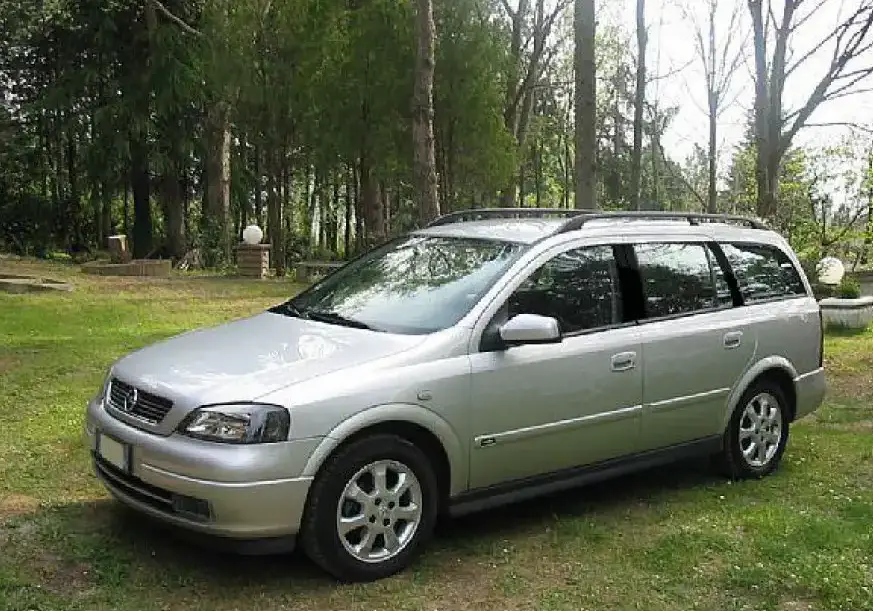
Technical Specifications
| Brand | Opel |
| Model | Astra |
| Generation | Astra G Caravan (facelift 2002) |
| Type (Engine) | 1.7 CDTI (80 Hp) |
| Start of production | February, 2003 |
| End of production | May, 2004 |
| Powertrain Architecture | Internal Combustion engine |
| Body type | Station wagon (estate) |
| Seats | 5 |
| Doors | 5 |
| Fuel consumption (urban) | 6.1 l/100 km (38.6 US mpg, 46.3 UK mpg, 16.4 km/l) |
| Fuel consumption (extra urban) | 4 l/100 km (58.8 US mpg, 70.6 UK mpg, 25 km/l) |
| Fuel consumption (combined) | 4.8 l/100 km (49 US mpg, 58.9 UK mpg, 20.8 km/l) |
| CO2 emissions | 129 g/km |
| Fuel Type | Diesel |
| Acceleration 0 – 100 km/h | 14.5 sec |
| Acceleration 0 – 62 mph | 14.5 sec |
| Acceleration 0 – 60 mph | 13.8 sec |
| Maximum speed | 168 km/h (104.39 mph) |
| Weight-to-power ratio | 15.3 kg/Hp, 65.6 Hp/tonne |
| Weight-to-torque ratio | 7.2 kg/Nm, 139.3 Nm/tonne |
| Power | 80 Hp @ 4400 rpm |
| Power per litre | 47.4 Hp/l |
| Torque | 170 Nm @ 1800 rpm (125.39 lb.-ft. @ 1800 rpm) |
| Engine layout | Front, Transverse |
| Engine Model/Code | Z17DTL |
| Engine displacement | 1686 cm3 (102.89 cu. in.) |
| Number of cylinders | 4 |
| Engine configuration | Inline |
| Cylinder Bore | 79 mm (3.11 in.) |
| Piston Stroke | 86 mm (3.39 in.) |
| Compression ratio | 18.4:1 |
| Number of valves per cylinder | 4 |
| Fuel injection system | Diesel Commonrail |
| Engine aspiration | Turbocharger, Intercooler |
| Valvetrain | DOHC |
| Engine oil capacity | 4.5 l (4.76 US qt | 3.96 UK qt) |
| Coolant | 7.1 l (7.5 US qt | 6.25 UK qt) |
| Kerb Weight | 1220 kg (2689.64 lbs.) |
| Max. weight | 1795 kg (3957.3 lbs.) |
| Max load | 575 kg (1267.66 lbs.) |
| Trunk (boot) space – minimum | 480 l (16.95 cu. ft.) |
| Trunk (boot) space – maximum | 1500 l (52.97 cu. ft.) |
| Fuel tank capacity | 52 l (13.74 US gal | 11.44 UK gal) |
| Length | 4288 mm (168.82 in.) |
| Width | 1710 mm (67.32 in.) |
| Width including mirrors | 1967 mm (77.44 in.) |
| Height | 1510 mm (59.45 in.) |
| Wheelbase | 2611 mm (102.8 in.) |
| Front track | 1484 mm (58.43 in.) |
| Rear (Back) track | 1460 mm (57.48 in.) |
| Ride height (ground clearance) | 130 mm (5.12 in.) |
| Drag coefficient (Cd) | 0.32 |
| Drivetrain Architecture | The Internal combustion engine (ICE) drives the front wheels of the vehicle. |
| Drive wheel | Front wheel drive |
| Number of gears and type of gearbox | 5 gears, manual transmission |
| Front suspension | Spring Strut |
| Rear suspension | Trailing arm |
| Front brakes | Disc |
| Rear brakes | Drum |
| Assisting systems | ABS (Anti-lock braking system) |
| Steering type | Steering rack and pinion |
| Power steering | Hydraulic Steering |
| Tires size | 195/60 R15 |
| Wheel rims size | 15 |
The Opel Astra G Caravan, particularly the facelifted models from 2002 onwards, represented a significant step forward in Opel’s station wagon offerings. The facelift brought revised styling, improved safety features, and updated engine options. The 1.7 CDTI 80 hp variant, introduced in 2003, was designed to appeal to buyers seeking a practical and economical family vehicle. It utilized the Z17DTL engine, a common-rail direct injection diesel, and was positioned as the entry point into the Astra G Caravan diesel range. This model competed with other compact estate cars like the Ford Focus Estate, Volkswagen Golf Estate, and Peugeot 307 SW.
Powertrain & Engine Architecture
The heart of the Astra G Caravan 1.7 CDTI is the Z17DTL engine, a 1.7-liter inline-four cylinder diesel. This engine is characterized by its common-rail direct injection system, which delivers fuel directly into the combustion chamber at extremely high pressure. This technology improves fuel efficiency and reduces emissions compared to older diesel injection systems. The engine features a double overhead camshaft (DOHC) design operating four valves per cylinder. A turbocharger with an intercooler is employed to boost power output, providing 80 horsepower at 4400 rpm and 170 Nm (125 lb-ft) of torque at 1800 rpm. The engine’s relatively low compression ratio of 18.4:1 contributes to its smooth operation and reduced noise levels. The 1.7 CDTI was typically paired with a five-speed manual transmission, although a four-speed automatic transmission was also available, albeit less common. The automatic transmission was designed for smooth, if not particularly sporty, gear changes.
Driving Characteristics
The 1.7 CDTI 80 hp Astra G Caravan offered a comfortable, but not particularly exhilarating, driving experience. Acceleration from 0-100 km/h (0-62 mph) took around 14.5 seconds, and top speed was limited to 168 km/h (104 mph). The engine’s torque peak at 1800 rpm provided adequate pulling power for everyday driving, making it suitable for hauling passengers and cargo. However, overtaking maneuvers required careful planning. Compared to the more powerful 1.8-liter petrol or 2.0-liter diesel variants, the 1.7 CDTI felt noticeably slower. The five-speed manual transmission offered precise shifts, while the optional four-speed automatic provided convenience at the expense of responsiveness. The gear ratios were optimized for fuel economy rather than performance, resulting in a relaxed cruising experience.
Equipment & Trim Levels
The Astra G Caravan 1.7 CDTI typically came with a reasonable level of standard equipment. This included central locking, power windows, power steering, and an adjustable steering column. Interior upholstery was typically cloth, with a functional, if somewhat basic, dashboard layout. Optional extras included air conditioning, alloy wheels, a CD player, and upgraded interior trim. Higher trim levels, such as the ‘Enjoy’ or ‘Cosmo’ variants, added features like climate control, rain-sensing wipers, and more luxurious interior appointments. Safety features included ABS (Anti-lock Braking System) and driver and passenger airbags.
Chassis & Braking
The Astra G Caravan featured a MacPherson strut front suspension and a trailing arm rear suspension. This setup provided a good balance between ride comfort and handling. The front brakes were ventilated discs, while the rear brakes were drums. This configuration was typical for vehicles in this weight class and price range. The steering was a rack and pinion system with hydraulic power assistance, offering precise and responsive steering feel. The 195/60 R15 tires provided adequate grip in most conditions.
Market Reception & Comparison
The Astra G Caravan 1.7 CDTI was generally well-received by critics as a practical and economical family car. Its fuel economy of around 4.8 l/100 km (49 US mpg) was a major selling point, particularly in Europe where diesel fuel was often cheaper than petrol. However, some reviewers criticized its lack of performance, especially when fully loaded. Compared to the 1.8-liter petrol version, the 1.7 CDTI offered significantly better fuel economy but considerably less power. The 2.0-liter diesel variants provided a better balance of performance and economy, but at a higher price point. Reliability was generally good, although the common-rail diesel injection system could be prone to issues if not properly maintained.
Legacy
The Opel Astra G Caravan 1.7 CDTI remains a relatively common sight on European roads today. The Z17DTL engine, while not known for its blistering performance, is generally considered to be a durable and reliable unit when properly maintained. Parts availability is good, and repair costs are relatively low. In the used car market, these models are often sought after by buyers looking for an affordable and economical estate car. However, potential buyers should be aware of the potential for issues with the diesel injection system and ensure that the vehicle has been regularly serviced. The engine’s simplicity, compared to later common-rail designs, contributes to its longevity, making it a viable option for budget-conscious buyers seeking a dependable workhorse.

