
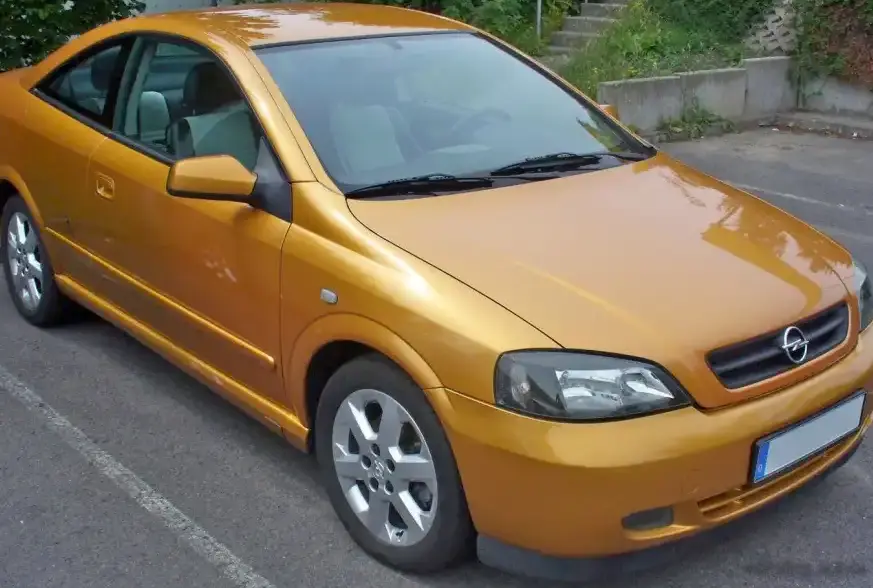
The Opel Astra G Coupe 2.0 16V Turbo, produced between December 2002 and November 2004, represented the performance pinnacle of the Astra G Coupe range. Positioned as the flagship model, it offered a significant power upgrade over the naturally aspirated and lower-boosted turbo variants. This coupe, built on the GM/Opel T-platform (internally designated as 1HX0), aimed to deliver a sporty and engaging driving experience within the compact coupe segment, primarily targeting European markets. It distinguished itself with a more aggressive aesthetic and a focus on driver enjoyment compared to the more practical Astra hatchback and wagon models.
Technical Specifications
| Brand | Opel |
| Model | Astra |
| Generation | Astra G Coupe |
| Type (Engine) | 2.0 16V Turbo (200 Hp) |
| Start of production | December, 2002 |
| End of production | November, 2004 |
| Powertrain Architecture | Internal Combustion engine |
| Body type | Coupe |
| Seats | 4 |
| Doors | 2 |
| Fuel consumption (urban) | 12.4 l/100 km (19 US mpg, 22.8 UK mpg, 8.1 km/l) |
| Fuel consumption (extra urban) | 6.7 l/100 km (35.1 US mpg, 42.2 UK mpg, 14.9 km/l) |
| Fuel consumption (combined) | 8.8 l/100 km (26.7 US mpg, 32.1 UK mpg, 11.4 km/l) |
| CO2 emissions | 211 g/km |
| Fuel Type | Petrol (Gasoline) |
| Acceleration 0 – 100 km/h | 7.8 sec |
| Acceleration 0 – 62 mph | 7.8 sec |
| Acceleration 0 – 60 mph | 7.4 sec |
| Maximum speed | 231 km/h (143.54 mph) |
| Emission standard | Euro 4 |
| Weight-to-power ratio | 6.5 kg/Hp, 155 Hp/tonne |
| Weight-to-torque ratio | 5.2 kg/Nm, 193.8 Nm/tonne |
| Power | 200 Hp @ 5600 rpm |
| Power per litre | 100.1 Hp/l |
| Torque | 250 Nm @ 1950-5500 rpm (184.39 lb.-ft. @ 1950-5500 rpm) |
| Engine layout | Front, Transverse |
| Engine Model/Code | Z20LET |
| Engine displacement | 1998 cm3 (121.93 cu. in.) |
| Number of cylinders | 4 |
| Engine configuration | Inline |
| Cylinder Bore | 86 mm (3.39 in.) |
| Piston Stroke | 86 mm (3.39 in.) |
| Compression ratio | 8.8:1 |
| Number of valves per cylinder | 4 |
| Fuel injection system | Multi-port manifold injection |
| Engine aspiration | Turbocharger, Intercooler |
| Valvetrain | DOHC |
| Engine oil capacity | 4.25 l (4.49 US qt | 3.74 UK qt) |
| Coolant | 7.4 l (7.82 US qt | 6.51 UK qt) |
| Kerb Weight | 1290 kg (2843.96 lbs.) |
| Max. weight | 1660 kg (3659.67 lbs.) |
| Max load | 370 kg (815.71 lbs.) |
| Trunk (boot) space – minimum | 460 l (16.24 cu. ft.) |
| Fuel tank capacity | 52 l (13.74 US gal | 11.44 UK gal) |
| Max. roof load | 100 kg (220.46 lbs.) |
| Length | 4267 mm (167.99 in.) |
| Width | 1709 mm (67.28 in.) |
| Width including mirrors | 1967 mm (77.44 in.) |
| Height | 1390 mm (54.72 in.) |
| Wheelbase | 2606 mm (102.6 in.) |
| Front track | 1467 mm (57.76 in.) |
| Rear (Back) track | 1456 mm (57.32 in.) |
| Ride height (ground clearance) | 130 mm (5.12 in.) |
| Drag coefficient (Cd) | 0.30 |
| Minimum turning circle (turning diameter) | 11.5 m (37.73 ft.) |
| Drivetrain Architecture | The Internal combustion engine (ICE) drives the front wheels of the vehicle. |
| Drive wheel | Front wheel drive |
| Number of gears and type of gearbox | 5 gears, manual transmission |
| Front suspension | Independent, type McPherson with coil spring and anti-roll bar |
| Rear suspension | Semi-independent, coil spring |
| Front brakes | Ventilated discs |
| Rear brakes | Disc |
| Assisting systems | ABS (Anti-lock braking system) |
| Steering type | Steering rack and pinion |
| Power steering | Hydraulic Steering |
| Tires size | 215/40 R17 |
| Wheel rims size | 7.5J x 17 |
Powertrain & Engine Architecture
The heart of the Astra G Coupe 2.0 16V Turbo is the Z20LET engine, a 1998cc inline-four cylinder powerplant. This engine is a member of Opel’s ‘Ecotec’ family, known for its lightweight construction and focus on efficiency. The Z20LET utilizes a cast iron block with an aluminum cylinder head, featuring dual overhead camshafts (DOHC) and four valves per cylinder. Crucially, it’s equipped with a Garrett GT2252V turbocharger with an intercooler, boosting power output to 200 horsepower at 5600 rpm and 250 Nm (184 lb-ft) of torque available from a low 1950 rpm through to 5500 rpm. Fuel delivery is managed by a multi-port fuel injection system. The engine’s relatively high 8.8:1 compression ratio contributes to its responsiveness. The standard transmission for this model was a Getrag F28 five-speed manual gearbox, known for its durability and precise shift feel. While an automatic transmission was offered in other Astra G variants, it was not paired with the 200hp turbo engine.
Driving Characteristics
The 2.0 16V Turbo Coupe offered a noticeably more engaging driving experience than its lower-powered siblings. The turbocharger provides a surge of power in the mid-range, resulting in brisk acceleration – 0 to 60 mph in approximately 7.4 seconds and a top speed of 143.5 mph. The five-speed manual transmission allows for precise control over the engine’s powerband. The gear ratios are well-matched to the engine’s torque curve, providing strong acceleration in each gear. Compared to the naturally aspirated 1.8L models, the turbo engine delivers significantly more power and torque, making overtaking and highway cruising much easier. While not a dedicated sports car, the Astra G Coupe 2.0 16V Turbo offered a compelling blend of performance and practicality.
Equipment & Trim Levels
The 2.0 16V Turbo Coupe was generally well-equipped, reflecting its position as the range-topping model. Standard features typically included air conditioning, power windows and mirrors, central locking, an upgraded stereo system, and alloy wheels (usually 17-inch). Interior upholstery was typically a sporty cloth or optional leather. Optional extras included a sunroof, heated seats, and upgraded audio systems. The dashboard featured a sporty design with aluminum trim accents. Safety features included ABS brakes and driver and passenger airbags.
Chassis & Braking
The Astra G Coupe utilized an independent McPherson strut suspension at the front and a semi-independent coil spring suspension at the rear. This setup provided a good balance between ride comfort and handling. The front brakes were ventilated discs, while the rear brakes were solid discs, providing adequate stopping power for the car’s performance capabilities. A stabilizer bar was fitted to both the front and rear axles to reduce body roll during cornering. The steering was a hydraulic power-assisted rack and pinion system, offering precise and responsive steering feel.
Market Reception & Comparison
The Astra G Coupe 2.0 16V Turbo was generally well-received by automotive critics, who praised its performance, handling, and sporty styling. However, some reviewers noted that the interior quality was not quite as refined as some of its competitors. Compared to other trims in the Astra G Coupe lineup, the 2.0 16V Turbo offered a significant performance advantage, but at a higher price point. Fuel economy was also lower than the naturally aspirated models, reflecting the increased power output. Against rivals like the Ford Focus Coupe and Volkswagen Golf GTI, the Astra G Coupe 2.0 16V Turbo offered a competitive package, particularly in terms of value for money.
Legacy
The Z20LET engine, while generally reliable, is known to require regular maintenance, particularly regarding the turbocharger and cooling system. Proper oil changes and coolant flushes are crucial to prevent premature wear. The Astra G Coupe 2.0 16V Turbo has developed a following among enthusiasts, and well-maintained examples are becoming increasingly sought after in the used car market. Its combination of performance, style, and relative affordability has made it a popular choice for those seeking a sporty and engaging coupe. The engine’s tuning potential also contributes to its appeal within the aftermarket modification scene.

