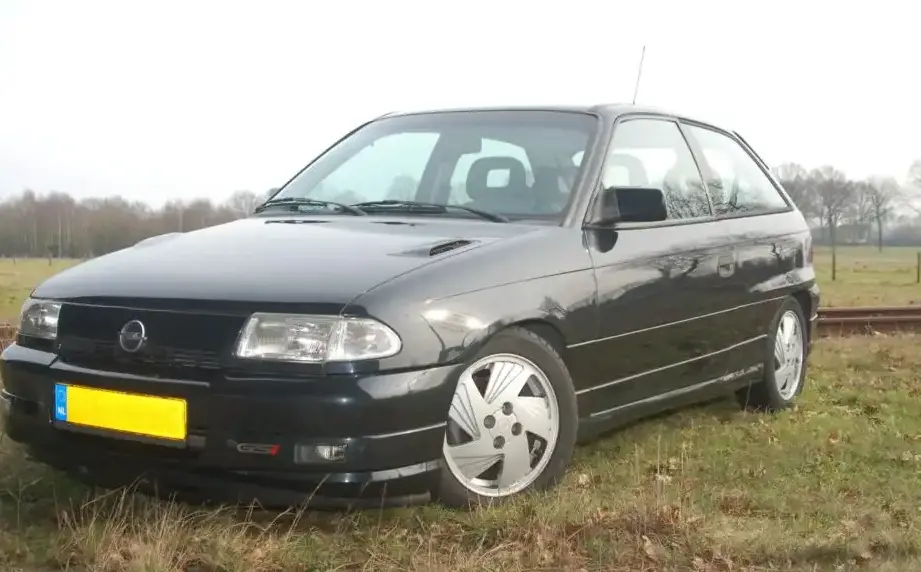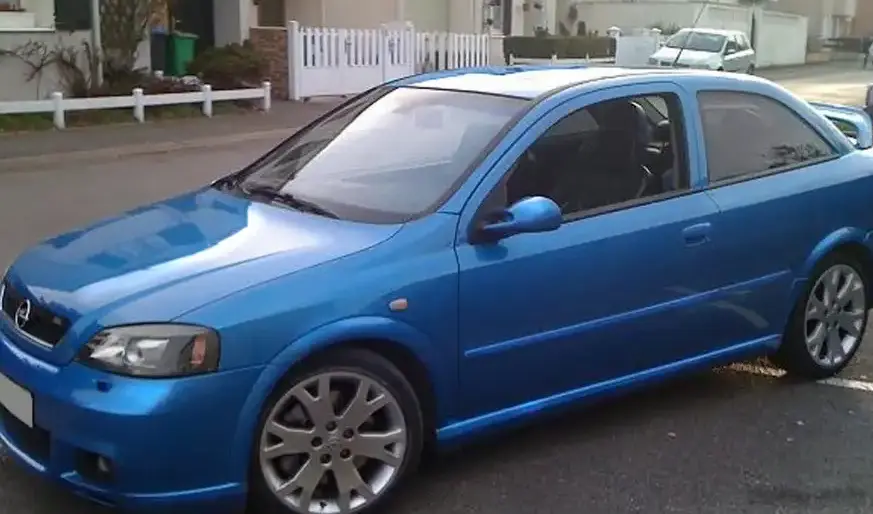
The Opel Astra G facelift, produced from 2002 to 2004, represented a significant refresh of the popular Astra G series. Among the variants offered, the 2.0 16V Turbo OPC (Order Pick Company) stood out as the performance flagship. This hot hatch, designed to compete with rivals like the Volkswagen Golf GTI and Ford Focus ST, brought a substantial power increase and sporty handling to the Astra lineup. The OPC was only available as a 3-door hatchback, emphasizing its focus on driving enthusiasts. Production of this specific model was relatively limited, making it a sought-after vehicle among Opel collectors and performance car aficionados.
Technical Specifications
| Brand | Opel |
| Model | Astra |
| Generation | Astra G (facelift 2002) |
| Type (Engine) | 2.0 16V Turbo OPC (200 Hp) |
| Start of production | November, 2002 |
| End of production | February, 2004 |
| Powertrain Architecture | Internal Combustion engine |
| Body type | Hatchback |
| Seats | 5 |
| Doors | 3 |
| Fuel consumption (urban) | 12.5 l/100 km (18.8 US mpg, 22.6 UK mpg, 8 km/l) |
| Fuel consumption (extra urban) | 6.8 l/100 km (34.6 US mpg, 41.5 UK mpg, 14.7 km/l) |
| Fuel consumption (combined) | 8.9 l/100 km (26.4 US mpg, 31.7 UK mpg, 11.2 km/l) |
| CO2 emissions | 214 g/km |
| Fuel Type | Petrol (Gasoline) |
| Acceleration 0 – 100 km/h | 7.5 sec |
| Acceleration 0 – 62 mph | 7.5 sec |
| Acceleration 0 – 60 mph | 7.1 sec |
| Maximum speed | 229 km/h (142.29 mph) |
| Weight-to-power ratio | 6.3 kg/Hp, 160 Hp/tonne |
| Weight-to-torque ratio | 5 kg/Nm, 200 Nm/tonne |
| Power | 200 Hp @ 5600 rpm |
| Power per litre | 100.1 Hp/l |
| Torque | 250 Nm @ 1950-5600 rpm (184.39 lb.-ft. @ 1950-5600 rpm) |
| Engine layout | Front, Transverse |
| Engine Model/Code | Z20LET |
| Engine displacement | 1998 cm3 (121.93 cu. in.) |
| Number of cylinders | 4 |
| Engine configuration | Inline |
| Cylinder Bore | 86 mm (3.39 in.) |
| Piston Stroke | 86 mm (3.39 in.) |
| Compression ratio | 8.8:1 |
| Number of valves per cylinder | 4 |
| Fuel injection system | Multi-port manifold injection |
| Engine aspiration | Turbocharger, Intercooler |
| Valvetrain | DOHC |
| Engine oil capacity | 4.25 l (4.49 US qt | 3.74 UK qt) |
| Coolant | 7.4 l (7.82 US qt | 6.51 UK qt) |
| Kerb Weight | 1250 kg (2755.78 lbs.) |
| Max. weight | 1770 kg (3902.18 lbs.) |
| Max load | 520 kg (1146.4 lbs.) |
| Trunk (boot) space – minimum | 370 l (13.07 cu. ft.) |
| Trunk (boot) space – maximum | 1180 l (41.67 cu. ft.) |
| Fuel tank capacity | 52 l (13.74 US gal | 11.44 UK gal) |
| Length | 4110 mm (161.81 in.) |
| Width | 1709 mm (67.28 in.) |
| Width including mirrors | 1967 mm (77.44 in.) |
| Height | 1425 mm (56.1 in.) |
| Wheelbase | 2606 mm (102.6 in.) |
| Front track | 1464 mm (57.64 in.) |
| Rear (Back) track | 1452 mm (57.17 in.) |
| Front overhang | 791 mm (31.14 in.) |
| Rear overhang | 713 mm (28.07 in.) |
| Ride height (ground clearance) | 130 mm (5.12 in.) |
| Drag coefficient (Cd) | 0.32 |
| Drivetrain Architecture | The Internal combustion engine (ICE) drives the front wheels of the vehicle. |
| Drive wheel | Front wheel drive |
| Number of gears and type of gearbox | 5 gears, manual transmission |
| Front suspension | Wishbone |
| Rear suspension | Suspension with traction connecting levers |
| Front brakes | Ventilated discs |
| Rear brakes | Disc |
| Assisting systems | ABS (Anti-lock braking system) |
| Steering type | Steering rack and pinion |
| Power steering | Hydraulic Steering |
| Tires size | 215/40 R17 |
| Wheel rims size | 7.5J x 17 |
Powertrain & Engine Architecture
The heart of the Astra OPC was the Z20LET, a 2.0-liter turbocharged inline-four cylinder engine. This engine was a derivative of the Family II engine series, known for its robustness and tuning potential. The Z20LET featured a cast iron block and an aluminum cylinder head with dual overhead camshafts (DOHC) and four valves per cylinder. A key component was the Garrett GT2252V turbocharger with an intercooler, providing significant boost. Fuel delivery was handled by a multi-port fuel injection system. The engine produced 200 horsepower at 5600 rpm and 250 Nm (184 lb-ft) of torque available from 1950 to 5600 rpm. The engine was paired exclusively with a Getrag F28 five-speed manual transmission, chosen for its durability and positive shift feel. This combination allowed for quick acceleration and responsive driving.
Driving Characteristics
The Astra OPC offered a noticeably more engaging driving experience than its naturally aspirated siblings. The turbocharger provided a surge of power in the mid-range, making overtaking and spirited driving effortless. While not as raw or visceral as some contemporary hot hatches, the OPC delivered a well-balanced and predictable handling experience. The suspension was firmer than standard Astra models, reducing body roll and improving cornering stability. The five-speed manual transmission had relatively short throws, contributing to a sporty feel. The 0-60 mph sprint was achieved in around 7.1 seconds, and the car had a top speed of 142 mph. Compared to the base 1.4L or 1.6L Astra models, the OPC was in a different league, offering a significantly more powerful and dynamic driving experience.
Equipment & Trim Levels
The Astra OPC came reasonably well-equipped, though options were available to further enhance the experience. Standard features included sport seats with unique upholstery, a leather-wrapped steering wheel, air conditioning, and an upgraded audio system. Exterior styling cues included a distinctive front bumper with larger air intakes, side skirts, a rear spoiler, and 17-inch alloy wheels. Optional extras included Recaro sport seats, xenon headlights, and a sunroof. The interior was focused on a sporty aesthetic, with aluminum trim accents and a revised instrument cluster.
Chassis & Braking
The Astra OPC benefited from several chassis upgrades compared to standard Astra G models. The suspension was lowered and stiffened, and thicker stabilizer bars were fitted to reduce body roll. The braking system was also upgraded, featuring ventilated front discs and solid rear discs. Anti-lock braking system (ABS) was standard. While the braking performance was adequate for the car’s performance level, it wasn’t considered a standout feature compared to some rivals.
Market Reception & Comparison
The Astra OPC was generally well-received by automotive critics, who praised its performance, handling, and value for money. However, some reviewers noted that the interior quality wasn’t quite as refined as some of its competitors, such as the Volkswagen Golf GTI. Fuel economy was also a concern, with combined fuel consumption averaging around 26.4 US mpg. Compared to the naturally aspirated 1.8L Astra models, the OPC offered a significant performance boost but came with higher running costs and insurance premiums. The OPC was positioned as a direct competitor to the Golf GTI and Ford Focus ST, offering a similar level of performance and practicality at a competitive price point.
Legacy
The Opel Astra G OPC has developed a loyal following among enthusiasts. The Z20LET engine is known for its durability and potential for further tuning. While some maintenance issues, such as turbocharger failures and oil leaks, can occur with age, the engine is generally considered reliable if properly maintained. Today, the Astra OPC is a sought-after vehicle in the used car market, particularly among those looking for a classic hot hatch with a strong performance pedigree. Its relative rarity and engaging driving experience have helped it maintain its value and appeal over the years.