
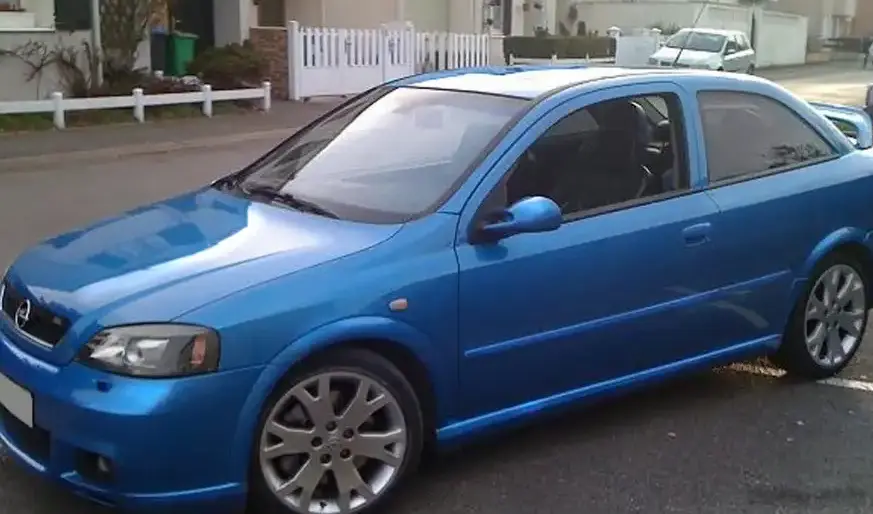
Technical Specifications
| Brand | Opel |
| Model | Astra |
| Generation | Astra G (facelift 2002) |
| Type (Engine) | 2.2 16 V (147 Hp) |
| Start of production | 2002 |
| End of production | February, 2004 |
| Powertrain Architecture | Internal Combustion engine |
| Body type | Hatchback |
| Seats | 5 |
| Doors | 3-5 |
| Fuel consumption (urban) | 12 l/100 km (19.6 US mpg) |
| Fuel consumption (extra urban) | 6.3 l/100 km (37.3 US mpg) |
| Fuel consumption (combined) | 8.4 l/100 km (28 US mpg) |
| CO2 emissions | 200 g/km |
| Fuel Type | Petrol (Gasoline) |
| Acceleration 0 – 100 km/h | 8.8 sec |
| Acceleration 0 – 62 mph | 8.8 sec |
| Acceleration 0 – 60 mph | 8.4 sec |
| Maximum speed | 214 km/h (132.97 mph) |
| Weight-to-power ratio | 8 kg/Hp |
| Weight-to-torque ratio | 5.8 kg/Nm |
| Power | 147 Hp @ 5800 rpm |
| Torque | 203 Nm @ 4000 rpm (149.73 lb.-ft. @ 4000 rpm) |
| Engine layout | Front, Transverse |
| Engine Model/Code | Z22SE |
| Engine displacement | 2198 cm3 (134.13 cu. in.) |
| Number of cylinders | 4 |
| Engine configuration | Inline |
| Cylinder Bore | 86 mm (3.39 in.) |
| Piston Stroke | 94.6 mm (3.72 in.) |
| Compression ratio | 10:1 |
| Number of valves per cylinder | 4 |
| Fuel injection system | Multi-port manifold injection |
| Engine aspiration | Naturally aspirated engine |
| Valvetrain | DOHC |
| Engine oil capacity | 5 l (5.28 US qt | 4.4 UK qt) |
| Coolant capacity | 6.8 l (7.19 US qt | 5.98 UK qt) |
| Kerb Weight | 1175 kg (2590.43 lbs.) |
| Max. weight | 1745 kg (3847.07 lbs.) |
| Max load | 570 kg (1256.63 lbs.) |
| Trunk (boot) space – minimum | 370 l (13.07 cu. ft.) |
| Trunk (boot) space – maximum | 1180 l (41.67 cu. ft.) |
| Fuel tank capacity | 52 l (13.74 US gal | 11.44 UK gal) |
| Length | 4110 mm (161.81 in.) |
| Width | 1709 mm (67.28 in.) |
| Width including mirrors | 1967 mm (77.44 in.) |
| Height | 1425 mm (56.1 in.) |
| Wheelbase | 2606 mm (102.6 in.) |
| Front track | 1464 mm (57.64 in.) |
| Rear track | 1452 mm (57.17 in.) |
| Front overhang | 791 mm (31.14 in.) |
| Rear overhang | 713 mm (28.07 in.) |
| Ride height (ground clearance) | 160 mm (6.3 in.) |
| Drag coefficient (Cd) | 0.32 |
| Drivetrain Architecture | Front wheel drive |
| Number of gears | 5 |
| Gearbox type | Manual transmission |
| Front suspension | Wishbone |
| Rear suspension | Suspension with traction connecting levers |
| Front brakes | Ventilated discs |
| Rear brakes | Disc |
| Assisting systems | ABS (Anti-lock braking system) |
| Steering type | Steering rack and pinion |
| Power steering | Hydraulic Steering |
| Tires size | 195/60 R15 |
| Wheel rims size | 15 |
The Opel Astra G (facelift, produced 2002-2004) 2.2 16V was a performance-oriented variant within the Astra G range. Introduced as part of the facelifted G generation (internally designated as the 1HX0/A3 platform), this model aimed to provide a more engaging driving experience compared to the base engine options. Production spanned from 2002 to February 2004, positioning it as a late-cycle offering before the arrival of the Astra H. The 2.2 16V was primarily marketed in Europe, offering a step up in power and refinement for buyers seeking a sporty compact hatchback. It occupied a mid-range position in the lineup, bridging the gap between the more economical 1.4 and 1.8-liter models and the later, more focused turbocharged variants.
Powertrain & Engine Architecture
The heart of the Astra G 2.2 16V is the Z22SE engine, a 2.2-liter inline-four cylinder powerplant. This engine belongs to the Opel/Vauxhall “Ecotec” family, known for its dual overhead camshafts (DOHC) and four valves per cylinder. The Z22SE utilizes multi-port fuel injection, delivering fuel directly into the intake ports. The engine’s 147 horsepower at 5800 rpm and 203 Nm (149.73 lb-ft) of torque at 4000 rpm provided a noticeable performance increase over the smaller displacement engines available in the Astra G lineup. The engine’s design prioritized a balance between power and fuel efficiency, though it wasn’t as focused on outright performance as some of its competitors. The standard transmission was a five-speed manual, although a four-speed automatic transmission was also offered, albeit less common. The automatic transmission, while providing convenience, did impact acceleration and fuel economy. The four-speed automatic featured typical torque converter technology for smooth, but not particularly quick, shifts.
Driving Characteristics
The 2.2 16V Astra G offered a more spirited driving experience than its lower-powered siblings. Acceleration to 60 mph took approximately 8.4 seconds, and it could reach a top speed of 133 mph. The engine provided adequate power for everyday driving and overtaking maneuvers. The five-speed manual transmission allowed drivers to fully utilize the engine’s powerband, while the optional automatic, though smoother, resulted in some power loss. Compared to the 1.8-liter models, the 2.2 16V felt significantly more responsive, particularly at higher speeds. However, it didn’t possess the same level of outright performance as the later, turbocharged Astra models. The gear ratios in the manual transmission were well-spaced, providing good acceleration in each gear. The automatic transmission, while convenient, felt less engaging and resulted in slightly higher engine speeds during acceleration.
Equipment & Trim Levels
The 2.2 16V Astra G was typically offered in higher trim levels, such as Elegance or Sport. Standard equipment often included power windows, central locking, air conditioning, and an upgraded audio system. Sport trims added features like alloy wheels, sport seats, and a leather-wrapped steering wheel. Optional extras included a sunroof, upgraded audio systems, and metallic paint finishes. Interior upholstery was typically cloth, with leather options available on higher-spec models. The dashboard layout was consistent across the Astra G range, featuring a straightforward design with easy-to-read gauges. Higher trim levels also featured upgraded interior trim pieces and additional sound deadening material for a more refined cabin experience.
Chassis & Braking
The Astra G 2.2 16V utilized a MacPherson strut front suspension and a torsion beam rear suspension. The suspension was tuned to provide a balance between comfort and handling. Braking duties were handled by ventilated discs on the front wheels and solid discs on the rear. Anti-lock Braking System (ABS) was standard. The chassis was reinforced compared to the lower-powered models to handle the increased power output. Stabilizer bars were fitted front and rear to reduce body roll during cornering. The front stabilizer bar was typically thicker on the 2.2 16V model compared to the 1.8-liter variants, further improving handling characteristics.
Market Reception & Comparison
The Astra G 2.2 16V was generally well-received by automotive critics. It was praised for its responsive engine, comfortable ride, and well-equipped interior. However, some critics noted that the automatic transmission felt sluggish and that the handling wasn’t as sharp as some of its rivals, such as the Ford Focus. Compared to the 1.8-liter models, the 2.2 16V offered a significant performance upgrade, but at the cost of slightly higher fuel consumption. The 2.2 16V provided a compelling alternative to the diesel-powered Astra models, offering a more refined driving experience. It was seen as a good all-rounder, offering a balance of performance, comfort, and practicality.
Legacy
The Z22SE engine proved to be a relatively reliable unit, although regular maintenance is crucial. Common issues include oil leaks and occasional sensor failures. Today, the Astra G 2.2 16V is a popular choice among enthusiasts looking for an affordable and enjoyable classic hatchback. Parts availability is generally good, and the car’s relatively simple mechanical design makes it relatively easy to maintain. While not a highly sought-after collector’s item, well-maintained examples of the 2.2 16V Astra G are becoming increasingly rare and are appreciated for their blend of practicality, performance, and affordability. The engine’s robust design and readily available parts contribute to its continued appeal in the used car market.

