Technical Specifications
| Brand | Opel |
| Model | Astra |
| Generation | Astra G (facelift 2002) |
| Type (Engine) | 2.2 16 V (147 Hp) Automatic |
| Start of production | 2002 |
| End of production | February, 2004 |
| Powertrain Architecture | Internal Combustion engine |
| Body type | Hatchback |
| Seats | 5 |
| Doors | 3-5 |
| Fuel consumption (urban) | 11.7 l/100 km (20.1 US mpg, 24.1 UK mpg, 8.5 km/l) |
| Fuel consumption (extra urban) | 6.6 l/100 km (35.6 US mpg, 42.8 UK mpg, 15.2 km/l) |
| Fuel consumption (combined) | 8.5 l/100 km (27.7 US mpg, 33.2 UK mpg, 11.8 km/l) |
| Fuel Type | Petrol (Gasoline) |
| Acceleration 0 – 100 km/h | 10 sec |
| Acceleration 0 – 62 mph | 10 sec |
| Acceleration 0 – 60 mph | 9.5 sec |
| Maximum speed | 208 km/h (129.25 mph) |
| Weight-to-power ratio | 8.1 kg/Hp, 123 Hp/tonne |
| Weight-to-torque ratio | 5.9 kg/Nm, 169.9 Nm/tonne |
| Power | 147 Hp @ 5800 rpm |
| Power per litre | 66.9 Hp/l |
| Torque | 203 Nm @ 4000 rpm (149.73 lb.-ft. @ 4000 rpm) |
| Engine layout | Front, Transverse |
| Engine Model/Code | Z22SE |
| Engine displacement | 2198 cm3 (134.13 cu. in.) |
| Number of cylinders | 4 |
| Engine configuration | Inline |
| Cylinder Bore | 86 mm (3.39 in.) |
| Piston Stroke | 94.6 mm (3.72 in.) |
| Compression ratio | 10:1 |
| Number of valves per cylinder | 4 |
| Fuel injection system | Multi-port manifold injection |
| Engine aspiration | Naturally aspirated engine |
| Valvetrain | DOHC |
| Engine oil capacity | 5 l (5.28 US qt | 4.4 UK qt) |
| Coolant capacity | 6.8 l (7.19 US qt | 5.98 UK qt) |
| Kerb Weight | 1195 kg (2634.52 lbs.) |
| Max. weight | 1765 kg (3891.16 lbs.) |
| Max load | 570 kg (1256.63 lbs.) |
| Trunk (boot) space – minimum | 370 l (13.07 cu. ft.) |
| Trunk (boot) space – maximum | 1180 l (41.67 cu. ft.) |
| Fuel tank capacity | 52 l (13.74 US gal | 11.44 UK gal) |
| Length | 4110 mm (161.81 in.) |
| Width | 1709 mm (67.28 in.) |
| Width including mirrors | 1967 mm (77.44 in.) |
| Height | 1425 mm (56.1 in.) |
| Wheelbase | 2606 mm (102.6 in.) |
| Front track | 1464 mm (57.64 in.) |
| Rear track | 1452 mm (57.17 in.) |
| Front overhang | 791 mm (31.14 in.) |
| Rear overhang | 713 mm (28.07 in.) |
| Ride height (ground clearance) | 160 mm (6.3 in.) |
| Drag coefficient (Cd) | 0.32 |
| Drivetrain Architecture | ICE to Front Wheels |
| Drive wheel | Front wheel drive |
| Number of gears and type of gearbox | 4 gears, automatic transmission |
| Front suspension | Wishbone |
| Rear suspension | Suspension with traction connecting levers |
| Front brakes | Ventilated discs |
| Rear brakes | Disc |
| Assisting systems | ABS (Anti-lock braking system) |
| Steering type | Steering rack and pinion |
| Power steering | Hydraulic Steering |
| Tires size | 195/60 R15 |
| Wheel rims size | 15 |
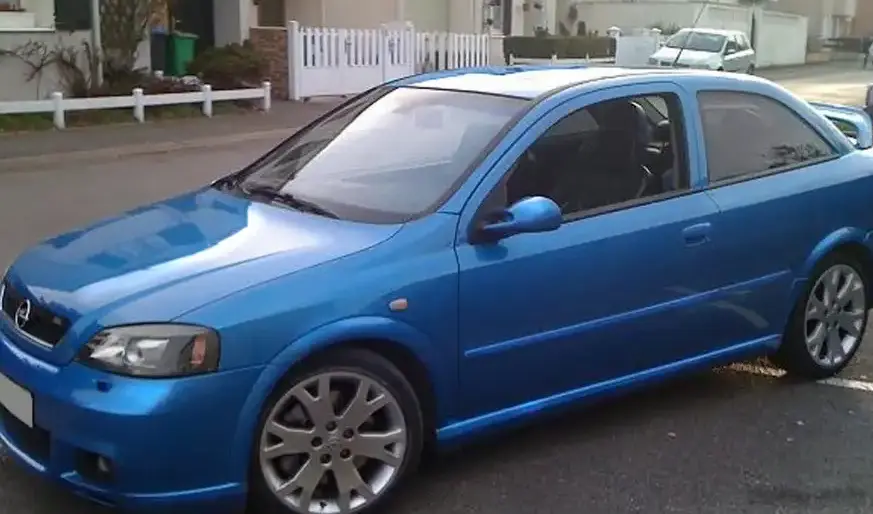
The Opel Astra G (facelift, introduced in 2002) 2.2 16V Automatic represents a significant offering within the Astra G range, produced from 2002 through February 2004. This variant, powered by the Z22SE engine, aimed to provide a blend of performance and convenience, appealing to buyers seeking a more refined driving experience than the base models. It sat towards the upper end of the Astra G lineup, positioned below the more performance-focused OPC (Vauxhall/Opel Performance Centre) models but above the lower-displacement engine options. The facelift brought styling updates and refinements to the already popular Astra G, solidifying its position as a competitive compact car in the European market.
Powertrain & Engine Architecture
The heart of the Astra G 2.2 16V Automatic is the Z22SE engine, a 2.2-liter inline-four cylinder powerplant. This engine utilizes multi-port fuel injection and a double overhead camshaft (DOHC) valvetrain, contributing to its respectable power output. The Z22SE is a naturally aspirated engine, meaning it doesn’t rely on turbocharging or supercharging for increased performance. The engine’s 147 horsepower at 5800 rpm and 203 Nm (149.73 lb-ft) of torque at 4000 rpm provided a noticeable step up in performance compared to the smaller displacement engines available in the Astra G range. Paired with this engine was a four-speed automatic transmission. While not the most modern transmission by today’s standards, it offered smooth shifts and convenience, catering to drivers who prioritized ease of use over ultimate performance. The transmission was designed to handle the engine’s torque output effectively, providing adequate acceleration and cruising ability.
Driving Characteristics
The 2.2-liter engine and four-speed automatic combination delivered a comfortable and capable driving experience. Acceleration from 0-60 mph took approximately 9.5 seconds, and the car could reach a top speed of 208 km/h (129.25 mph). While not a sports car, the Astra G 2.2 16V Automatic offered sufficient power for everyday driving and overtaking maneuvers. The automatic transmission, while smooth, did result in some power loss compared to the manual transmission versions. The gear ratios were tuned for a balance between fuel efficiency and responsiveness. Compared to the 1.8-liter models, the 2.2 offered a more relaxed driving experience, particularly on the highway, due to its increased torque. It wasn’t as nimble as the smaller-engined Astras, but it provided a more refined and comfortable ride.
Equipment & Trim Levels
The Astra G 2.2 16V Automatic typically came with a reasonable level of standard equipment. This included power windows, central locking, power steering, and an anti-lock braking system (ABS). Interior upholstery was usually cloth, with options for upgraded materials available. Depending on the specific market and optional packages selected, features like air conditioning, alloy wheels, a CD player, and even sunroofs could be added. The trim level often dictated the level of interior finish and exterior detailing. Higher trim levels might include features like upgraded seat fabrics, woodgrain interior trim, and more sophisticated audio systems.
Chassis & Braking
The Astra G utilized a front-wheel-drive layout with a wishbone front suspension and a suspension with traction connecting levers at the rear. This suspension setup provided a good balance between ride comfort and handling. The braking system consisted of ventilated discs at the front and solid discs at the rear, providing adequate stopping power for the vehicle’s weight and performance. The hydraulic power steering offered a reasonable level of assistance, making the car easy to maneuver in urban environments.
Market Reception & Comparison
The Astra G 2.2 16V Automatic was generally well-received by automotive critics as a practical and comfortable family car. It was praised for its refined engine, smooth automatic transmission, and decent level of equipment. However, some critics noted that the four-speed automatic transmission felt somewhat dated compared to newer transmissions with more gears. Fuel economy was considered average for its class. Compared to the 1.8-liter versions, the 2.2 offered more power and a more relaxed driving experience, but at the cost of slightly higher fuel consumption. Compared to the more powerful OPC models, it lacked the outright performance and sporty handling, but it was significantly more affordable and practical for everyday use.
Legacy
The Opel Astra G 2.2 16V Automatic, while not a particularly rare or collectible car, remains a reasonably reliable and affordable option in the used car market. The Z22SE engine is known for its durability, and with proper maintenance, it can provide many years of service. The four-speed automatic transmission is generally reliable as well, although it may require servicing or rebuilding after high mileage. Today, these Astras are often sought after by enthusiasts looking for a classic European hatchback that offers a good balance of practicality, comfort, and affordability.