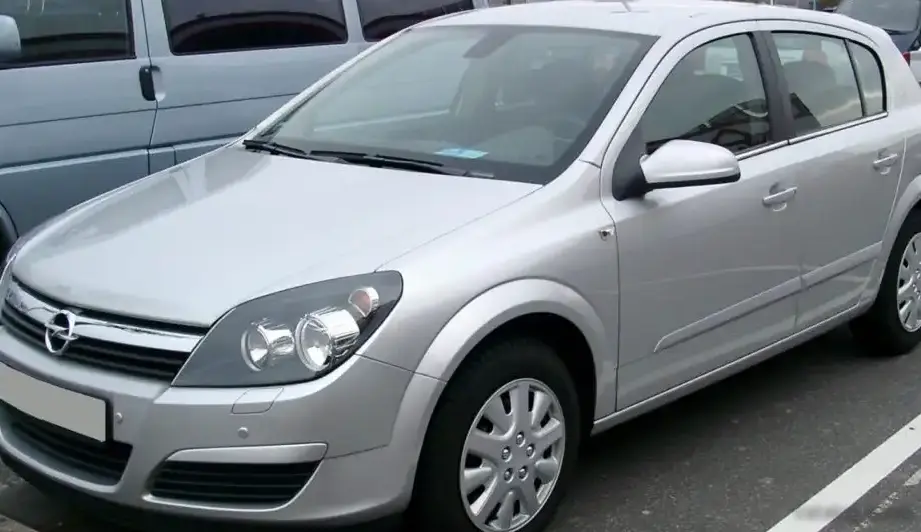
The Opel Astra H 1.6i 16V Automatic, produced between 2004 and 2006, represented a key entry point into the Astra H range, Opel’s compact offering during that period. Positioned as a comfortable and practical option, this variant aimed at buyers prioritizing ease of use and affordability over outright performance. It utilized the 1HX0/A3 platform shared with other General Motors and partner vehicles, including the Fiat Stilo and Saab 9-3. The 1.6-liter engine paired with a four-speed automatic transmission offered a balance between fuel efficiency and everyday drivability, making it a popular choice in European markets.
Technical Specifications
| Brand | Opel |
| Model | Astra |
| Generation | Astra H |
| Type (Engine) | 1.6i 16V (105 Hp) Automatic |
| Start of production | 2004 |
| End of production | 2006 |
| Powertrain Architecture | Internal Combustion engine |
| Body type | Hatchback |
| Seats | 5 |
| Doors | 5 |
| Fuel consumption (urban) | 8.4 l/100 km (28 US mpg, 33.6 UK mpg, 11.9 km/l) |
| Fuel consumption (extra urban) | 5.4 l/100 km (43.6 US mpg, 52.3 UK mpg, 18.5 km/l) |
| Fuel consumption (combined) | 6.5 l/100 km (36.2 US mpg, 43.5 UK mpg, 15.4 km/l) |
| Fuel Type | Petrol (Gasoline) |
| Acceleration 0 – 100 km/h | 13.3 sec |
| Acceleration 0 – 62 mph | 13.3 sec |
| Acceleration 0 – 60 mph | 12.6 sec |
| Maximum speed | 185 km/h (114.95 mph) |
| Emission standard | Euro 4 |
| Weight-to-power ratio | 12 kg/Hp, 83 Hp/tonne |
| Weight-to-torque ratio | 8.4 kg/Nm, 118.6 Nm/tonne |
| Power | 105 Hp @ 6000 rpm |
| Power per litre | 65.7 Hp/l |
| Torque | 150 Nm @ 3900 rpm (110.63 lb.-ft. @ 3900 rpm) |
| Engine layout | Front, Transverse |
| Engine Model/Code | Z16XEP, Z16XE1 |
| Engine displacement | 1598 cm3 (97.52 cu. in.) |
| Number of cylinders | 4 |
| Engine configuration | Inline |
| Cylinder Bore | 79 mm (3.11 in.) |
| Piston Stroke | 81.5 mm (3.21 in.) |
| Compression ratio | 10.5:1 |
| Number of valves per cylinder | 4 |
| Fuel injection system | Multi-port manifold injection |
| Engine aspiration | Naturally aspirated engine |
| Valvetrain | DOHC |
| Engine oil capacity | 4 l (4.23 US qt | 3.52 UK qt) |
| Coolant capacity | 6.1 l (6.45 US qt | 5.37 UK qt) |
| Kerb Weight | 1265 kg (2788.85 lbs.) |
| Max. weight | 1740 kg (3836.04 lbs.) |
| Max load | 475 kg (1047.2 lbs.) |
| Trunk (boot) space – minimum | 380 l (13.42 cu. ft.) |
| Trunk (boot) space – maximum | 1330 l (46.97 cu. ft.) |
| Fuel tank capacity | 52 l (13.74 US gal | 11.44 UK gal) |
| Length | 4249 mm (167.28 in.) |
| Width | 1753 mm (69.02 in.) |
| Width including mirrors | 2033 mm (80.04 in.) |
| Height | 1467 mm (57.76 in.) |
| Wheelbase | 2614 mm (102.91 in.) |
| Front track | 1488 mm (58.58 in.) |
| Rear track | 1488 mm (58.58 in.) |
| Front overhang | 871 mm (34.29 in.) |
| Rear overhang | 764 mm (30.08 in.) |
| Ride height (ground clearance) | 160 mm (6.3 in.) |
| Drag coefficient (Cd) | 0.31 |
| Drivetrain Architecture | The Internal combustion engine (ICE) drives the front wheels of the vehicle. |
| Drive wheel | Front wheel drive |
| Number of gears and type of gearbox | 5 gears, automatic transmission |
| Front suspension | Spring Strut |
| Rear suspension | Spring Strut |
| Front brakes | Ventilated discs |
| Rear brakes | Disc |
| Assisting systems | ABS (Anti-lock braking system) |
| Steering type | Steering rack and pinion |
| Tires size | 195/65 R15 |
| Wheel rims size | 6.5J x 15 |
Powertrain & Engine Architecture
The Astra H 1.6i 16V Automatic was powered by the Z16XEP or Z16XE1 engine, a 1.6-liter inline-four cylinder gasoline engine. These engines were part of Opel’s ‘Ecotec’ family, known for their relatively lightweight construction and focus on fuel efficiency. The engine featured a dual overhead camshaft (DOHC) valvetrain with four valves per cylinder, contributing to improved breathing and power delivery. Fuel was delivered via a multi-port fuel injection system. The engine’s 105 horsepower output at 6000 rpm and 150 Nm (110.63 lb-ft) of torque at 3900 rpm were respectable for its displacement, but not particularly high. The engine was paired with a four-speed automatic transmission, which, while providing convenience, wasn’t known for its responsiveness or fuel efficiency compared to manual counterparts. This transmission was a common unit used across various GM vehicles of the era.
Driving Characteristics
The 1.6i Automatic Astra H offered a comfortable, if not particularly exciting, driving experience. Acceleration from 0-60 mph took around 12.6 seconds, and 0-100 km/h in 13.3 seconds, making it noticeably slower than versions equipped with the 1.8-liter or turbo engines. The four-speed automatic transmission contributed to this, with relatively wide gear ratios that didn’t always allow the engine to operate in its optimal power band. In typical driving situations, the transmission shifted smoothly, but downshifts could be hesitant, especially when needing to overtake or climb hills. The focus was clearly on providing a relaxed and easy-to-drive vehicle, rather than sporty performance. Fuel economy was a strong point, with combined figures around 36.2 US mpg.
Equipment & Trim Levels
The 1.6i Automatic typically represented a mid-range trim level within the Astra H lineup. Standard equipment generally included air conditioning, power windows, central locking, and an audio system. Safety features such as ABS and front airbags were also standard. Higher trim levels added features like alloy wheels, upgraded upholstery, a multi-function steering wheel, and optional extras like a sunroof or parking sensors. Interior upholstery was typically cloth, with a relatively simple dashboard layout. The overall interior design prioritized functionality and durability over luxury.
Chassis & Braking
The Astra H 1.6i Automatic utilized a MacPherson strut suspension setup at the front and a torsion beam suspension at the rear. This configuration provided a good balance between ride comfort and handling. Braking duties were handled by ventilated discs at the front and solid discs at the rear. ABS (Anti-lock Braking System) was standard, enhancing braking performance and stability. The suspension was tuned for comfort, resulting in a relatively soft ride, but it could feel somewhat understeer-prone when pushed hard through corners. The weight distribution was fairly balanced, contributing to predictable handling characteristics.
Market Reception & Comparison
The Astra H 1.6i Automatic was generally well-received as a practical and affordable family car. Critics praised its comfortable ride, decent fuel economy, and spacious interior. However, the performance was often criticized as being underwhelming, particularly compared to the more powerful engine options. Compared to the 1.8-liter versions, the 1.6i offered lower running costs but significantly less power. The 1.7 CDTi diesel variant provided even better fuel economy, but with a different driving experience. The automatic transmission was seen as a convenience feature, but it did detract from both performance and fuel efficiency compared to the manual gearbox.
Legacy
The Opel Astra H 1.6i Automatic, while not a performance icon, remains a relatively reliable and affordable used car option. The Z16XEP/Z16XE1 engine is generally considered durable, although regular maintenance is crucial. Common issues include oil leaks and occasional sensor failures. The four-speed automatic transmission, while not the most sophisticated, is generally reliable if properly maintained. Today, these Astras are often sought after by buyers looking for a practical and economical vehicle for commuting or as a first car. Their simplicity and relatively low running costs make them an attractive option in the used car market.