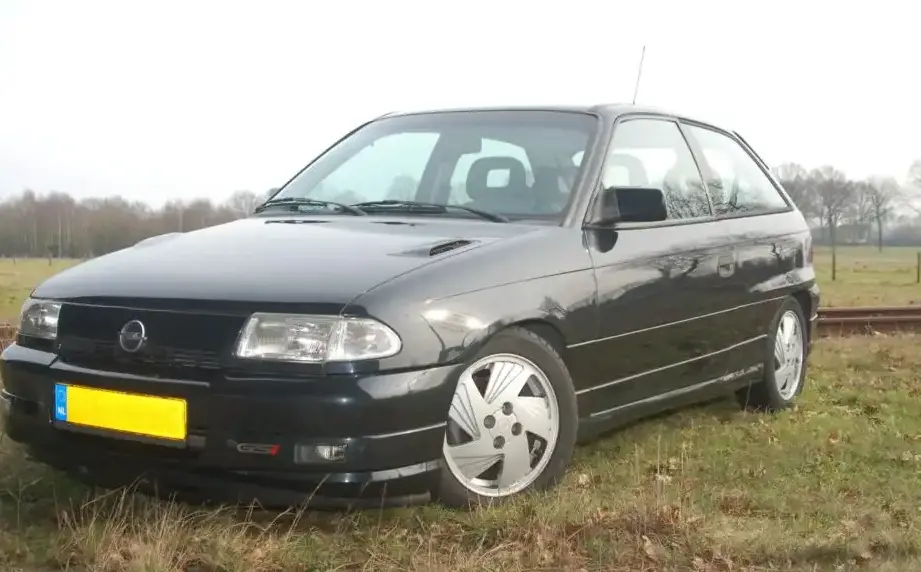
The Opel Astra H Caravan 2.0i 16V Turbo, produced from October 2004 to October 2006, represented a performance-oriented variant within the second generation (H) Astra Caravan (estate) lineup. Positioned as a mid-to-upper trim level, it offered a significant step up in power compared to the base models, appealing to drivers seeking a blend of practicality and spirited driving. This model was primarily sold in Europe, where the Astra held a strong market presence as a versatile and affordable family vehicle. The Astra H series, built on the GM Delta platform, aimed to improve upon its predecessor with enhanced interior space, improved ride quality, and a more modern design.
Technical Specifications
| Brand | Opel |
| Model | Astra |
| Generation | Astra H Caravan |
| Type (Engine) | 2.0i 16V Turbo (170 Hp) |
| Start of production | October, 2004 |
| End of production | October, 2006 |
| Powertrain Architecture | Internal Combustion engine |
| Body type | Station wagon (estate) |
| Seats | 5 |
| Doors | 5 |
| Fuel consumption (urban) | 13.2 l/100 km (17.8 US mpg, 21.4 UK mpg, 7.6 km/l) |
| Fuel consumption (extra urban) | 7.2 l/100 km (32.7 US mpg, 39.2 UK mpg, 13.9 km/l) |
| Fuel consumption (combined) | 9.4 l/100 km (25 US mpg, 30.1 UK mpg, 10.6 km/l) |
| Fuel Type | Petrol (Gasoline) |
| Acceleration 0 – 100 km/h | 8.9 sec |
| Acceleration 0 – 62 mph | 8.9 sec |
| Acceleration 0 – 60 mph | 8.5 sec |
| Maximum speed | 217 km/h (134.84 mph) |
| Weight-to-power ratio | 8.4 kg/Hp, 119.3 Hp/tonne |
| Weight-to-torque ratio | 5.7 kg/Nm, 175.4 Nm/tonne |
| Power | 170 Hp @ 5200 rpm |
| Power per litre | 85.1 Hp/l |
| Torque | 250 Nm @ 1950 rpm (184.39 lb.-ft. @ 1950 rpm) |
| Engine layout | Front, Transverse |
| Engine Model/Code | Z20LEL |
| Engine displacement | 1998 cm3 (121.93 cu. in.) |
| Number of cylinders | 4 |
| Engine configuration | Inline |
| Cylinder Bore | 86 mm (3.39 in.) |
| Piston Stroke | 86 mm (3.39 in.) |
| Compression ratio | 8.8:1 |
| Number of valves per cylinder | 4 |
| Fuel injection system | Multi-port manifold injection |
| Engine aspiration | Turbocharger, Intercooler |
| Valvetrain | DOHC |
| Engine oil capacity | 4.3 l (4.54 US qt | 3.78 UK qt) |
| Coolant | 7.7 l (8.14 US qt | 6.78 UK qt) |
| Kerb Weight | 1425 kg (3141.59 lbs.) |
| Max. weight | 1950 kg (4299.01 lbs.) |
| Max load | 525 kg (1157.43 lbs.) |
| Trunk (boot) space – minimum | 540 l (19.07 cu. ft.) |
| Trunk (boot) space – maximum | 1590 l (56.15 cu. ft.) |
| Fuel tank capacity | 52 l (13.74 US gal | 11.44 UK gal) |
| Length | 4515 mm (177.76 in.) |
| Width | 1794 mm (70.63 in.) |
| Height | 1500 mm (59.06 in.) |
| Wheelbase | 2703 mm (106.42 in.) |
| Front track | 1488 mm (58.58 in.) |
| Rear (Back) track | 1488 mm (58.58 in.) |
| Front overhang | 871 mm (34.29 in.) |
| Rear overhang | 941 mm (37.05 in.) |
| Ride height (ground clearance) | 160 mm (6.3 in.) |
| Drag coefficient (Cd) | 0.31 |
| Drivetrain Architecture | The Internal combustion engine (ICE) drives the front wheels of the vehicle. |
| Drive wheel | Front wheel drive |
| Number of gears and type of gearbox | 6 gears, manual transmission |
| Front suspension | Spring Strut |
| Rear suspension | Spring Strut |
| Front brakes | Ventilated discs |
| Rear brakes | Disc |
| Assisting systems | ABS (Anti-lock braking system) |
| Steering type | Steering rack and pinion |
| Tires size | 225/45 R17 |
| Wheel rims size | 7J x 17 |
Powertrain & Engine Architecture
The heart of the Astra H Caravan 2.0i 16V Turbo is the Z20LEL engine, a 1.998-liter (121.93 cubic inches) inline-four cylinder gasoline engine. This engine belongs to Opel’s ‘Ecotec’ family, known for its focus on efficiency and performance. The Z20LEL features a cast iron block and an aluminum cylinder head, incorporating a dual overhead camshaft (DOHC) valvetrain with four valves per cylinder. Crucially, it’s equipped with a Garrett GT17 turbocharger and an intercooler, boosting power output to 170 horsepower at 5200 rpm and 250 Nm (184 lb-ft) of torque at a relatively low 1950 rpm. Fuel delivery is managed by a multi-port fuel injection system. The six-speed manual transmission was standard, providing well-spaced gear ratios to maximize the engine’s torque band. The engine’s design prioritized a balance between power and fuel economy, utilizing technologies like variable valve timing to optimize combustion under various driving conditions.
Driving Characteristics
The 2.0i 16V Turbo offered a noticeable performance upgrade over the lower-spec Astra Caravan models. The turbocharger provides a surge of power in the mid-range, making overtaking and highway cruising effortless. Acceleration from 0 to 60 mph was achieved in approximately 8.5 seconds, and the car could reach a top speed of 134.84 mph. The six-speed manual transmission allowed drivers to keep the engine in its optimal power band. Compared to the naturally aspirated 1.6L or 1.8L versions, the 2.0 Turbo felt significantly more responsive and capable. While not a dedicated sports car, the Astra H Caravan 2.0i Turbo provided a satisfying driving experience, combining practicality with a degree of performance. The suspension, tuned for comfort, did exhibit some body roll during aggressive cornering, but overall handling was secure and predictable.
Equipment & Trim Levels
The 2.0i 16V Turbo trim typically included a generous level of standard equipment. This often encompassed features like air conditioning, power windows and mirrors, a CD stereo system, alloy wheels (typically 17-inch), and ABS brakes. Higher-spec versions could be equipped with optional extras such as a sunroof, leather upholstery, automatic climate control, and parking sensors. Interior trim generally featured comfortable cloth seats, with a functional and ergonomically designed dashboard layout. The Caravan body style itself offered a spacious interior and a large cargo area, making it a practical choice for families and those needing to transport larger items.
Chassis & Braking
The Astra H Caravan utilized a MacPherson strut front suspension and a multi-link rear suspension, providing a comfortable ride and decent handling characteristics. The braking system consisted of ventilated discs on the front wheels and solid discs on the rear. ABS (Anti-lock Braking System) was standard, enhancing safety and control during emergency braking situations. The steering was rack and pinion, offering precise and responsive steering feel. The chassis was designed to balance ride comfort with handling stability, making it suitable for both everyday driving and longer journeys.
Market Reception & Comparison
The Astra H Caravan 2.0i 16V Turbo was generally well-received by automotive critics. It was praised for its strong performance, spacious interior, and practical estate car body style. However, some reviewers noted that the ride could be a little firm on rough roads. Compared to rivals like the Ford Focus Estate and Volkswagen Golf Variant, the Astra offered a competitive package in terms of price, performance, and equipment. Fuel economy, while reasonable for a turbocharged engine, was not class-leading. The 2.0 Turbo variant was often seen as a good compromise between the more affordable, lower-powered models and the more expensive, higher-performance OPC (Opel Performance Center) version.
Legacy
The Z20LEL engine, while generally reliable, is known to require regular maintenance, particularly regarding oil changes and turbocharger health. Common issues can include turbo failure, oil leaks, and occasional problems with the electronic throttle body. However, with proper care, these engines can provide many years of service. Today, the Astra H Caravan 2.0i 16V Turbo represents an affordable and practical used car option. Its combination of performance, space, and relatively low running costs makes it a popular choice for those seeking a versatile family vehicle. Parts availability is generally good, and the car’s relatively simple mechanical design makes it accessible for DIY repairs.